
Over the past few years, the term semantic layer has become one of the hottest topics in enterprise data architecture.
Microsoft Fabric has one. Power BI has one. dbt has one. Looker has one. Nearly every analytics platform now promotes a semantic layer as the key to consistent metrics, trusted reporting, self-service analytics, and natural language experiences.
They’re not wrong.
Semantic layers have become an essential component of the modern data stack because they bridge the gap between complex technical data structures and the language the business actually uses. Instead of exposing cryptic table names and database columns, they present familiar concepts such as Revenue, Purchase Order, Supplier, or Product. They simplify analytics, improve consistency, and make data easier to consume.
The problem isn’t the semantic layer.
The problem is what many organizations expect it to do.
Somewhere along the way, semantic layers began taking on a responsibility they were never designed to own. Instead of simply exposing business meaning, they’re increasingly being asked to define it. Every analytics platform, reporting tool, and AI application starts building its own interpretation of the business, often with the best of intentions.
It works well at first.
Until another team creates another semantic layer.
Then another.
Before long, Finance, Sales, Operations, and Marketing all have semantic layers that accurately represent their understanding of the business, but not necessarily the organization’s understanding of the business.
The result isn’t one trusted enterprise view.
It’s multiple trusted local views.
That’s an important distinction because consistency inside a single platform is not the same thing as consistency across an enterprise.
Over the years, we’ve been asking semantic layers to solve the wrong problem. They are exceptionally good at delivering business meaning to downstream tools, but they shouldn’t be responsible for creating that meaning in the first place.
That responsibility belongs somewhere else.
It belongs in what we call the semantic backbone.
Before discussing semantic layers, it’s worth defining a term that we believe will become increasingly important as organizations expand their AI and analytics initiatives.
Semantic Backbone (noun): The authoritative, enterprise-wide representation of business concepts, relationships, business rules, and definitions that serves as the source of truth for governance platforms, semantic layers, analytics, copilots, and AI systems.
Notice what’s missing from that definition.
There’s no mention of dashboards.
No reporting tools.
No AI models.
No databases.
The semantic backbone exists independently of every technology that consumes it.
Its purpose is to capture how the business understands itself.
For many organizations, that semantic backbone already exists, even if it hasn’t been described this way before. It’s the Enterprise Logical Data Model (ELDM): the place where business entities, relationships, definitions, business rules, and enterprise terminology are established before they’re implemented in databases, analytics platforms, governance tools, or AI applications.
That’s an important distinction because technologies change. Reporting platforms come and go. AI assistants evolve. Databases are modernized. Analytics tools are replaced.
Business meaning shouldn’t have to be recreated every time that happens.
The easiest way to understand the difference is to recognize that a semantic layer is an implementation.
A semantic backbone is an architecture.
A semantic layer sits between data and the people or applications consuming it. It translates technical structures into business-friendly language, defines metrics and calculations, organizes dimensions, and makes analytics easier to build and understand. Without semantic layers, every dashboard, report, and AI assistant would need to interpret raw database structures independently.
That’s exactly what semantic layers should do.
The challenge is that they are increasingly becoming the place where organizations define business meaning instead of simply exposing it.
That works surprisingly well until multiple semantic layers appear across the enterprise.
Imagine an organization running SAP for ERP, Salesforce for CRM, Microsoft Fabric for analytics, Power BI for reporting, dbt for analytics engineering, and Microsoft Copilot for business productivity.
Each platform benefits from its own semantic layer.
Each serves a different audience.
Each optimizes information for different workloads.
The question is this:
Where does each semantic layer get its understanding of the business?
If every platform answers that question independently, semantic drift becomes almost inevitable.
Let’s use a simple example.
A company wants to standardize the definition of a Purchase Order.
Procurement defines it as an approved request to purchase goods or services.
Finance considers a Purchase Order active only after budget approval.
Receiving associates it with inbound shipments.
Operations treats it as part of inventory planning.
Each perspective is valid because each reflects a different stage of the business process.
Now imagine building semantic layers independently.
The Power BI team creates one definition.
The dbt team creates another.
The Microsoft Fabric team builds a third.
Copilot learns from whichever source it’s connected to.
Every semantic layer is internally consistent.
Collectively, they’re inconsistent.
None of the technology failed.
The organization simply recreated business meaning five different times.
Now imagine approaching the problem differently.
Instead of asking every platform to define a Purchase Order, the organization establishes that definition once inside the Enterprise Logical Data Model. Relationships to Suppliers, Contracts, Products, Receipts, Invoices, Payments, and Approval Workflows are modeled there as well. Governance teams approve the definitions. Business stakeholders agree on the terminology. Architects validate the relationships.
Only then are semantic layers generated.
Power BI references the semantic backbone.
dbt references the semantic backbone.
Microsoft Fabric references the semantic backbone.
Copilot references the semantic backbone.
Every platform speaks the same business language because none of them are responsible for inventing it.
That’s the difference between a semantic layer and a semantic backbone.
A semantic layer delivers meaning.
A semantic backbone establishes it.
One of the reasons these two concepts are often confused is that they both deal with business meaning. It’s easy to assume they’re solving the same problem from different angles.
They’re not.
A semantic backbone is concerned with establishing business meaning. A semantic layer is concerned with delivering business meaning.
Those are very different responsibilities.
An Enterprise Logical Data Model, for example, captures the organization’s core business entities, relationships, business rules, domains, hierarchies, and canonical definitions. It answers questions such as:
Those answers should remain relatively stable regardless of whether the organization uses Power BI today, Fabric tomorrow, or another analytics platform five years from now.
A semantic layer operates much closer to the point of consumption.
It takes those approved business concepts and organizes them into metrics, dimensions, calculations, hierarchies, security rules, and user-friendly labels that reporting tools, analytics platforms, copilots, and AI assistants can consume efficiently.
One defines the business.
The other makes the business easier to consume.
The distinction becomes clearer when you compare their responsibilities.
| Semantic Backbone (Enterprise Logical Data Model) | Semantic Layer |
| Defines enterprise business concepts | Exposes business concepts to applications |
| Establishes canonical business definitions | Creates business-friendly metrics and measures |
| Models entities and relationships | Models dimensions, calculations, and aggregations |
| Captures business rules | Optimizes reporting logic |
| Represents the enterprise | Represents a specific analytics platform |
| Changes infrequently | Evolves with reporting requirements |
| Serves as the source of truth | Serves as the consumer of truth |
Neither replaces the other.
In fact, they’re most valuable when they’re designed to work together.
The semantic backbone establishes a stable architectural foundation that changes only when the business changes. Semantic layers can then evolve independently as reporting requirements, dashboards, AI assistants, and analytical workloads continue to grow.
That separation is important because business meaning should remain far more stable than reporting technology.
One of the most common misconceptions is that semantic drift is caused by poor governance.
In my experience, that’s rarely the case.
Semantic drift usually happens because every team is trying to solve the same problem independently.
The Finance team creates a semantic layer to support executive reporting.
The Sales team builds another for pipeline analytics.
Operations develops one for supply chain reporting.
Data engineering creates another through dbt.
Each team follows good practices. Each documents calculations carefully. Each validates definitions with business stakeholders.
Yet six months later, people begin asking why reports don’t match.
Revenue differs between dashboards.
Purchase Orders are counted differently across departments.
Product hierarchies no longer align.
None of those inconsistencies appeared overnight.
They accumulated one well-intentioned decision at a time.
The problem wasn’t poor governance.
The problem was that every semantic layer became responsible for defining business meaning instead of inheriting it.
This is exactly why semantic backbones matter.
Instead of recreating business definitions inside every reporting platform, organizations define them once within the Enterprise Logical Data Model. Relationships, business rules, approved terminology, and enterprise concepts become reusable architectural assets rather than platform-specific configurations.
Semantic layers no longer become isolated sources of truth.
They become trusted implementations of a shared source of truth.
One of the principles enterprise architects have embraced for decades is simple:
Design once. Reuse everywhere.
The same philosophy applies to enterprise semantics.
Business meaning should not be recreated every time a new dashboard is built, a new semantic layer is deployed, or a new AI assistant is introduced. Every time that happens, the organization creates another opportunity for definitions to drift, relationships to diverge, and business rules to become inconsistent.
Instead, business meaning should be established once within the Enterprise Logical Data Model and then reused consistently across the enterprise.
That approach transforms the ELDM from a design artifact into something much more valuable.
It becomes the semantic backbone of the organization.
From that backbone, semantic assets can be generated for Microsoft Power BI, Open Semantic Interchange (OSI), dbt, and other platforms without requiring every downstream team to reinterpret the business independently. Governance platforms reference the same definitions. Analytics platforms consume the same business concepts. Copilots and AI assistants inherit the same enterprise vocabulary.
The technology may differ.
The business meaning does not.
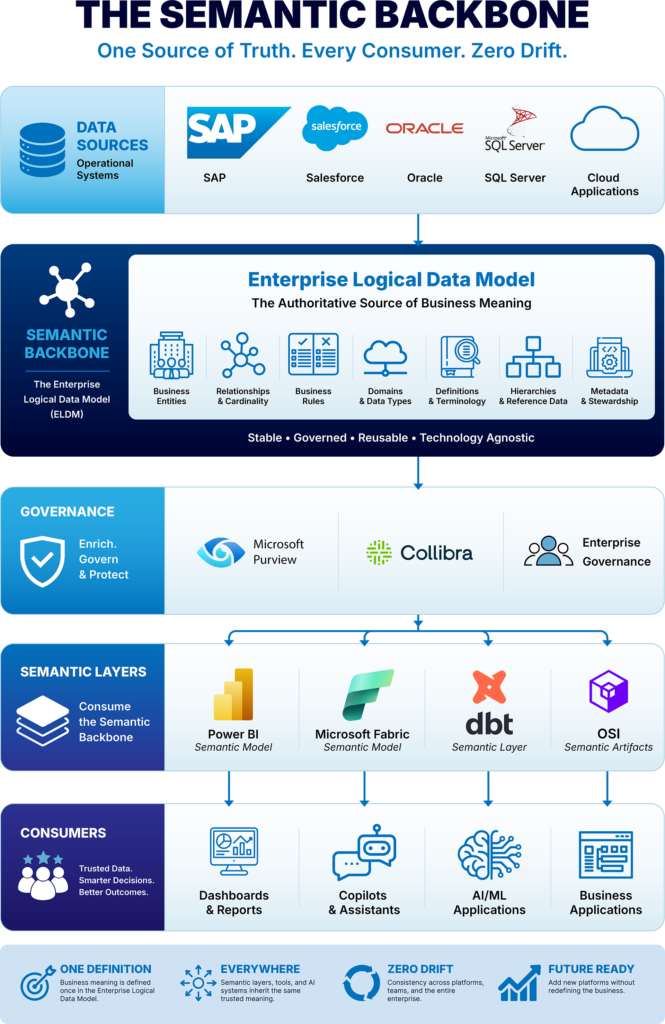
The easiest way to understand the relationship between a semantic backbone and semantic layers is to think about where each belongs within the enterprise architecture.
Operational systems such as SAP, Salesforce, SQL Server, Oracle, and cloud applications generate the data that powers the business. Governance platforms enrich that data with ownership, stewardship, classifications, and policies. Analytics platforms and AI applications consume business information to create dashboards, reports, copilots, and intelligent experiences.
The Enterprise Logical Data Model sits between those worlds.
Rather than belonging to a single application or analytics platform, it represents the business itself. It captures enterprise business concepts, relationships, business rules, hierarchies, and approved terminology independently of the technologies that consume them.
That distinction is important because technologies change far more often than businesses do.
Organizations replace reporting platforms. They adopt new cloud services. They introduce new AI assistants and retire older analytical tools. Throughout those changes, the business still sells products, purchases inventory, manages suppliers, serves customers, and processes invoices.
The business remains relatively stable.
Technology does not.
A semantic backbone preserves that stability by separating business meaning from implementation.
Once business meaning has been established within the Enterprise Logical Data Model, semantic assets can be generated for Power BI, Open Semantic Interchange (OSI), dbt, and future semantic standards without redefining the business every time a new platform is introduced.
That creates a far more sustainable architecture.
Instead of maintaining business definitions across multiple reporting tools, organizations maintain one authoritative enterprise model and allow downstream semantic layers to inherit that meaning.
The result is greater consistency, reduced maintenance, and significantly less semantic drift over time.
Semantic layers have become an essential part of modern analytics, and their importance will only continue to grow. Organizations will build more dashboards, deploy more copilots, adopt more AI assistants, and introduce more analytical platforms over the coming years.
The challenge isn’t the number of semantic layers.
The challenge is the number of places where business meaning is created.
Every time a reporting platform independently defines a Product, Purchase Order, Supplier, or Revenue, another opportunity for inconsistency is introduced. Those differences may be small at first, but over time they accumulate across dashboards, reports, AI assistants, and business applications until teams begin asking why two systems describe the same business differently.
The answer is rarely the technology.
More often, it’s because every platform became responsible for defining business meaning instead of inheriting it.
That’s why semantic layers should not become the source of truth.
They should become consumers of the source of truth.
An Enterprise Logical Data Model provides that authoritative foundation by establishing business concepts, relationships, rules, and definitions once for the entire enterprise. Governance platforms enrich those concepts with stewardship and policy. Semantic layers then expose that trusted business meaning to reporting tools, analytics platforms, copilots, and AI applications.
Each technology performs the role it was designed to perform.
The result is a modern data architecture where governance, analytics, and AI all operate from the same enterprise understanding instead of creating their own.
Organizations don’t need fewer semantic layers.
They need one semantic backbone.
When business meaning is established once and shared everywhere, semantic layers become more consistent, analytics become more trustworthy, and AI systems gain the context they need to produce reliable, explainable results.
That’s the difference between building semantic layers and building semantic architecture.
Learn more about the semantic backbone and semantic layers today.
A semantic backbone is the authoritative source of enterprise business meaning. It defines business concepts, relationships, business rules, and terminology through an Enterprise Logical Data Model (ELDM). A semantic layer consumes that information by organizing it into metrics, dimensions, calculations, and business-friendly structures for reporting, analytics, and AI. In short, the semantic backbone establishes meaning, while the semantic layer delivers it.
Semantic layers provide consistency within a specific analytics platform, but they are not designed to serve as the enterprise’s source of truth. Without a centralized semantic backbone, different teams and platforms often create their own business definitions, leading to semantic drift. A semantic backbone ensures every semantic layer inherits the same trusted business meaning across the enterprise.
A semantic backbone is an enterprise-wide architectural foundation that captures business entities, relationships, business rules, hierarchies, and approved terminology within an Enterprise Logical Data Model. It serves as the authoritative source of business meaning for governance platforms, semantic layers, analytics tools, copilots, and AI systems, ensuring consistent understanding across every technology.
AI assistants, copilots, dashboards, and semantic layers all depend on consistent business context to produce reliable results. By providing a single, governed source of enterprise meaning, a semantic backbone reduces semantic drift, improves the accuracy of metrics and reports, and helps AI generate responses that align with approved business definitions rather than conflicting interpretations.
ER/Studio enables organizations to establish an Enterprise Logical Data Model as the semantic backbone of the enterprise. With the ER/Studio Semantic Generator, organizations can generate semantic assets directly from that authoritative model, including semantic artifacts for Microsoft Power BI, Open Semantic Interchange (OSI), and the dbt Semantic Layer. This allows governance platforms, analytics tools, and AI applications to consume the same trusted business meaning instead of creating independent definitions.