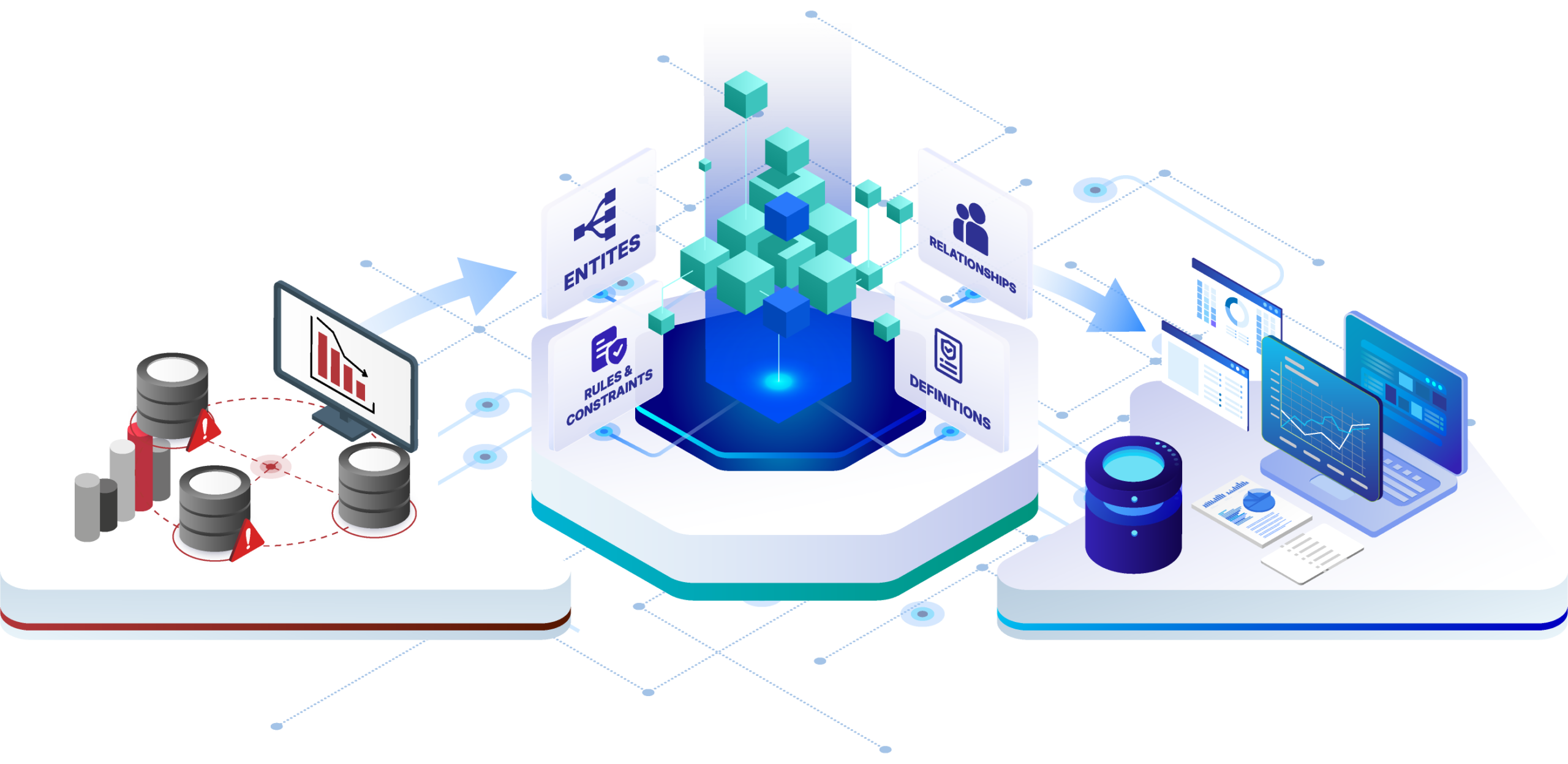
Artificial intelligence has moved from experimentation to expectation. Organizations across every industry are under pressure to operationalize AI, drive automation, and unlock predictive insights that create real business value. Yet despite heavy investment in tools and talent, many AI initiatives struggle to scale or fail to deliver meaningful outcomes.
The problem is rarely the algorithm.
It is the data.
AI readiness is not defined by how advanced your models are. It is defined by how prepared your data is to support them. Without a strong data foundation, even the most sophisticated AI strategies will produce inconsistent, unreliable, or unusable results.
This is where data modeling becomes essential.
AI readiness is often misunderstood as a measure of technical maturity. In reality, it is a measure of how well an organization can support AI with trusted, structured, and accessible data.
An AI-ready organization typically has:
These elements all point back to a single foundation: how data is structured and understood.
Raw data alone is not enough. It must be organized, contextualized, and connected in a way that AI systems can interpret and use effectively.
“Only one in five organizations have achieved data readiness, even though it is critical for AI-driven transformation.”
– World Economic Forum
Many organizations assume that modern AI platforms can compensate for poor data quality or fragmented data environments. While tools have become more powerful, they cannot solve structural problems in data.
This leads to a familiar pattern.
Teams invest in AI, build promising prototypes, and then hit a wall when trying to scale. Data scientists spend the majority of their time preparing data rather than refining models. Business stakeholders begin to question the outputs, especially when results conflict with established metrics or expectations.
At that point, confidence erodes.
The underlying issue is not just bad data. It is a lack of shared structure and meaning across that data. The well-known principle of “garbage in, garbage out” still applies, and AI amplifies its impact.
Data modeling provides the structure that AI depends on. It defines how data is organized, how entities relate to one another, and how business concepts are represented within systems.
This structure enables several critical capabilities for AI.
First, it ensures consistency. When data definitions vary across systems, AI models struggle to learn reliable patterns. Data modeling enforces standardization so that the same concept means the same thing everywhere.
Second, it reduces complexity. Instead of forcing data scientists to reverse-engineer relationships, models provide a clear blueprint of how data fits together.
Third, it accelerates development. With well-defined models in place, teams can spend less time cleaning data and more time building and improving AI solutions.
And finally, it improves trust. When outputs can be traced back to clearly defined data structures, stakeholders are far more likely to rely on AI-driven insights.
“60% of AI projects are expected to fail due to poor data readiness.”
– Business Insider
Not all data modeling is created equal, especially in the context of AI.
Physical models focus on how data is stored. Logical models focus on what the data actually means. For AI readiness, that distinction is critical.
Logical data modeling defines:
This layer ensures that when an AI model analyzes concepts like customer, revenue, or risk, those concepts are consistent and clearly understood.
It also creates a shared language across teams, which becomes increasingly important as AI initiatives grow in scope and complexity.
AI-ready organizations do not rely on a single type of model. They use a layered approach that connects business context to technical implementation.
Conceptual models provide a high-level view of key entities and relationships. They help align stakeholders and define the scope of AI initiatives.
Logical models add detail, defining how those entities are structured and related without tying them to a specific technology.
Physical models bring everything into execution, translating logical definitions into optimized database structures.
Together, these layers create a cohesive framework that supports both analytics and machine learning. Without that alignment, gaps begin to emerge between business expectations and technical outcomes.
Modern data strategies often emphasize pipelines, ingestion frameworks, and real-time processing. These are important components of a data ecosystem, but they do not replace the need for modeling.
Pipelines move data.
Without strong data models, organizations risk moving inconsistent or poorly defined data at scale, which only amplifies existing issues. This can lead to conflicting metrics, integration challenges, and unreliable AI outputs.
Data modeling ensures that what flows through those pipelines is structured, governed, and ready for use.
AI systems rarely rely on a single data source. Instead, they pull from a wide range of structured and unstructured data, often spread across different platforms and environments.
This introduces significant complexity.
Data modeling helps manage that complexity by:
When data is modeled effectively, AI systems can access the right information at the right time without unnecessary friction or delays.
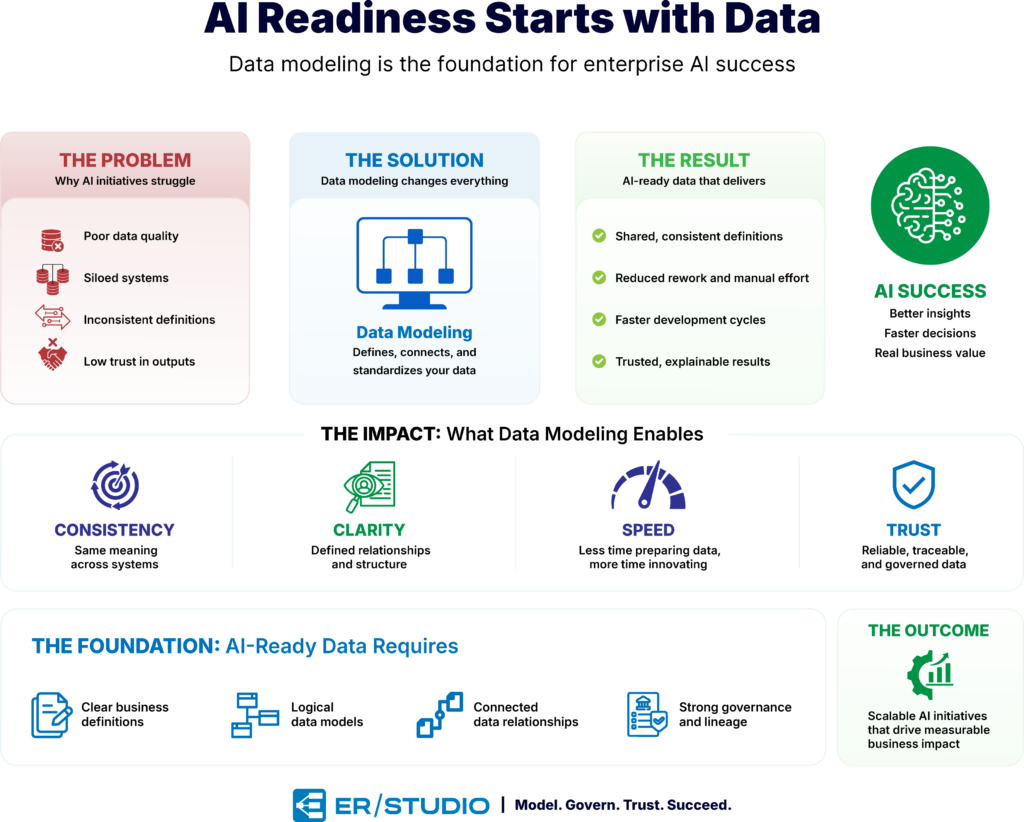
As AI becomes more embedded in decision-making, trust becomes non-negotiable. Organizations must be able to explain how models arrive at their conclusions and ensure those conclusions are based on accurate, governed data.
Data modeling plays a central role in this effort.
It supports governance by establishing consistent definitions, documenting relationships, and enabling visibility into data lineage. This makes it easier to audit data, enforce quality standards, and ensure compliance with regulatory requirements.
More importantly, it builds confidence.
When stakeholders understand the data behind AI outputs, they are far more likely to trust and adopt those insights.
AI readiness is not just a technical challenge. It requires alignment across multiple roles within the organization.
This includes:
Data modeling acts as the bridge between these groups. It provides a shared framework that connects business needs with technical implementation.
When collaboration is built into the modeling process, organizations can move faster and avoid the disconnects that often derail AI initiatives.
As organizations grow, their data environments become more complex. Manual approaches to data modeling can quickly become difficult to maintain, especially when new data sources and use cases are constantly emerging.
To support AI at scale, data modeling must be:
Scalability is not just about handling more data. It is about maintaining consistency and clarity as complexity increases.
It is easy to attribute AI failures to gaps in talent or technology, but the root cause is often much simpler.
The data foundation is not strong enough.
Without data modeling:
Organizations end up spending more time fixing data issues than advancing their AI capabilities. Progress slows, costs increase, and momentum is lost.
A strong data model changes that dynamic entirely.
ER/Studio provides the capabilities organizations need to establish and maintain a strong data foundation for AI.
It enables teams to:
These capabilities allow organizations to move beyond fragmented data environments and build a cohesive, scalable foundation for AI.
AI readiness is not achieved through a single initiative. It is built over time through disciplined data practices that support consistency, scalability, and trust.
Data modeling is at the center of that effort.
It transforms raw data into structured, meaningful assets that AI systems can use effectively. It aligns teams, reduces complexity, and creates a foundation that supports long-term innovation.
Most importantly, it ensures that AI delivers results that the business can trust.
AI does not become real when a model is deployed.
It becomes real when the business trusts it.
That level of trust is only possible when the data behind every prediction, recommendation, and decision is structured, consistent, and well understood. Data modeling is what makes that possible. It connects raw data to business meaning, aligns teams, and creates the clarity that AI systems need to operate effectively.
Organizations that invest in their data foundation are not just improving their chances of AI success. They are building a long-term capability that supports innovation, adaptability, and competitive advantage.
If you are serious about AI readiness, the next step is not another tool or another pilot.
It is your data.
Ready to see how ER/Studio can help you build a true AI-ready data foundation? Book a demo today.
AI readiness is an organization’s ability to successfully deploy and scale AI initiatives. It depends heavily on having clean, structured, and well-governed data that AI systems can use effectively.
Data modeling provides the structure and consistency that AI models rely on. It ensures data is organized, standardized, and aligned with business meaning, which improves accuracy and trust in AI outputs.
Logical data models define what the data means, including entities and relationships. Physical models define how that data is stored in databases. Logical models are especially important for AI because they ensure consistency across systems.
AI can function without formal data modeling, but it will be less reliable, harder to scale, and more difficult to trust. Most failed AI initiatives can be traced back to poor data structure and lack of governance.
ER/Studio helps organizations design, manage, and govern data models at scale. It enables collaboration, improves data consistency, and provides the structure needed to support reliable and scalable AI initiatives.




