Imagine two home builders competing for the same project.
The first builder insists on starting with architectural plans. Before any concrete is poured, they sit down with the homeowner to understand how the house will be used, how many people will live there, how the space may need to change over time, and which safety and building standards must be followed. They design a foundation that can support not only the initial structure, but future additions as well. They rely on industry standards, from standard door sizes to approved materials and tools, so every contractor involved can work efficiently and consistently from the same assumptions.
The second builder takes a very different approach. They promise speed and low upfront cost. They begin construction immediately with minimal planning. If something does not fit, they adjust it later. If a wall needs to be moved, they tear it down and rebuild it. Their goal is to get a structure standing as fast as possible and deal with problems as they arise.
At first, both houses may look similar. Over time, the difference becomes impossible to ignore.
Enterprise data architecture follows the same pattern.
Fast and cheap construction often cuts corners that are invisible at the beginning. Foundations may be poured without accounting for soil conditions. Load bearing walls may not align properly. Electrical systems may be installed without clear documentation. Plumbing may be routed in ways that make future repairs difficult or risky.
As long as nothing changes, these issues can remain hidden. Once the homeowner wants to remodel, expand, or even perform routine maintenance, the consequences surface. Doors that are not standard sizes require custom replacements. Walls cannot be moved without compromising structural integrity. Safety inspections become complicated and expensive. What looked like savings at the start turns into ongoing cost, risk, and frustration.
The root problem is not speed itself. It is the absence of a shared plan and agreed upon standards.
In data architecture, skipping logical data modeling creates the same category of problems.
When teams move directly to physical data models, they are defining tables, columns, data types, indexes, and storage structures without first agreeing on meaning. A physical data model describes how data is stored in a specific technology. It reflects platform constraints, performance considerations, and implementation choices such as normalization, denormalization, partitioning, and surrogate keys.
A physical model is necessary, just as wiring diagrams and plumbing layouts are necessary in a house. But those details assume that the architectural plan already exists.
Without a logical data model, every physical implementation encodes its own interpretation of business concepts. One system may define ‘customer’ as an individual with an active account. Another may define ‘customer’ as any entity that has ever placed an order. A third may treat customer and prospect as interchangeable. Each definition may make sense locally, but across the organization they create confusion and conflict.
At first, these differences are easy to ignore. The problems appear later, when reports disagree, dashboards show conflicting numbers, and teams spend more time reconciling data than analyzing it.
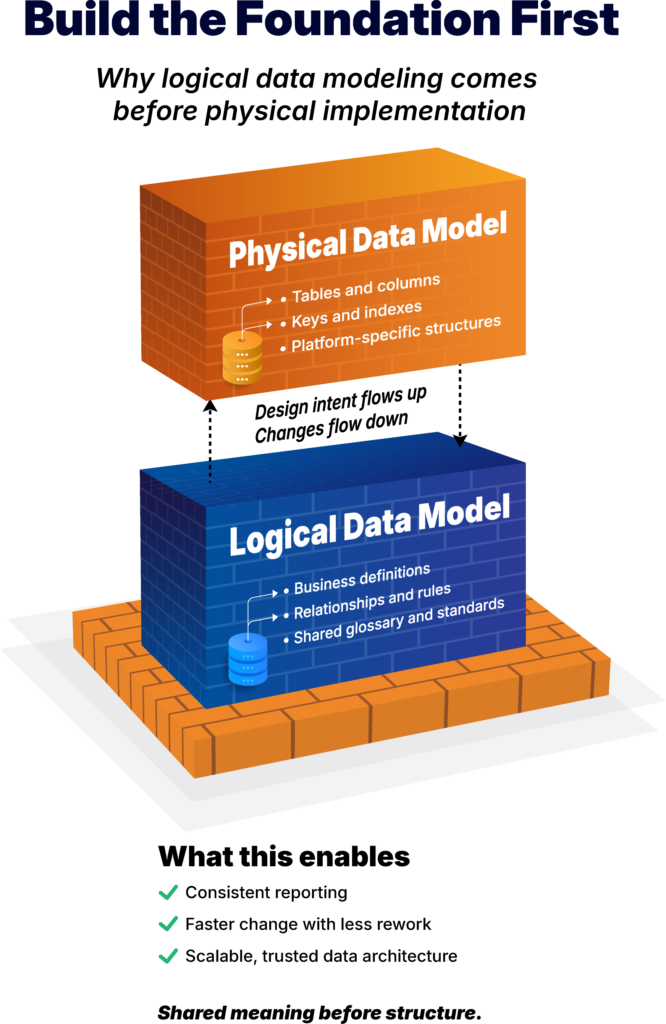
A logical data model is the architectural blueprint of an organization’s data. It defines what the data represents, how core business concepts relate to one another, and which rules govern those relationships, without being tied to any specific database or platform.
At the logical level, data is described in business terms. Entities such as customer, product, order, and revenue are defined based on how the organization understands and operates its business. Relationships describe how those concepts connect. Rules document what is required, optional, allowed, or prohibited.
This is also where shared business glossaries and data dictionaries live. Logical data models provide a structured way to define terms like revenue once and ensure that definition is reused everywhere. Does revenue include refunds. Does it recognize contract value or cash received. When is it counted. These definitions are agreed upon collaboratively and become part of the model itself.
In home building terms, the logical data model is the architectural plan. It defines how many rooms exist, how they connect, and which standards must be followed. It does not specify the brand of wiring or the exact placement of pipes. It establishes intent and structure so every downstream decision aligns.
The physical data model is the implementation of that plan. It translates logical entities and relationships into tables, columns, keys, and storage structures optimized for a specific platform. Multiple physical models can be derived from the same logical model, just as multiple houses can be built from the same architectural blueprint using different materials or construction techniques.
When logical and physical models are connected, meaning is preserved while implementation remains flexible. When physical models exist alone, meaning becomes implicit, fragmented, and fragile.
“A logical data model isn’t just a technical artifact. It’s a vital tool for aligning business needs with IT implementation, reducing errors and improving scalability.”
– Enqurious
Physical data models are designed to solve technical problems. They optimize for performance, storage, and access patterns. In doing so, they often obscure business meaning. Denormalization may collapse multiple concepts into a single table. Surrogate keys may replace natural identifiers. Platform specific constructs may encode rules that are not visible outside the database.
When physical models are the only source of truth, teams are forced to reverse engineer meaning from implementation details. New engineers, analysts, and business users must infer intent by inspecting schemas and guessing based on column names. This is inefficient and error prone.
This is the data equivalent of trying to understand a house by opening walls and tracing wires, instead of reading the architectural plans. You can see what exists, but you cannot easily understand why it was built that way or how it was meant to evolve.
Logical data models eliminate this problem by making intent explicit before technical tradeoffs are introduced.
Professional builders rely on standards because standards make collaboration possible. Standard door sizes allow replacements to be sourced easily. Standard tools allow multiple contractors to work together without friction. Approved materials ensure safety and durability.
Logical data models introduce the same discipline into data architecture. Through shared business glossaries and data dictionaries, they establish standards for how data is defined and used across the organization. When revenue, customer, and product are defined once and reused everywhere, reports align and trust increases.
ER/Studio enables this by allowing teams to collaborate on logical models, define business terms, and connect those definitions directly to physical implementations. The result is a cohesive data catalog where meaning, structure, and standards are aligned rather than scattered across tools and documents.
Fast construction assumes problems can be fixed after the house is built. In reality, reinforcing a foundation after the fact is expensive and disruptive. Replacing nonstandard components requires custom work. Safety issues may require major reconstruction.
In data environments, the same pattern appears. Once physical models are deployed across warehouses, lakes, and operational systems, correcting foundational issues becomes extremely difficult. Changing a definition requires updating pipelines, reports, dashboards, and downstream applications. Many organizations choose to live with inconsistencies because the cost of fixing them seems too high.
This is how data debt accumulates. Each workaround adds complexity. Each exception erodes confidence. Over time, teams spend more effort explaining data than using it.
Logical data modeling prevents these problems by resolving ambiguity before it spreads.
Construction succeeds when everyone works from the same plans and standards. Architects, builders, electricians, and inspectors all understand what is being built and why.
Logical data models create that shared language for data. Business glossaries and data dictionaries ensure that when someone references revenue or customer, everyone understands exactly what that means. This shared understanding accelerates collaboration across business and technical teams.
ER/Studio supports this by treating logical models as living assets that evolve with the business. Changes in definitions are reflected consistently across models and implementations, rather than being rediscovered repeatedly in downstream systems.
A well designed house can be expanded, renovated, or adapted because it was built on a strong foundation using consistent standards. A poorly designed house must be torn apart to change anything meaningful.
Data environments are no different. New sources, regulations, and technologies are inevitable. Organizations that rely only on physical models often find themselves rebuilding instead of extending because their original designs did not anticipate change.
Logical data models provide stability amid change. By separating business meaning from physical implementation, they allow organizations to evolve platforms without redefining their core concepts each time.
The promise of fast and dirty approaches is immediate delivery. The reality is long-term slowdown. Each inconsistency introduces friction. Each undocumented decision creates risk. Each misaligned definition requires explanation.
Organizations that invest in logical data modeling move faster over time because they reduce rework, improve accuracy, and increase confidence in their data.
ER/Studio embodies this philosophy by making logical data models foundational to the design process. Through collaboration, standards, and clear documentation, ER/Studio helps organizations build data architectures that are resilient, scalable, and trusted.
Because whether you are building a house or building enterprise data systems, speed without a foundation is not efficiency. It is deferred cost.
See how ER/Studio helps teams design data with intention, establish shared meaning, and build a foundation that delivers speed, trust, and long-term value.
Logical data modeling defines what data represents in business terms, how core concepts relate, and which rules govern those relationships. It establishes shared meaning before any physical implementation decisions are made. This is important because it creates consistency, reduces ambiguity, and ensures that data architecture reflects how the business actually operates, not just how data is stored in a specific system.
A logical data model focuses on business concepts such as customer, product, and revenue, along with their relationships and definitions, independent of technology. A physical data model focuses on how data is implemented in a specific platform, including tables, columns, keys, and storage structures. Logical models define intent and meaning, while physical models translate that intent into optimized implementations for particular databases or cloud platforms.
When organizations rely only on physical data models, business meaning becomes implicit and fragmented across systems. This leads to inconsistent definitions, conflicting reports, unclear lineage, and increased rework when changes are required. Over time, teams spend more effort reconciling data and explaining discrepancies than using data to drive decisions, which slows delivery and increases operational risk.
Logical data models provide a structured way to define and enforce standards through shared business glossaries, data dictionaries, and domain rules. By defining terms like revenue or customer once and reusing them across the enterprise, organizations ensure consistent interpretation across reports, analytics, and applications. This shared foundation improves trust, collaboration, and scalability as data environments grow.
Logical data models separate business meaning from physical implementation, which allows organizations to adapt platforms, schemas, and technologies without redefining core concepts each time. Because intent and standards are already established, changes can be made with confidence and less rework. This makes data architecture more resilient and allows teams to move faster as requirements, tools, and regulations evolve.




