
Artificial intelligence is changing the economics of enterprise data.
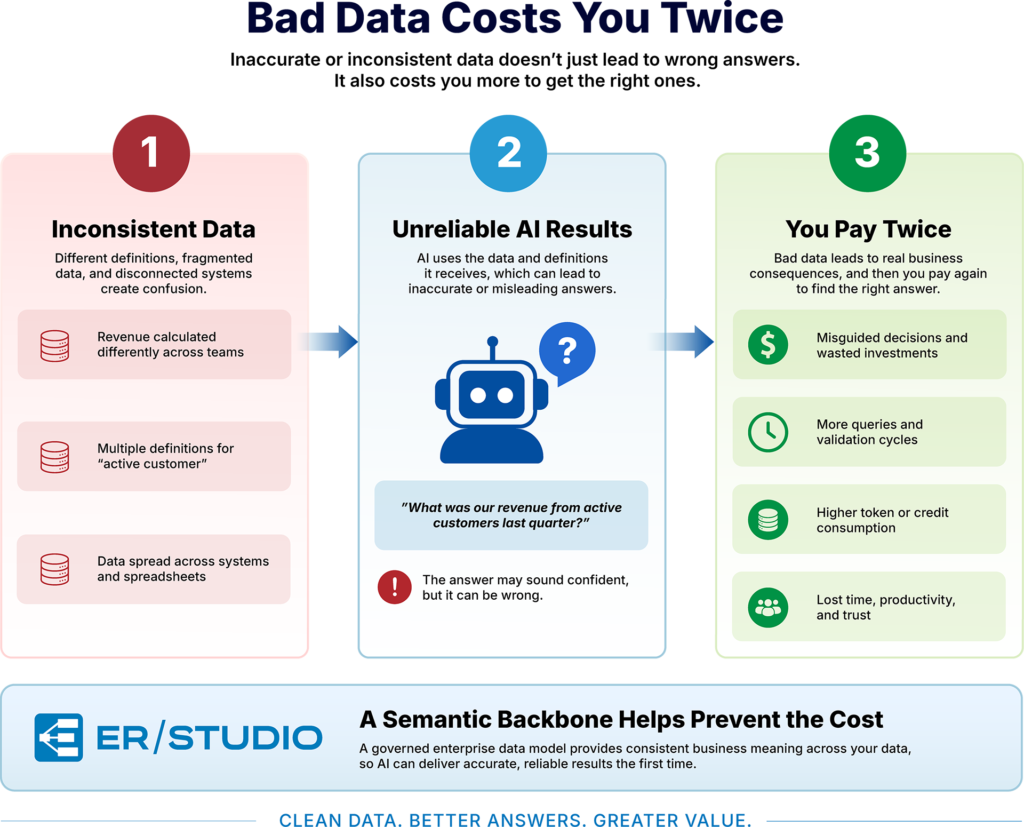
For years, organizations have understood that poor data quality has a cost. An inaccurate report can lead to a bad decision. An inconsistent customer record can disrupt operations. Conflicting definitions can cause departments to calculate the same metric differently.
AI raises the stakes.
When organizations begin using AI assistants, copilots, natural language analytics, and other generative AI applications to interact with enterprise information, unreliable data does not simply remain hidden inside a database. It can become the basis for an answer, recommendation, summary, forecast, or business decision.
And there is another cost that is easier to overlook.
Every time an AI system processes information, organizations consume computing resources. Depending on the platform and architecture, that consumption may be measured through tokens, credits, capacity, API calls, or other usage-based pricing. If the answer is wrong because the AI was given inconsistent data or conflicting business context, correcting the problem can require another query, another test, another validation cycle, and another round of consumption.
Bad data can therefore make AI expensive in two different ways.
First, organizations pay for the consequences of unreliable answers.
Then they pay again to generate better ones.
The more AI becomes integrated into everyday business processes, the more important it becomes to address the problem before information reaches the AI system.
There is a tendency to think of inaccurate AI output primarily as a problem with the AI model itself.
Sometimes it is.
But in enterprise environments, another question is just as important:
What information did the AI receive in the first place?
Consider a relatively simple question:
What was our revenue from active customers last quarter?
For an AI assistant to answer correctly, it needs much more than access to a collection of tables.
What does the organization mean by Revenue?
What qualifies as an Active Customer?
Which transactions should be included?
Are refunds excluded?
How are subsidiaries treated?
Which date determines the quarter?
If Finance, Sales, and Operations answer those questions differently, connecting an AI system to more data does not necessarily solve the problem. It may simply give the system more conflicting information to interpret.
The underlying data could even be technically correct. Every database record may accurately reflect the system that created it.
The problem is meaning.
One application defines an active customer as anyone who has purchased within the last 12 months. Another uses six months. A third considers a customer active as long as an account remains open.
All three systems contain valid data according to their own definitions.
Ask AI to determine the number of active customers across the organization, however, and those differences suddenly matter.
This is the same problem organizations have encountered for years when reports from different departments disagree. AI makes it more visible because users can now ask complex business questions conversationally and expect an immediate, authoritative answer.
If the underlying business meaning is inconsistent, the answer may sound far more certain than the data warrants.
The most obvious financial risk of unreliable AI is what happens when people trust the result.
Imagine an executive asks an AI assistant to summarize product profitability. The system retrieves information from several sources, but those sources calculate product costs differently. The resulting analysis identifies Product A as significantly more profitable than Product B.
Leadership uses the analysis to influence investment decisions.
Later, Finance discovers that one system excluded an important category of costs.
The AI did not necessarily invent the numbers. It used the information and definitions available to it. The problem existed before the prompt was entered.
The consequences can extend well beyond a single inaccurate report.
An unreliable AI-generated answer could contribute to incorrect forecasts, misguided inventory decisions, inefficient marketing spending, inaccurate financial analysis, compliance concerns, poor resource allocation, or flawed strategic recommendations.
The potential cost depends on how AI is being used.
If an employee uses AI to summarize a meeting, an error may be inconvenient.
If a financial analyst uses it to interpret revenue performance, a mistake could affect planning.
If an operations team relies on it to analyze inventory requirements, inconsistent information could influence purchasing.
If executives use AI-generated insights to guide investment decisions, the financial consequences can become much larger.
As AI moves closer to business decision-making, data reliability becomes more than a technical requirement.
It becomes an economic one.
There is also a more direct cost.
Enterprise AI is not free.
Organizations increasingly pay for generative AI based on some form of consumption. Depending on the service, that might involve tokens, API usage, credits, compute capacity, model calls, or subscription tiers with usage limits.
Every request consumes resources.
That is perfectly reasonable when the request produces useful work.
The economics become less attractive when organizations repeatedly consume those resources because the information feeding the system is unreliable.
Imagine a data team testing an AI-powered analytics application.
They ask:
How much revenue did we generate from our highest-value customers last year?
The system produces an answer.
Someone from Finance reviews it and says the revenue number is incorrect.
The team modifies the prompt and runs it again.
The result changes, but Sales says the customer classification is wrong.
The team adjusts the retrieval logic and runs another test.
Then someone discovers that two source systems use different definitions for “highest-value customer.”
Now the team has to investigate the data sources, reconcile the definitions, modify the AI workflow, rerun the query, and validate the result again.
Every iteration requires people.
Every iteration takes time.
And every iteration can consume additional AI resources.
Multiply that process across hundreds of questions, applications, departments, development teams, and AI initiatives, and inefficient AI consumption can become a meaningful expense.
“Gartner Predicts AI Inference Costs Per Agentic Workflow Will Increase More Than Fivefold Through 2028.”
– Gartner
Organizations often try to improve unreliable AI output at the point where the problem becomes visible.
They rewrite the prompt.
They change retrieval settings.
They add another document to the knowledge base.
They adjust instructions.
They switch models.
They rerun tests.
Those actions can be useful when the AI application itself is the problem. But they cannot permanently resolve conflicting business meaning upstream.
If one source defines Revenue differently from another, better prompting cannot decide which definition the organization considers authoritative.
If Customer means three different things across three systems, increasing the model’s context window does not establish which definition should govern a particular business question.
The organization is effectively paying AI to reconcile an architectural problem every time someone asks a question.
That is a costly way to manage enterprise knowledge.
The more scalable approach is to resolve business meaning before AI has to interpret it.
One of the misconceptions surrounding enterprise AI is that giving a model access to more information will naturally improve its answers.
Sometimes additional context helps.
But quantity and consistency are not the same thing.
Suppose an AI assistant has access to five enterprise systems, three business glossaries, two analytics platforms, and hundreds of internal documents.
That sounds impressive.
Now suppose each source defines important business concepts differently.
The AI has more information, but it also has more ambiguity.
Which definition of Customer should it use?
Which calculation for Revenue is authoritative?
Does Product refer to something sold, something manufactured, or a SKU?
Is an Employee someone currently on payroll, a contractor, or anyone with an active corporate account?
These are not questions an AI system should be expected to answer independently.
They are business decisions.
Organizations need an authoritative way to define those concepts before downstream systems consume them.
That is where the semantic backbone becomes important.
A semantic backbone provides an authoritative representation of an organization’s business concepts, relationships, rules, and definitions.
Rather than allowing every application to independently determine what Customer, Product, Revenue, Supplier, Policy, or Purchase Order means, the organization establishes those concepts centrally.
The Enterprise Logical Data Model, or ELDM, provides a natural foundation for doing this.
Unlike a physical data model, an Enterprise Logical Data Model is not tied to the implementation details of a particular database. It represents how the organization understands its business.
For example, an ELDM can establish:
Those concepts remain useful regardless of where the underlying information is physically stored.
That distinction matters because AI systems, analytics platforms, databases, and applications will change over time.
Business meaning should not have to be reinvented every time the technology changes.
This is the role of the Enterprise Logical Data Model as a semantic backbone: define business meaning once so that it can be reused consistently everywhere.
ER/Studio enables organizations to capture business entities, definitions, relationships, business rules, domains, hierarchies, and terminology within Enterprise Logical Data Models.
Instead of treating the logical model simply as an intermediate step on the way to database implementation, organizations can use it as an authoritative representation of business meaning.
That meaning can then remain connected to the technologies that depend on it.
Consider the earlier example of an Active Customer.
Rather than allowing Finance, Sales, an analytics platform, and an AI application to independently establish what Active Customer means, the organization can define the concept within its Enterprise Logical Data Model.
Business stakeholders can agree on the terminology.
Architects can model its relationships to Accounts, Orders, Products, Payments, and other concepts.
Governance teams can align approved definitions and policies.
Physical implementations can trace back to those business concepts.
Downstream semantic assets can inherit that meaning.
AI applications can then be supplied with governed business context based on the same foundation.
This does not guarantee that an AI system will never produce an incorrect answer. No data architecture can make that promise.
What it does is address one of the most important sources of unreliable enterprise AI: inconsistent business meaning.
AI does not simply need access to enterprise data.
It needs context about what that data means.
A database schema may tell an application that a table is called CUST_MSTR and a column is called ACTV_FLG.
A business definition explains what a Customer is and what conditions make that customer Active.
That distinction becomes critical when AI applications are expected to answer questions using natural language.
ER/Studio helps organizations establish this context within the Enterprise Logical Data Model and make that business knowledge reusable.
The semantic backbone can serve as the authoritative source from which downstream semantic implementations inherit meaning. Instead of asking each reporting platform, analytics team, governance application, or AI project to recreate definitions independently, they can begin with the same approved enterprise concepts.
This reduces the opportunity for semantic drift, where definitions gradually diverge as they are recreated across different technologies and teams.
The result is not simply cleaner documentation.
It is a more reliable information foundation for the systems consuming enterprise data.
Organizations naturally focus on model selection, prompt engineering, retrieval architectures, and token optimization when trying to control AI costs.
Those are important considerations.
But there is another form of optimization that begins much earlier.
Make the information being sent to AI easier to interpret correctly.
If teams spend less time correcting inconsistent definitions, retesting retrieval logic, investigating contradictory answers, and rerunning queries, they can reduce waste throughout the AI development and consumption lifecycle.
Consider two approaches.
In the first, an organization connects an AI application to numerous enterprise data sources and allows each project team to determine the business context it needs. Definitions are assembled through prompts, documentation, semantic layers, and local knowledge.
Every new use case requires another interpretation exercise.
In the second, the organization establishes important business concepts and relationships within an Enterprise Logical Data Model. Those definitions become reusable architectural assets that can support governance, analytics, semantic layers, and AI applications.
The second approach does not eliminate AI testing. Testing remains essential.
It does, however, reduce the need to repeatedly rediscover what the business means.
That is a significant distinction.
AI credits should be spent performing valuable AI work, not repeatedly compensating for definitions the organization could have standardized upstream.
Imagine an organization asks five AI applications the same question:
How many active customers do we have?
Application A retrieves information from the CRM.
Application B uses the data warehouse.
Application C relies on a Power BI semantic model.
Application D retrieves business definitions from a governance catalog.
Application E uses a custom retrieval system connected to internal documentation.
Without a common semantic foundation, all five could potentially produce different answers while accurately reflecting their respective sources.
Now imagine that each system ultimately inherits the organization’s approved definition of Active Customer from the same semantic backbone.
The applications can still use different technologies.
They can still serve different audiences.
They can still optimize information differently.
But they begin from the same business meaning.
That is the architectural principle behind the Enterprise Logical Data Model.
The objective is not to force every application into a single implementation. It is to ensure that different implementations do not independently reinvent the business.
As organizations expand their use of AI, the economics of inconsistent data will become increasingly difficult to ignore.
A wrong answer is not free.
Someone has to identify it.
Someone has to investigate it.
Someone has to determine why it happened.
Someone has to correct the underlying issue.
Someone has to rerun the process.
Someone has to validate the new result.
And throughout that process, the organization may continue consuming AI resources.
The real cost of unreliable AI therefore extends beyond tokens or credits. It includes wasted employee time, delayed projects, duplicated work, repeated testing, unreliable reporting, and the business consequences of decisions based on incorrect information.
The best place to reduce those costs is not after AI produces the wrong answer.
It is before the question is ever asked.
ER/Studio helps organizations establish Enterprise Logical Data Models that serve as a semantic backbone for their data architecture. Business concepts, relationships, rules, and definitions can be established once and reused across physical implementations, governance platforms, analytics environments, semantic layers, and AI initiatives.
The technologies consuming that information may be different.
The business meaning does not have to be.
For organizations investing heavily in artificial intelligence, that consistency has a direct economic value. Better-defined data means less ambiguity for downstream systems, fewer conflicting interpretations for teams to reconcile, and a stronger foundation for generating reliable results without repeatedly spending time and AI resources correcting preventable problems.
Because when every AI interaction has a cost, getting the context right the first time matters.
Ready to build a stronger foundation for AI? Try ER/Studio free and start turning consistent business definitions into more reliable results.
Unreliable or inconsistently defined data can cause AI applications to produce incorrect or conflicting results. Teams may then need to investigate the source, adjust prompts or retrieval logic, rerun queries, and validate new outputs. That consumes employee time as well as additional tokens, credits, API calls, or compute capacity.
Prompt engineering can improve how an AI application interprets the context it receives, but it cannot establish authoritative business definitions that do not already exist. If different enterprise systems define concepts such as Customer or Revenue differently, organizations need to resolve those differences at the semantic and architectural level.
A semantic backbone is an authoritative representation of business concepts, relationships, rules, and definitions that can be reused across enterprise technologies. Rather than allowing every downstream system to independently define business meaning, the semantic backbone provides a shared foundation from which those systems can inherit it.
An Enterprise Logical Data Model captures business concepts, relationships, definitions, rules, domains, and terminology independently of any specific technology. This provides governed business context that can be reused by downstream applications, helping AI initiatives work from more consistent enterprise meaning.
ER/Studio enables organizations to establish Enterprise Logical Data Models that serve as a semantic backbone for enterprise data. By connecting approved business meaning with physical implementations, governance, semantic assets, and downstream systems, organizations can reduce semantic drift and provide AI applications with more consistent business context.




