Every organization relies on data to make decisions. Leaders review dashboards to understand performance, analysts build reports to identify trends, and data teams design pipelines that move information across systems. Yet many companies face a surprisingly simple problem that quietly undermines all of this work.
Different teams are often speaking different data languages.
The marketing team may define a “customer” differently from the sales team. Finance may calculate “revenue” using rules that differ from those used in product analytics. A data engineer may transform a field during ingestion without realizing that analysts depend on the original meaning.
Over time, these small inconsistencies accumulate. The same term begins to mean different things in different systems, reports, and conversations. What starts as a minor misunderstanding can evolve into a much larger issue known as semantic drift.
Semantic drift occurs when the meaning of data changes gradually as it moves across systems, teams, and transformations. When this happens, organizations lose confidence in their data because no one can be completely sure that everyone is interpreting it the same way.
The question every data driven organization should ask is simple.
Is your company speaking the same language when it comes to data?
Understanding semantic drift and learning how to prevent it is essential for maintaining trust in modern data environments.
Semantic drift refers to the gradual change in meaning of data elements as they are used, transformed, and interpreted across systems.
This change rarely happens intentionally. In most cases it emerges slowly as data flows through pipelines, applications, analytics tools, and reporting systems.
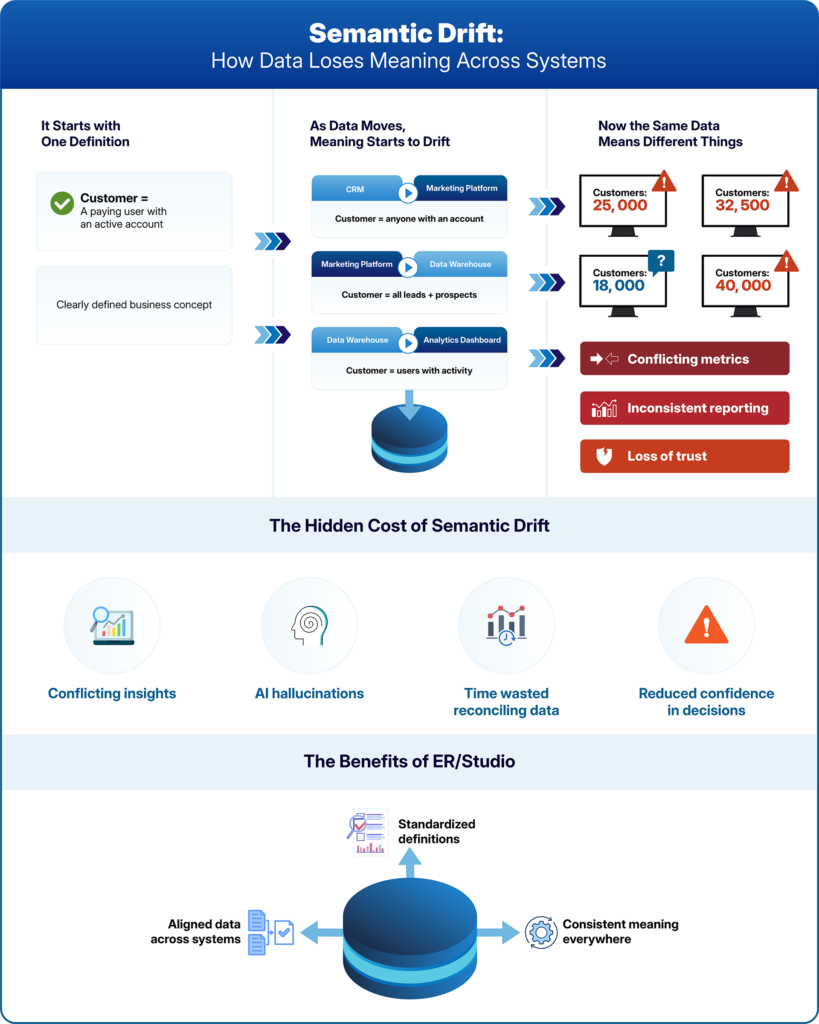
Consider a simple example involving the concept of a “customer.”
In an operational system, a customer may represent anyone who has created an account on a platform. In a billing system, a customer might represent only individuals who have completed a purchase. In a marketing database, the term might include prospects who have never purchased anything at all.
Each system may use the same label, yet the meaning behind that label is different.
When analysts build reports using these datasets, conflicting metrics begin to appear. One dashboard may report a higher number of customers than another. Leadership meetings become filled with debates about which numbers are correct.
In reality, the problem is not the numbers themselves. The problem is that the organization has allowed the meaning of the term “customer” to drift.
This is the essence of semantic drift.
“You cannot write a test for ‘this column still means what the business thinks it means.’ The meaning lives in someone’s head. Often in several heads, each with a slightly different version.”
– Quentin Kasseh
Modern data ecosystems make semantic drift almost inevitable if organizations do not actively manage it.
Data no longer lives in a single database or application. It moves across a wide range of systems including operational databases, analytics warehouses, application platforms, and machine learning environments.
Each time data is copied, transformed, or aggregated, the risk of semantic change increases.
Several factors contribute to this phenomenon.
ETL pipelines often transform data as it moves between systems. Fields may be renamed, aggregated, or filtered. Over time, these transformations can alter the meaning of the data being stored.
Different teams frequently build their own datasets to support specific goals. Marketing, finance, operations, and product teams may each define metrics according to their needs. Without shared definitions, those metrics slowly diverge.
Cloud data platforms make it easy to ingest and analyze new data sources. While this flexibility accelerates innovation, it also creates environments where datasets multiply faster than they can be documented or governed.
When organizations lack a shared vocabulary for key data concepts, each system becomes a potential source of semantic drift.
The result is an environment where data appears consistent on the surface but carries different meanings beneath.
Semantic drift may seem like a technical inconvenience, but its consequences often extend far beyond the data team.
One of the most immediate impacts is loss of trust.
When executives see conflicting numbers across dashboards, they begin to question the reliability of the underlying data. Analysts spend more time reconciling discrepancies than generating insights. Meetings that should focus on strategy instead revolve around validating metrics.
Semantic drift can also slow innovation.
Data scientists depend on accurate, well understood datasets to build machine learning models. If the meaning of features or attributes is unclear, model accuracy suffers. Engineers may hesitate to integrate data from unfamiliar systems because they cannot confidently interpret its meaning.
In regulated industries, semantic drift may introduce compliance risks as well. Inconsistent definitions of sensitive attributes can complicate governance policies and regulatory reporting.
Ultimately, semantic drift erodes the value of the data ecosystem organizations work so hard to build.
Preventing it requires a deliberate architectural approach.
The solution to semantic drift is not simply better documentation. Organizations must establish a shared data language that aligns business definitions with technical implementations.
A shared data language ensures that when teams refer to terms such as customer, revenue, product, or account, they are referring to the same concept across every system.
This alignment requires collaboration between business stakeholders, data architects, and technical teams.
Business teams provide the context and meaning behind key concepts. Data architects translate those concepts into structured models. Engineers implement the models within operational and analytical systems.
When these groups work together, organizations create a consistent vocabulary that guides how data is designed and interpreted.
Data modeling platforms play a crucial role in maintaining this alignment.
Data modeling provides the structural foundation needed to maintain a shared data language.
A well designed data model defines entities, attributes, and relationships that represent business concepts clearly. It captures the meaning of each data element and how it connects to other elements within the system.
This structure helps organizations maintain semantic consistency even as systems evolve.
When data models serve as the authoritative reference for architecture, teams gain several advantages.
First, definitions remain visible and accessible. Analysts and engineers can consult models to understand what each data element represents.
Second, relationships between entities become clear. This prevents misinterpretation of how datasets relate to one another.
Third, models provide a framework for governance. When new systems are introduced, they can be aligned with existing models rather than introducing new, conflicting definitions.
Platforms like ER/Studio enable organizations to maintain these models across complex environments that span operational databases, analytics platforms, and cloud data warehouses.
ER/Studio provides the architectural tools organizations need to ensure that data meaning remains consistent across systems.
By combining data modeling, metadata management, and governance integration, ER/Studio helps organizations maintain a shared understanding of their data.
ER/Studio allows teams to define entities and attributes that represent core business concepts. These models capture the meaning behind data elements and make those definitions visible to everyone who works with the data.
When teams share a common vocabulary, the risk of semantic drift decreases significantly.
One of the most common sources of semantic drift occurs when logical definitions diverge from physical implementations.
ER/Studio bridges this gap by linking logical data models with physical database schemas. This ensures that the meaning defined at the business level is preserved as data is implemented across systems.
ER/Studio integrates with governance platforms such as Collibra and Microsoft Purview to synchronize technical metadata with business definitions.
This integration ensures that catalogs, lineage tools, and governance systems reflect the same definitions captured within the data model.
Understanding how data moves through systems is essential for maintaining semantic clarity.
ER/Studio helps document relationships and dependencies across datasets so teams can trace how attributes evolve as they pass through pipelines and transformations.
When teams understand where data originates and how it changes, they are better equipped to detect and prevent semantic drift.
Technology alone cannot eliminate semantic drift. Organizations must also foster a culture that values shared definitions and collaborative data governance.
This culture begins with recognizing that data is a shared asset rather than the property of any single team.
Business leaders, data engineers, analysts, and architects all contribute to the way data is defined and interpreted. When these groups communicate openly and rely on shared models, the organization develops a consistent language around its data.
Over time, this alignment improves trust, reduces confusion, and allows teams to focus on generating insights rather than debating definitions.
As organizations continue to expand their data ecosystems, semantic drift becomes an increasingly important challenge.
Without shared definitions and clear architecture, even the most advanced analytics platforms can produce conflicting interpretations of the same data.
By establishing strong data models and aligning systems around a common vocabulary, organizations can ensure that their data tells a consistent story.
ER/Studio helps make that possible by providing the modeling foundation that keeps complex data environments aligned, governed, and understood.
Because in a world driven by data, success often begins with a simple question.
Is your company speaking the same language?
ER/Studio will help answer that question. Reach out today.
Semantic drift occurs when the meaning of data changes over time as it moves across systems, teams, and transformations. Even if a data element keeps the same name, such as “customer” or “revenue,” its definition can gradually shift depending on how different systems store, process, or interpret it. This leads to inconsistent understanding across the organization and makes it difficult to trust analytics, reporting, and AI outputs.
Semantic drift is more common today because data ecosystems are highly distributed and constantly evolving. Data flows through cloud platforms, warehouses, pipelines, and applications, often being transformed along the way. Different teams also create their own datasets and metrics to meet specific needs. Without shared definitions and centralized modeling, these changes accumulate, causing data meaning to diverge across systems.
Semantic drift directly affects the reliability of analytics and AI systems. When data definitions are inconsistent, dashboards can show conflicting results, and analysts may spend significant time reconciling discrepancies. For AI systems, the impact is even greater. AI models rely on patterns in data, not business meaning. When underlying data is inconsistent, AI can produce misleading insights, hallucinations, or unpredictable behavior, reducing trust in outcomes.
Preventing semantic drift requires establishing a shared data language across the organization. This includes defining core business concepts, standardizing definitions, and ensuring consistency between logical models and physical implementations. Data modeling plays a critical role by providing a structured framework for how data is defined and related. Organizations also need governance processes to maintain alignment as systems evolve and new data sources are introduced.
ER/Studio helps organizations prevent semantic drift by providing a centralized platform for defining and maintaining data meaning. It enables teams to model core entities, relationships, and definitions, ensuring consistency across systems. By linking logical models with physical data structures and integrating with governance tools like Collibra and Microsoft Purview, ER/Studio ensures that business definitions remain aligned with technical implementations, even as data environments grow more complex.