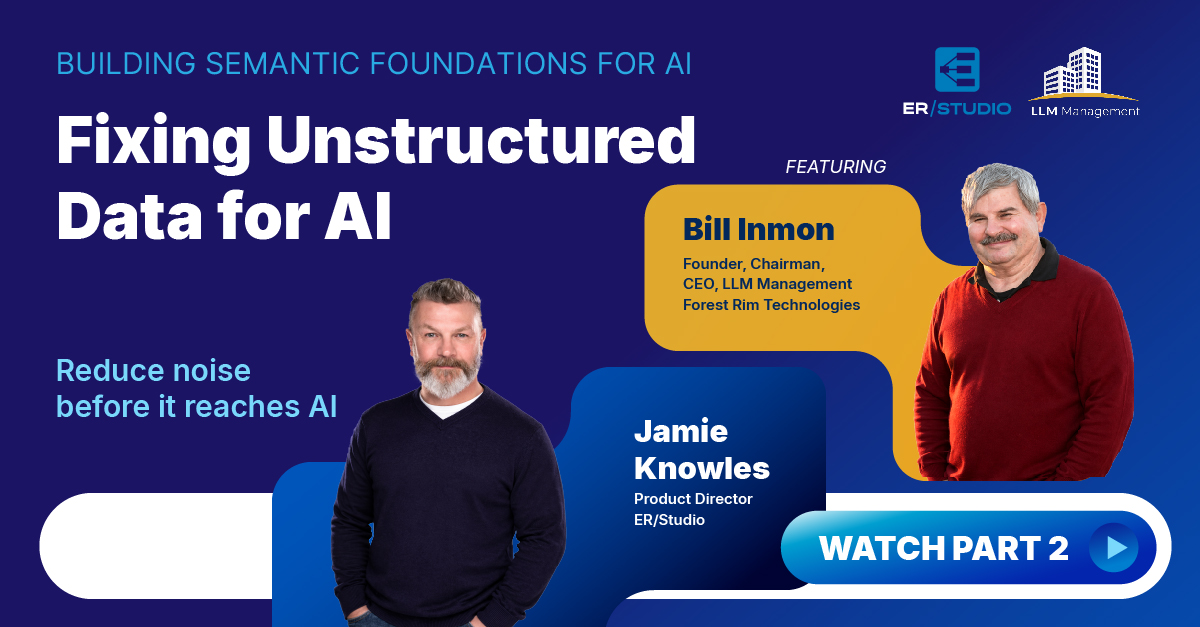
Unstructured data contains valuable business information, but pushing raw documents directly into AI systems introduces noise, increases cost, and leads to unreliable results.
In Part 2 of this series, Bill Inmon introduces Textual ETL, a deterministic approach to processing unstructured data before it reaches AI systems.
Rather than relying on AI to interpret raw text on its own, Textual ETL extracts relevant data elements, removes noise, and aligns the results to a predefined semantic model.
This approach reduces the burden on AI systems, helping improve performance, lower cost, and increase accuracy.
Building on the foundation established in Part 1, this session explores how organizations can extend a semantic foundation across structured and unstructured data, creating a more consistent and reliable foundation for AI.
Data architects, data engineers, data modelers, governance leaders, analytics leaders, and AI stakeholders working with structured and unstructured data.
Bill Inmon
Founder, Chairman, CEO, LLM Management/Forest Rim Technologies
Widely recognized as the father of data warehousing
Jamie Knowles
Product Director, ER/Studio
Part 1: Busting Modern Data Myths
Part 1 explains why semantic drift develops in modern data environments and why a strong semantic foundation is critical before scaling AI initiatives.
Watch this on-demand session to learn how Textual ETL helps reduce noise, improve consistency, and align unstructured data to a shared semantic model.
Raw text often contains noise, ambiguity, and inconsistent context. Without structure, AI systems have to interpret too much on their own.
Textual ETL is a deterministic approach to extracting meaningful data from unstructured sources and aligning it to a predefined semantic model.
AI can process text, but without structure and context, results can be inconsistent, costly, and difficult to govern.
It reduces the amount of irrelevant or noisy information sent to AI systems, helping improve accuracy, consistency, and processing efficiency.
Part 1 focuses on restoring semantic consistency across modern data environments. Part 2 extends that foundation to unstructured data.
Connect with our team to explore how ER/Studio supports data modeling, semantic consistency, and governed data architecture.