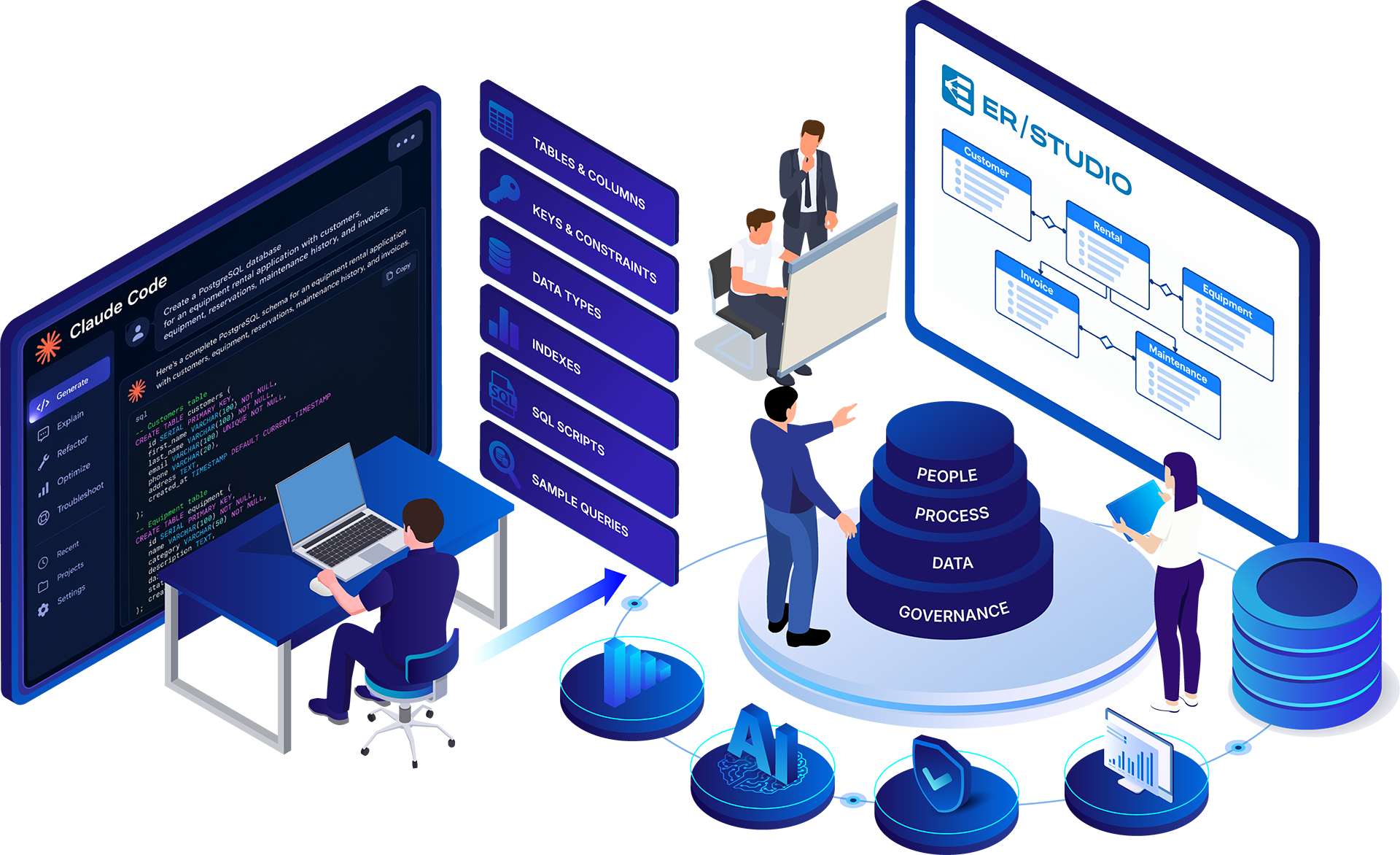
Artificial intelligence is changing how developers write software.
Tools like Claude Code can generate SQL, create database schemas, explain normalization, and even scaffold entire applications from natural language prompts. Tasks that once required hours of manual effort can now be completed in minutes, making AI an invaluable productivity tool for developers, data engineers, and architects alike.
As these capabilities continue to improve, many organizations are asking an important question.
If AI can generate database schemas, do we still need enterprise data modeling tools?
The short answer is yes, but not because AI is incapable.
It is because enterprise data modeling solves a fundamentally different problem.
Claude Code is designed to help developers create code. ER/Studio is designed to help organizations create shared business understanding. Those goals overlap in some areas, but they are far from identical.
A generated SQL schema may accurately implement a database, but it does not establish enterprise business definitions, standardize terminology across departments, document relationships that span dozens of systems, or provide the governance foundation required for analytics and AI.
That distinction becomes increasingly important as organizations grow.
A startup building its first application has very different requirements than a global enterprise managing thousands of databases, multiple business units, regulatory obligations, governance platforms, and AI initiatives. While Claude Code can accelerate implementation, enterprise architecture requires capabilities that extend far beyond code generation.
The question, then, is not whether Claude Code or ER/Studio is better.
The better question is when each tool should be used.
Claude Code represents one of the most capable AI-assisted development environments available today. It can understand natural language requests, generate working SQL, explain database concepts, refactor existing schemas, and accelerate many of the repetitive tasks involved in database development.
For individual developers or small project teams, this can dramatically improve productivity.
For example, a developer might prompt Claude Code with:
Create a PostgreSQL database for an equipment rental application with customers, equipment, reservations, maintenance history, and invoices.
Within seconds, Claude Code can generate:
It can also explain why certain design decisions were made, suggest normalization improvements, and revise the schema based on additional prompts.
That level of productivity would have been remarkable only a few years ago.
Claude Code is equally valuable for tasks such as:
For many development tasks, AI has become an indispensable assistant.
The key point is that Claude Code excels at generating implementations.
Enterprise data architecture, however, begins long before implementation.
A database schema describes how information is stored.
An enterprise data model describes what that information means.
That distinction may sound subtle, but it fundamentally changes how organizations design, govern, and manage data.
Consider a simple business concept such as Asset.
Claude Code can certainly generate a table named Asset with columns, keys, and relationships.
What it cannot determine on its own is how the business defines an asset.
Does an asset include leased equipment?
Are software licenses considered assets?
Should digital content be modeled separately?
How do maintenance records relate to depreciation schedules?
Which department owns the authoritative definition?
These are not technical questions.
They are business questions.
The answers require collaboration between architects, business stakeholders, governance teams, compliance leaders, and subject matter experts. They often involve discussions that span multiple departments and systems, resulting in definitions that become enterprise standards rather than project-specific assumptions.
This is the role of the Enterprise Logical Data Model (ELDM).
Before physical tables are created, architects use logical models to establish common business concepts, define relationships, document business rules, and create terminology that can be shared across the organization. Because logical models are independent of any specific database platform, they provide a stable semantic foundation that survives technology changes over time.
Once those definitions have been agreed upon, ER/Studio can automatically transform logical models into physical implementations for SQL Server, PostgreSQL, Oracle, Snowflake, Databricks, and many other platforms.
Claude Code can help generate the physical implementation.
ER/Studio ensures the implementation reflects an agreed-upon understanding of the business.
That difference becomes increasingly valuable as organizations scale.
One of the most common patterns emerging with AI-assisted development is the tendency to move directly from an idea to physical database structures.
A prompt becomes a schema.
A schema becomes an application.
The process is remarkably fast, but it often skips the stage where organizations agree on business meaning.
Initially, this may not seem like a problem.
The application works.
The tables are normalized.
The SQL executes successfully.
As additional applications, analytics platforms, and AI initiatives begin consuming the same data, however, inconsistencies start to appear.
Different teams define business concepts differently.
Metrics evolve independently.
Reports produce conflicting results.
Governance teams struggle to standardize terminology.
AI assistants return different answers depending on which system they reference.
None of these problems originate in the SQL.
They originate in the absence of a shared semantic foundation.
Enterprise Logical Data Models exist to prevent exactly this outcome. By establishing business meaning before implementation, organizations create a consistent vocabulary that can be reused across applications, databases, governance platforms, semantic layers, analytics environments, and AI systems.
Instead of asking every new project to define its own interpretation of the business, enterprise architecture allows that understanding to be created once and extended everywhere.
That is not something an AI coding assistant is designed to replace.
It is something AI becomes significantly more effective when it can build upon.
Both Claude Code and ER/Studio help teams build better databases, but they approach the problem from very different perspectives.
Claude Code is an AI-powered development assistant that accelerates coding and implementation. ER/Studio is an enterprise data modeling platform that establishes the architectural and semantic foundation organizations depend on over the lifetime of their data ecosystem.
The comparison is not about which tool generates SQL faster.
It is about which tool solves the broader enterprise problem.
| Capability | Claude Code | ER/Studio |
| Generate SQL and DDL | ✔ Excellent | ✔ Generate from models |
| Create database schemas | ✔ From prompts | ✔ From conceptual, logical, and physical models |
| Enterprise Logical Data Models | ✘ | ✔ |
| Conceptual, logical, and physical modeling | Limited | ✔ |
| Automatic logical-to-physical transformation | ✘ | ✔ |
| Enterprise business glossary | ✘ | ✔ |
| Shared enterprise data dictionary | ✘ | ✔ |
| Multi-user collaboration | Limited | ✔ |
| Central repository | ✘ | ✔ |
| Version control and change management | Limited | ✔ |
| Impact analysis | ✘ | ✔ |
| Reverse engineering existing databases | Limited | ✔ |
| Compare and merge models | ✘ | ✔ |
| Microsoft Purview integration | ✘ | ✔ |
| Collibra integration | ✘ | ✔ |
| Semantic asset generation | ✘ | ✔ |
| Power BI Semantic Layer generation | ✘ | ✔ |
| dbt Semantic Layer generation | ✘ | ✔ |
| Enterprise AI semantic foundation | Limited | ✔ |
The comparison reveals an important pattern.
Claude Code excels at helping developers produce implementation artifacts quickly. ER/Studio focuses on creating enterprise assets that remain valuable long after the application has been deployed.
Both are valuable.
They simply solve different problems.
Imagine an organization is developing a new enterprise asset management application.
The project involves maintenance scheduling, inventory tracking, procurement, accounting, regulatory reporting, mobile inspections, and predictive maintenance powered by AI.
A developer opens Claude Code and enters a prompt describing the application.
Within minutes, Claude produces a relational schema containing tables such as:
The SQL is well structured.
Relationships are logical.
The application can begin development almost immediately.
From a software development perspective, this is an enormous productivity gain.
Now imagine the same project six months later.
The analytics team needs dashboards.
The governance team is implementing Microsoft Purview.
Finance wants depreciation reporting.
Operations wants maintenance KPIs.
A new AI assistant needs to answer questions about equipment performance.
Suddenly, everyone begins asking questions that the database schema cannot answer.
What exactly qualifies as an asset?
Should leased equipment be included?
Are spare parts considered assets?
How should retired equipment be represented?
Which department owns the authoritative definition?
Should maintenance history include inspections or only completed repairs?
These questions are not answered by SQL.
They require enterprise architecture.
Using ER/Studio, architects establish those business concepts before implementation begins. The Enterprise Logical Data Model captures agreed-upon definitions, documents relationships, records business rules, and provides terminology that can be reused across governance, analytics, and AI initiatives.
Once approved, ER/Studio generates the physical implementation while preserving alignment with the logical model.
Months or even years later, when additional systems consume the same information, every team continues building upon the same enterprise definitions instead of inventing new ones.
That continuity is difficult to achieve through AI-generated code alone.
Another important distinction between Claude Code and ER/Studio is the scope of collaboration.
Claude Code is primarily designed for individuals or small development teams. A developer interacts with the AI, reviews generated output, and incorporates it into a project.
Enterprise architecture is rarely that simple.
A logical model may require input from business analysts, solution architects, database administrators, governance leaders, compliance teams, security specialists, and application owners. Each stakeholder contributes knowledge that shapes the final design.
ER/Studio provides a collaborative environment where these conversations become part of the architecture itself.
Multiple architects can work against a shared repository.
Changes can be reviewed before implementation.
Business definitions remain centralized rather than scattered across documents and emails.
Impact analysis helps teams understand how proposed changes affect downstream systems before modifications are made.
Instead of relying on individual memory, organizations build a shared understanding that persists across projects, personnel changes, and technology upgrades.
This collaborative capability becomes increasingly valuable as organizations grow.
One of the most common misconceptions surrounding AI-assisted development is that better AI eliminates the need for governance.
In reality, the opposite is happening.
As AI generates more code, more schemas, and more applications, organizations need stronger governance to ensure those implementations remain consistent with enterprise standards.
Without governance, AI accelerates inconsistency just as effectively as it accelerates productivity.
Consider an organization where five development teams independently ask Claude Code to design a database for managing products.
Each schema may be technically sound.
Each may use slightly different terminology.
Each may define key business concepts differently.
After several years, the organization now has five applications describing products in five different ways.
Analytics teams spend time reconciling definitions.
Governance teams attempt to standardize terminology after implementation.
AI assistants produce conflicting answers because every application represents the business differently.
The problem was never the quality of the generated SQL.
The problem was that every project began with a different understanding of the business.
ER/Studio addresses this challenge by establishing enterprise standards before implementation begins. Logical models, business glossaries, naming standards, and governance workflows provide the consistency that AI-generated implementations can inherit rather than recreate.
In this way, governance does not compete with AI.
It enables AI to produce more consistent results.
Organizations sometimes frame this discussion as a choice between AI and enterprise modeling.
That is the wrong comparison.
Claude Code and ER/Studio complement each other remarkably well.
Architects define enterprise concepts inside ER/Studio.
Business stakeholders approve shared terminology.
Logical models establish relationships and business rules.
Physical models are generated automatically.
Developers then use Claude Code to accelerate application development, SQL optimization, stored procedures, migrations, and testing while remaining aligned with the enterprise architecture already established.
Instead of replacing architects, AI allows architects to spend less time writing repetitive SQL and more time solving higher-value problems involving business semantics, governance, and enterprise design.
That combination delivers far greater value than either tool independently.
AI accelerates implementation.
Enterprise architecture ensures that implementation remains consistent, governed, and understandable for years to come.
Claude Code is an outstanding choice when the goal is to accelerate software development, prototype new ideas, generate SQL, or assist developers with day-to-day implementation tasks. Individual developers, small application teams, and organizations building isolated solutions can realize significant productivity benefits from AI-assisted coding.
Enterprise organizations face a broader challenge.
They need consistent business definitions across hundreds of databases. They need governance integrated into architecture. They need collaboration across technical and business teams. They need semantic foundations that support analytics, Power BI, dbt, Microsoft Purview, Collibra, and increasingly, AI.
Those requirements extend far beyond code generation.
ER/Studio was built to address exactly those enterprise challenges.
Rather than replacing AI, it provides the governed architectural foundation that allows AI-generated solutions to scale across the enterprise without sacrificing consistency or business meaning.
As AI continues transforming software development, enterprise data modeling becomes even more important.
The future is not choosing between AI and architecture.
The future is combining AI-powered development with enterprise data models that ensure every application, dashboard, semantic layer, and AI assistant speaks the same data language.
That is where Claude Code ends.
And where enterprise architecture begins.
Ready to move beyond AI-generated schemas? Explore how ER/Studio helps transform enterprise data models into governed business assets.
Claude Code is an excellent AI-assisted development tool for generating SQL, database schemas, and application code. However, it is not designed to replace enterprise data modeling platforms. ER/Studio provides capabilities such as conceptual, logical, and physical data modeling, enterprise collaboration, governance integration, business glossaries, impact analysis, and semantic modeling that are essential for managing data across large organizations.
Claude Code is well suited for rapid prototyping, learning SQL, building small applications, generating DDL scripts, and assisting developers with coding tasks. If you’re designing a standalone application or exploring database concepts, AI can significantly accelerate development. Enterprise projects that require standardized business definitions, governance, and long-term architectural management typically benefit from a dedicated data modeling platform like ER/Studio.
AI can generate technically correct database schemas, but it cannot determine how an organization defines its business concepts. An Enterprise Logical Data Model captures agreed-upon business definitions, relationships, rules, and terminology before implementation begins. ER/Studio automatically transforms these logical models into physical database designs, ensuring the implementation remains aligned with enterprise business meaning rather than project-specific assumptions.
ER/Studio helps organizations prepare data for AI by creating a governed semantic foundation built on Enterprise Logical Data Models. Shared business definitions, metadata, and relationships can be extended into governance platforms, semantic layers, analytics environments, and AI applications, helping reduce semantic drift and improve the consistency and trustworthiness of AI-generated insights.
For most enterprise organizations, the strongest approach is to use both. ER/Studio establishes the enterprise architecture, business definitions, and governance framework, while Claude Code accelerates SQL generation, application development, and implementation tasks. Together, they enable organizations to combine AI-assisted productivity with governed, enterprise-scale data architecture.




