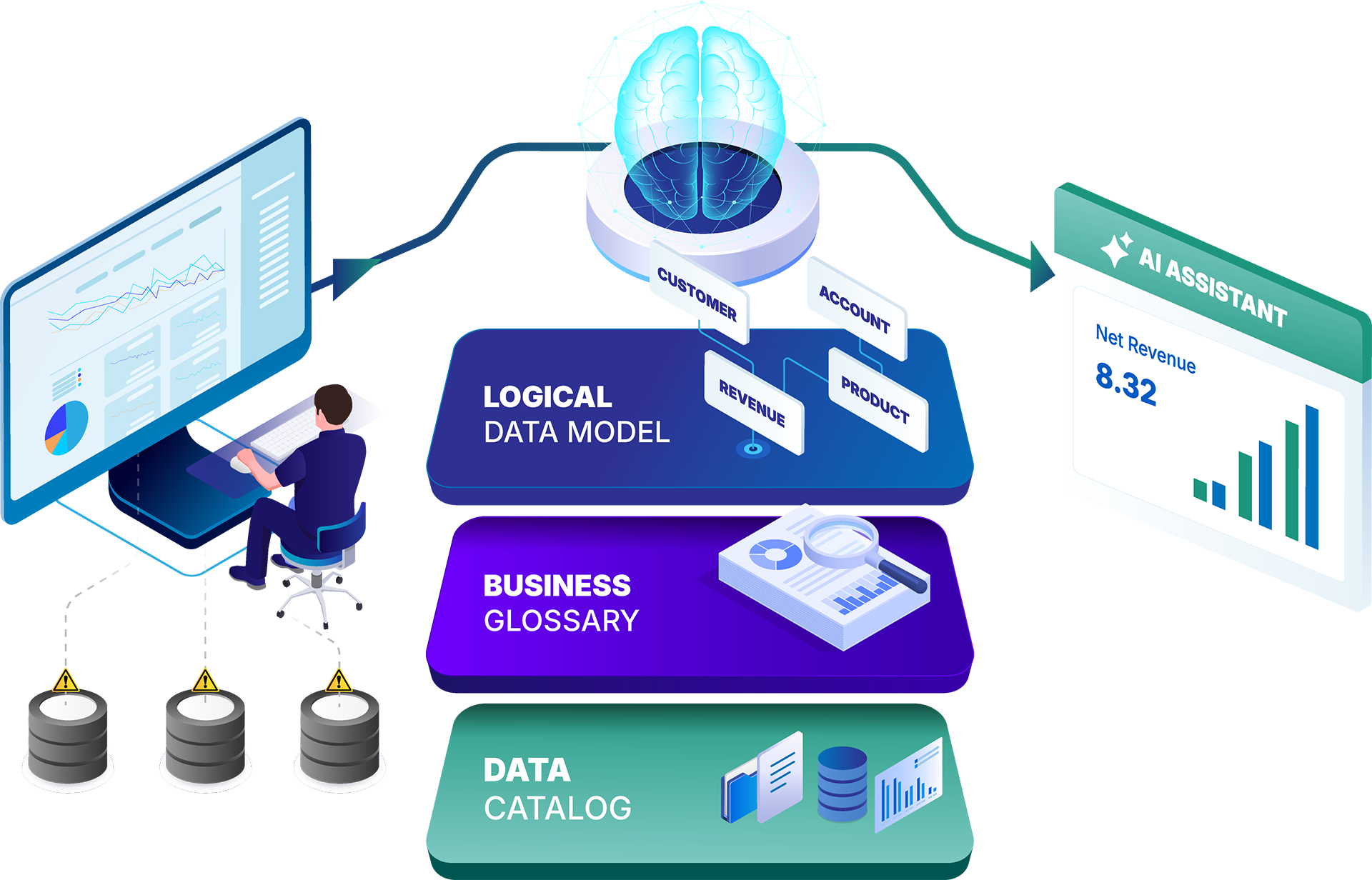
LLM data modeling is the discipline of structuring data environments so that large language models can consume, interpret, and reason over enterprise data with accuracy and consistency.
It extends traditional data modeling to handle what AI consumption introduces: unambiguous definitions, governed metadata, and traceable lineage from business meaning to physical implementation.
Traditional BI kept a human in the loop at every step. An analyst writing a SQL query against a star schema knew (or learned the hard way) that the customer dimension in marketing meant something different from the customer table in finance. They compensated mentally.
LLMs eliminate that interpretive buffer. They consume definitions literally through RAG, semantic layers, or text-to-SQL access. If your schema defines “revenue” three different ways across three physical models, the LLM treats each as equally valid and delivers the contradiction with the same confidence as a correct answer. Three different revenue values in the same quarterly report is a scenario most data architects know from BI. LLMs replicate it at machine speed.
Enterprise benchmarks report hallucination rates between 15% and 52% across commercial LLMs, with data quality and training bias accounting for the majority of those factors. Poor data quality already costs organizations at least $12.9 million per year on average, according to Gartner. LLMs do not reduce that cost. They distribute it across every AI-generated insight, recommendation, and summary that touches ungoverned data.
The fix is structural. Inconsistent definitions require intervention at the modeling layer, and no amount of LLM improvement changes that. A model trained on better data still hallucinates when the metadata it retrieves contains conflicting definitions. The architecture is the variable organizations control. ER/Studio manages that variable across the full lifecycle, from conceptual design through production governance.
Whether LLM outputs are trustworthy depends on three layers working together. Miss any one, and the system produces outputs that look credible and aren’t.
A logical data model defines what data represents independent of how it’s physically stored. When an LLM encounters “customer_id,” the logical model tells it whether that means someone who purchased, someone who registered, or someone who was quoted. Without one, the LLM has column names and data types but no access to business meaning.
The gap becomes acute in RAG pipelines, where the LLM retrieves schema metadata to ground its responses. A column named cust_acct_nbr paired with a logical attribute “Customer Account Number” and a definition (“unique identifier assigned at first purchase, excluding trial accounts”) gives the LLM unambiguous context. Without that logical layer, the LLM infers meaning from naming patterns, and those inferences are wrong often enough to erode trust. ER/Studio’s Business Data Objects capture concepts at the business level before they expand into entity-relationship diagrams, so the semantic layer LLMs need exists at design time rather than getting reconstructed after the fact.
An enterprise glossary associates authoritative definitions with the physical data assets that represent them. An entry for “net revenue” should link directly to the tables and columns where that metric is calculated, so any system consuming the data (LLMs included) resolves the term to a single, governed definition. ER/Studio’s Team Server hosts these glossaries with ontology and taxonomy management, giving stakeholders and AI systems a navigable map of synonyms, hierarchies, and related terms.
The NIST AI Risk Management Framework identifies governance as a “continual and intrinsic requirement” over an AI system’s lifespan. A governed glossary is how that requirement becomes operational at the data layer. It prevents the scenario where an LLM generates a quarterly report using one team’s revenue definition while another team’s dashboard uses a different one.
Models and glossaries lose value the moment they fall out of sync with production. A logical model that described the schema accurately six months ago no longer reflects reality after schema changes hit production without anyone updating the model. The most common failure mode: the model existed, the glossary was populated, then three sprint cycles of schema changes made both stale.
Close the gap with governance processes: version management that tracks model history, compare-and-merge workflows that surface drift between a model and a live database, and impact analysis that flags which downstream systems a proposed change will affect before it deploys. Without these, AI consumes metadata reflecting a previous state of the environment, and the outputs follow.
LLMs accelerate three modeling activities reliably: schema documentation, draft entity-relationship generation from natural-language requirements, and DDL production from logical model descriptions. ER/Studio’s ERbert generates structured, metadata-rich models from plain-language input, giving architects a starting point instead of a blank canvas.
The validation risk appears when teams treat AI-generated models as authoritative. An LLM can produce a plausible physical schema for a customer data platform in minutes, with reasonable column names, normalized structures, and appropriate data types. What it won’t contain is the business context that makes the model trustworthy: why this entity is separated from that one, which cardinality constraint reflects a specific business rule, which naming convention aligns with existing standards. An AI-generated “customer” schema won’t know your organization distinguishes billing customers from end users, or that the “status” field carries HIPAA implications.
The workflow that produces reliable results follows a specific pattern:
| Step | Human Architect Owns | LLM Accelerates |
| Requirements gathering | Interpreting business intent, identifying ambiguity, resolving conflicting stakeholder definitions | Summarizing stakeholder inputs, drafting initial entity lists |
| Logical model design | Validating business rules, resolving definitional conflicts, enforcing naming standards | Generating draft structures from requirements text |
| Physical model generation | Reviewing platform-specific decisions, data type mappings, index strategy | Producing DDL code, suggesting data type mappings across 30+ database platforms |
| Documentation | Ensuring definitions reflect actual business meaning, not inferred patterns | Drafting attribute descriptions, generating change summaries |
| Impact analysis | Making judgment calls about downstream consequences for reports, pipelines, and governance catalogs | Identifying potentially affected objects across large model sets |
The architect’s role shifts toward validation, governance, and the judgment calls that determine whether a model accurately represents business reality. Teams reporting 45% faster data model updates after adopting structured modeling workflows hit that speed because the architect handles the decisions that need domain expertise while tooling handles the mechanical work.
ER/Studio covers the full lifecycle: logical and physical modeling across 30+ database platforms, governed glossaries through Team Server, bi-directional sync with Collibra and Microsoft Purview, and compare-and-merge workflows with impact analysis.
Organizations using our technology report 70% fewer data errors. See what AI-ready data architecture looks like in your environment.
Request a demo or start a free trial.
LLMs generate plausible schema structures but cannot validate whether a model accurately represents your business rules. The architect provides the judgment that decides whether “customer” means the same thing across CRM, billing, and analytics. Without that validation, AI-generated models introduce definitional drift that accumulates with each iteration.
Reverse engineering and documenting a legacy database typically takes one to three weeks for the physical model. The corresponding logical model with business definitions adds four to eight weeks, depending on schema complexity and stakeholder availability. Organizations with dozens of databases should prioritize the assets LLMs will query first and work outward.
RAG reduces hallucination rates by 30% to 70% across domains compared to standalone LLMs, but it retrieves whatever metadata exists in the source. If the source holds conflicting definitions, RAG retrieves the inconsistency faithfully. Governed models are what make retrieval reliable.
The NIST AI Risk Management Framework treats data governance as a continual requirement across the AI lifecycle. The EU AI Act mandates data quality standards for high-risk systems. HIPAA, SOX, BCBS 239, and GDPR already require lineage documentation and definitional traceability. These apply to any LLM application touching regulated data, whether the model is built in-house or accessed through an API.
Warehouse modeling optimizes for query performance and analyst workflows. LLM data modeling adds a requirement warehouse modeling often treated as optional: machine-readable business semantics. Column definitions, glossary associations, and term relationships must be explicit, because an LLM cannot infer context the way an analyst can. A Kimball-style star schema can be structurally sound and semantically opaque to an LLM at the same time.




