Modern data platforms are evolving faster than traditional architectures can support.
Organizations are being asked to deliver AI-ready data, real-time analytics, and continuous change, while maintaining governance, consistency, and documentation. Most data environments were not designed for this level of complexity.
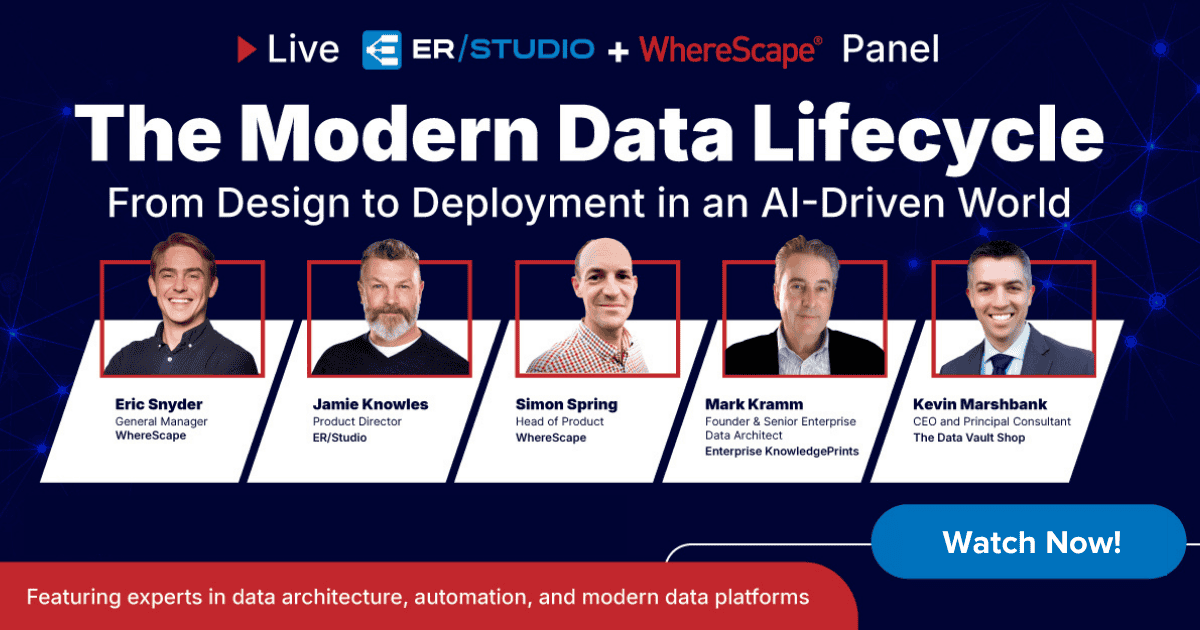
In this expert panel discussion, leaders from ER/Studio and WhereScape break down what a modern data lifecycle looks like in practice, and how to connect data modeling, engineering, and governance into a unified, scalable foundation.
Access the full panel discussion
Data architects, data engineers, governance leaders, and analytics professionals responsible for building or evolving modern data platforms.
Moderator
Eric Snyder — GM, WhereScape | Former GM, ER/Studio
Panelists
Simon Spring — Head of Product, WhereScape
Jamie Knowles — Head of Product, ER/Studio
Mark Kramm — Founder & Senior Enterprise Data Architect, Enterprise KnowledgePrints
Kevin Marshbank — CEO & Principal Consultant, The Data Vault Shop
A modern data lifecycle connects data modeling, engineering, governance, and analytics into a continuous, adaptable process that supports AI, real-time analytics, and evolving business needs.
They rely on disconnected workflows and rigid architectures that cannot adapt to rapid change, increasing data complexity, and AI-driven requirements.
Data modeling provides structure, consistency, and shared definitions—critical for ensuring data quality, governance, and reliable AI outcomes.
A semantic backbone creates shared definitions and models across systems, improving consistency for analytics, governance, and AI use cases.
Yes. Many organizations evolve incrementally using metadata-driven approaches, automation, and strong modeling foundations.
Connect with our team to explore how ER/Studio supports data modeling, governance, and modernization initiatives.




