
Artificial intelligence and advanced analytics promise faster insights, smarter decisions, and competitive advantage. Organizations invest heavily in cloud platforms, machine learning tools, data science talent, and visualization technologies to unlock that value. Yet many AI and analytics initiatives fail long before they deliver meaningful results. Models perform inconsistently. Metrics conflict across dashboards. Predictions degrade over time. Stakeholders lose confidence and projects stall.
When these failures occur, they are often blamed on data quality, tooling limitations, or immature processes. While those factors play a role, they rarely explain the full picture. The more fundamental issue is structural. AI and analytics break first in environments where data models are missing, incomplete, or disconnected from reality.
Data modeling provides the structural foundation that intelligence systems depend on. Without it, even the most advanced analytics stack is built on assumptions rather than understanding.
One of the most persistent myths in modern data programs is that volume alone leads to insight. Organizations accumulate massive amounts of data, believing that scale will compensate for ambiguity. In practice, more data often amplifies confusion.
Analytics and AI systems depend on consistency. They assume that fields mean the same thing across sources, that relationships are stable, and that transformations follow known rules. When these assumptions are violated, results become unreliable.
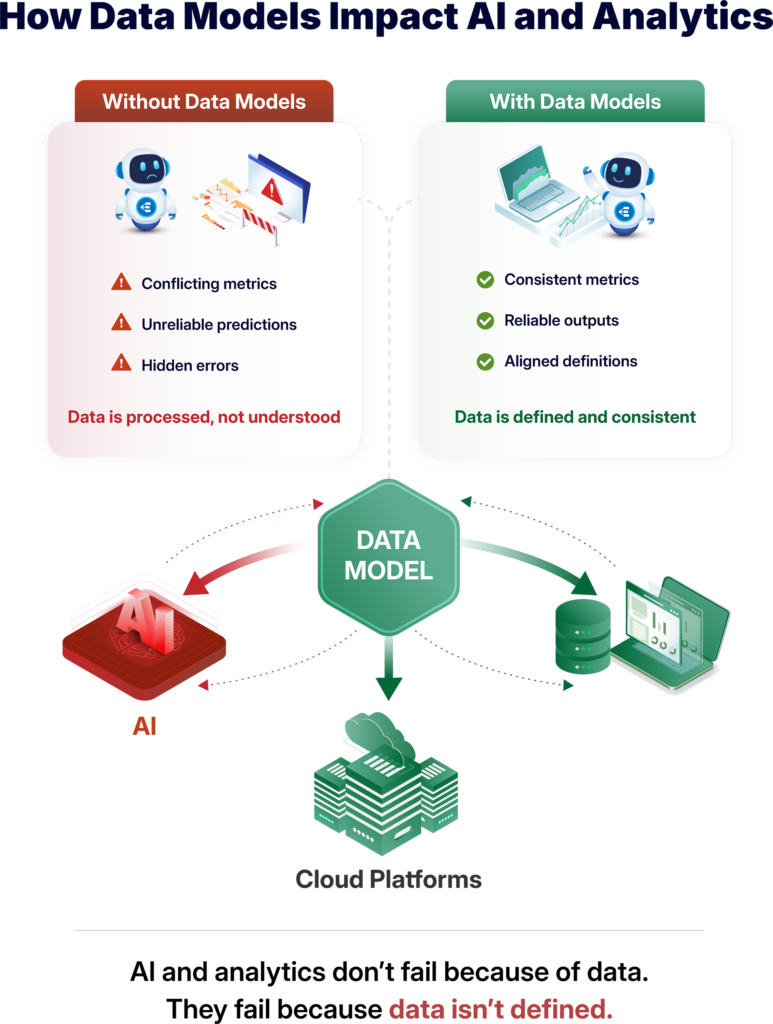
Without data models, teams lack a shared understanding of what data represents. Definitions vary across domains. The same metric is calculated differently by different teams. AI models trained on inconsistent inputs produce inconsistent outputs. More data simply means more noise.
“A lot of the game of AI today is finding the appropriate business context.”
– Andrew Ng, Founder of Google Brain
Analytics succeeds or fails on trust. Business leaders rely on dashboards to make decisions. Analysts rely on data to tell a coherent story. When reports disagree, trust erodes quickly.
Structural ambiguity is a major cause of this breakdown. When data models are absent, teams do not have a single, authoritative view of entities, relationships, and definitions. Customer may mean one thing in a sales report and something else in a finance dashboard. Revenue may be calculated differently depending on context. Time dimensions may be interpreted inconsistently.
These issues are not easily resolved through visualization or governance tooling alone. They originate in structure. Without models that define how data is organized and how concepts relate, analytics teams are forced to make assumptions. Over time, those assumptions diverge.
AI systems are more sensitive to structural issues than traditional analytics. Machine learning models depend on features derived from raw data. Those features encode assumptions about meaning, relationships, and behavior.
When data models are missing, feature engineering becomes guesswork. Data scientists may not fully understand how fields are populated, how values change over time, or how transformations affect interpretation. A small schema change can have a disproportionate impact on model performance.
In many organizations, AI models perform well during experimentation but degrade in production. This is often attributed to concept drift or changing behavior. In reality, structural drift plays a significant role. When data structures evolve without corresponding updates to models and features, predictions become unreliable.
Data modeling makes structure explicit, reducing the likelihood of silent failure.
Feature engineering exposes one of the earliest points where structural ambiguity can destabilize AI systems, but it is not the last. When poorly understood data structures feed feature pipelines, the consequences extend beyond brittle models or degraded performance. They introduce a more insidious risk that many organizations underestimate, AI hallucination.
In enterprise contexts, hallucination is not limited to generative text models producing fabricated responses. It appears whenever an AI system produces outputs that are statistically plausible but semantically incorrect. These failures are especially dangerous because they do not look like failures at all. They look like confident answers.
AI systems do not pause when they encounter ambiguity. They do not raise their hand and admit that definitions conflict or relationships are unclear. When data lacks consistent structure, the system fills the gaps through inference. The result is an answer that appears complete, credible, and actionable, even when it is wrong.
This behavior is not a flaw in AI design. It is a predictable outcome of feeding intelligence systems data that lacks explicit meaning.
AI models are optimized to produce outputs, not to validate the business semantics of their inputs. When a dataset contains fields that look similar but represent different concepts across sources, or when relationships are implied rather than defined, the model still generates results. It has no structural signal to tell it that something is wrong.
In environments without strong data models, AI systems cannot distinguish between authoritative data and coincidental correlation. A value may be statistically consistent while representing different business realities. A relationship may appear stable while masking different lifecycle rules. Without models, the system has no way to detect these inconsistencies.
As a result, hallucinations emerge not as obvious errors, but as confident conclusions built on flawed assumptions. These are far more damaging than visible failures because they quietly erode trust over time.
When organizations encounter hallucination risk, they often respond by adding validation layers, approval workflows, or governance controls. These measures are important, but they address symptoms rather than causes.
Validation rules check whether values fall within expected ranges. Governance policies regulate who can access data and how it may be used. Neither defines what the data actually means or how concepts relate across systems.
Without data models, validation rules are built on assumptions that may already be inconsistent. Governance enforces usage without resolving ambiguity. AI systems continue to operate on data that lacks clear structure, meaning hallucination risk remains.
Sound structure must precede control.
Data modeling reduces hallucination risk by making structure explicit and durable. Models define entities, relationships, constraints, and intended usage in a way that aligns data producers, consumers, and automated systems around the same understanding.
When data is modeled correctly, feature pipelines draw from well defined sources. Relationships are intentional rather than inferred. Definitions remain consistent across domains. This limits the degrees of freedom AI systems have to invent meaning where none exists.
In practical terms, this leads to more stable training data, more reliable features in production, and outputs that reflect business reality rather than statistical coincidence.
No AI system is perfect, and errors will always occur. The difference between manageable error and dangerous hallucination is whether the system operates within well defined boundaries.
Structured, modeled data creates those boundaries. When assumptions are explicit, teams can recognize when outputs deviate from expectations. When dependencies are documented, changes can be assessed before they affect AI behavior. When definitions are consistent, issues can be traced and corrected quickly.
Data modeling does not eliminate AI risk. It transforms AI risk from hidden and compounding into visible and manageable.
Organizations often talk about AI readiness in terms of platforms, talent, and tooling. In reality, readiness depends on whether intelligence systems are built on data that has clear meaning and stable structure.
AI systems will never admit uncertainty. They will always produce an answer. Data modeling ensures that answer is grounded in structure rather than assumption.
This is why AI readiness starts with architecture, not algorithms.
AI readiness is often framed as a question of tooling, talent, or data volume. In practice, it is an architectural challenge. Organizations that invest in data modeling early create a stable foundation for advanced analytics.
Data models ensure consistent definitions, document dependencies, and support impact analysis. They enable teams to understand how changes affect AI systems before those changes are deployed.
ER Studio supports AI readiness by connecting data models to analytics and governance platforms. It ensures that intelligence systems are built on trusted structure rather than assumptions.
When AI and analytics fail, the cost is not limited to wasted investment. Trust is damaged. Decision making slows. Teams become skeptical of data driven initiatives.
These outcomes are often attributed to culture or change management issues. In reality, they are symptoms of structural neglect. Without data models, intelligence systems cannot scale reliably.
AI and analytics are not one time projects. They are ongoing capabilities that must evolve with the organization. Data modeling provides the continuity required for that evolution.
Organizations that treat modeling as optional documentation will continue to struggle with brittle intelligence systems. Those that treat it as foundational architecture will build analytics and AI that endure.
Data modeling does not replace analytics or AI tooling. It makes them reliable.
Build AI on defined data. Schedule your ER/Studio demo today.
AI and analytics systems depend on consistent structure and meaning. When data models are missing, definitions vary across systems, relationships are unclear, and transformations encode different assumptions. This leads to conflicting metrics, unreliable outputs, and a breakdown in trust.
More data does not resolve ambiguity. When definitions and relationships are inconsistent, additional data increases noise rather than accuracy. AI systems assume consistency, and without it, larger datasets amplify errors.
AI systems rely on features derived from data, which depend on stable definitions and relationships. Without data models, feature engineering becomes inconsistent, making models fragile and more likely to degrade in production.
AI hallucinations occur when systems generate outputs that appear valid but are based on inconsistent or ambiguous data. Without defined structure and meaning, AI fills in gaps through inference, producing confident but incorrect results.
ER/Studio provides a structured data modeling layer that defines entities, relationships, and business rules across systems. By establishing consistent meaning at the source, it ensures that analytics and AI systems are built on stable, aligned data, reducing risk and improving trust in results.




