
Few professions have been subjected to more speculation during the AI boom than data modeling.
As large language models demonstrate an impressive ability to generate SQL, create database schemas, write code, summarize documentation, and answer technical questions, many organizations have started asking whether data modelers will eventually become unnecessary.
On the surface, the question seems reasonable.
If AI can generate tables, relationships, attributes, and even entire database structures from a prompt, why would organizations continue investing in data modeling expertise?
The short answer is that AI can automate portions of data modeling, but it cannot replace the fundamental responsibility of understanding, defining, and governing business meaning.
In fact, as organizations become more dependent on AI, the need for strong data modeling practices may actually increase.
The reason is simple. Data modeling is not primarily a documentation exercise. It is not simply drawing entities and relationships on a diagram. At its core, data modeling is the process of creating a shared understanding of how a business operates.
AI can generate structures.
It cannot determine what those structures should mean.
That distinction is likely to define the future of the profession.
Predictions about the death of data modeling are not new.
Over the past several decades, similar claims have accompanied nearly every major technology shift.
When relational databases became mainstream, some predicted that sophisticated modeling would no longer be necessary.
When data warehouses emerged, others argued that dimensional modeling would replace traditional modeling disciplines.
The rise of NoSQL platforms produced another round of predictions suggesting that flexible schemas would eliminate the need for formal data design.
More recently, cloud-native platforms and low-code development tools generated similar conversations.
Yet data modeling never disappeared.
The reason is that technology changes do not eliminate the need for business understanding.
Organizations still need to answer questions such as:
These are not technical questions.
They are business questions.
Technology can change how data is stored and processed, but it does not eliminate the need to define meaning.
The discussion becomes more productive when we separate the activities associated with data modeling from the discipline itself.
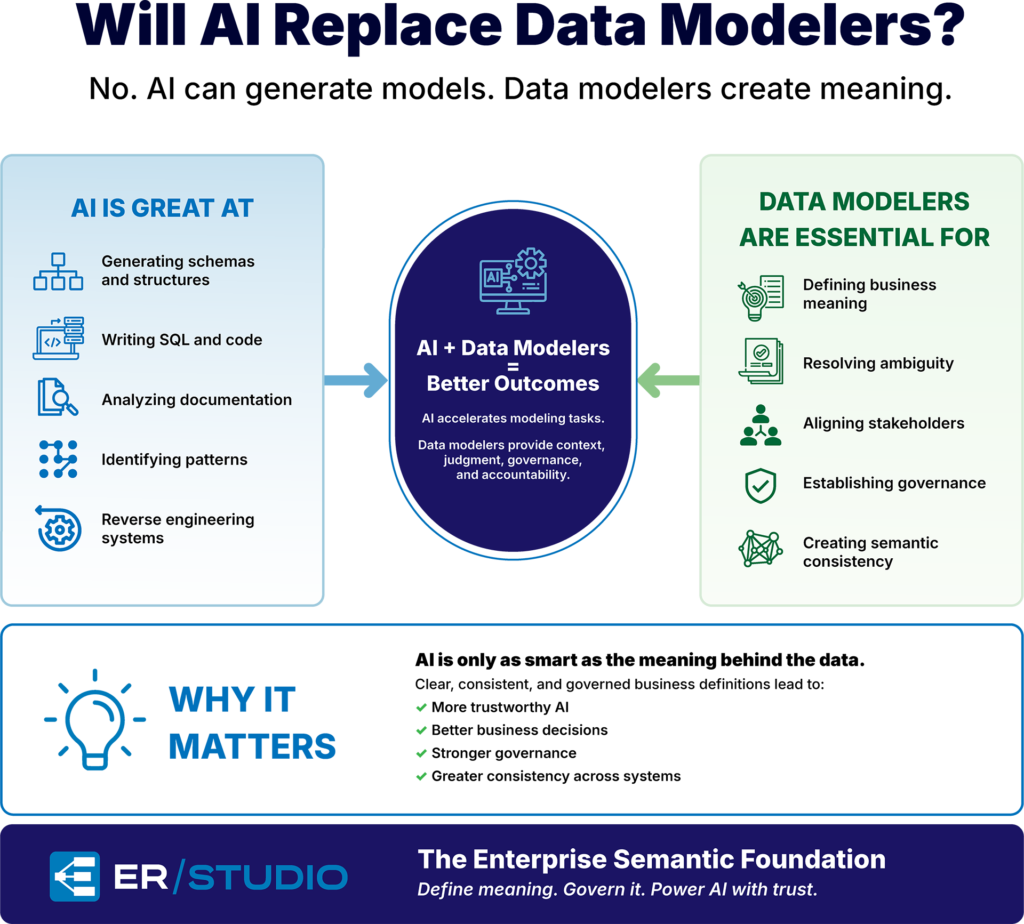
AI is becoming increasingly capable of automating many modeling-related tasks.
For example, AI can:
These capabilities are valuable.
In fact, they have the potential to make data modelers significantly more productive.
Much like modern development tools help software engineers write code faster, AI can help data modelers perform routine activities more efficiently.
The mistake is assuming that because AI can assist with modeling tasks, it can replace the role entirely.
Generating a model is not the same as validating a model.
And validating a model is where much of the real value exists.
One of the biggest misconceptions about data modeling is that the primary deliverable is a diagram.
The diagram is important, but it is not the real outcome.
The real outcome is alignment.
Experienced data modelers spend a significant portion of their time identifying inconsistencies, exposing assumptions, and helping stakeholders reach agreement on business concepts.
Consider a company attempting to standardize product information across ecommerce, manufacturing, finance, and supply chain systems.
At first glance, creating a product entity seems straightforward.
Then the conversations begin.
Does a bundled offering count as a product?
What about service packages?
Can a product exist before it becomes available for sale?
How should discontinued products be handled?
Do regional variations represent separate products or attributes of a single product?
These discussions are often where projects uncover their most important insights.
The challenge is not drawing the entity.
The challenge is helping the organization agree on what the entity represents.
AI can facilitate these conversations. It can summarize discussions, propose alternatives, and generate candidate models.
What it cannot do is determine which interpretation aligns with the organization’s business objectives.
That requires human judgment.
One of the most interesting developments in the AI era is that organizations are becoming more dependent on consistent business meaning, not less.
Before AI, inconsistencies could remain hidden within departments, applications, and reports.
Marketing might define a concept differently than finance. Operations might use different terminology than product teams. These differences created friction, but they were often manageable because systems operated independently.
Large language models are increasingly expected to answer questions across multiple systems simultaneously. Employees ask questions in natural language and expect a single, trustworthy answer.
That expectation creates pressure on organizations to establish semantic consistency.
If different systems define the same concept differently, AI cannot magically resolve those conflicts. Instead, it often exposes them.
In many cases, AI acts as a spotlight that reveals semantic problems that have existed for years.
As a result, organizations are rediscovering the importance of logical data modeling, enterprise semantics, governance, and business architecture.
Far from making these disciplines obsolete, AI is making them more visible.
While AI is unlikely to eliminate data modeling, it will almost certainly change how data modelers work.
The future data modeler will spend less time on manual documentation and more time on activities that require business understanding.
Rather than drawing every entity by hand, modelers may increasingly use AI-generated starting points. Instead of spending hours creating physical schemas, they may focus on validating business concepts and ensuring consistency across domains.
The profession may evolve from being heavily documentation-focused to being more centered on semantic architecture.
This shift is already beginning.
Organizations are increasingly concerned with questions such as:
These challenges are closely aligned with the strengths of experienced data modelers.
The ability to understand business meaning, identify inconsistencies, and create shared understanding may become even more valuable as AI adoption accelerates.
The bigger risk may actually be organizations attempting to use AI without data modeling.
Many AI initiatives begin with the assumption that large language models can compensate for weaknesses in the underlying data environment.
Unfortunately, that assumption rarely holds up in practice.
AI systems inherit the quality, consistency, and meaning of the information they consume.
If business definitions are inconsistent, AI outputs often become inconsistent.
If relationships between entities are unclear, AI reasoning becomes less reliable.
If governance is fragmented, trust in AI outcomes becomes difficult to maintain.
These are not AI problems.
They are architecture problems.
Data modeling remains one of the most effective ways to address them because it creates a shared understanding of business concepts before those concepts become embedded in databases, reports, applications, and AI systems.
Organizations that neglect this foundation often discover that AI exposes complexity faster than it resolves it.
The most likely future is not AI versus data modelers.
It is AI-enabled data modelers.
Just as modern software developers use AI coding assistants without becoming obsolete, data modelers will increasingly use AI to automate repetitive work while focusing on higher-value activities.
The combination is powerful.
AI can accelerate modeling tasks, generate alternatives, analyze documentation, and identify potential issues.
Human modelers provide context, judgment, governance, business understanding, and accountability.
Together, they can create stronger outcomes than either could independently.
Organizations that embrace this partnership will likely move faster while maintaining the consistency and trust required for long-term success.
As AI becomes embedded throughout the enterprise, the importance of enterprise-wide business understanding continues to grow.
This is one reason enterprise logical data models are receiving renewed attention.
Enterprise models help establish common definitions, relationships, identifiers, and business rules that can be shared across systems, governance programs, analytics environments, and AI initiatives.
They provide the semantic foundation that helps organizations reduce ambiguity and improve consistency.
In many ways, the future of AI depends on the same thing the future of data modeling has always depended on: creating a clear understanding of how the business actually works.
Technology may evolve rapidly.
Business meaning still matters.
ER/Studio helps organizations create and maintain the logical, physical, and enterprise data models that provide structure and meaning across the enterprise. By connecting architecture, governance, metadata, and business definitions, ER/Studio helps teams establish the semantic foundation needed for analytics, modernization, and AI initiatives.
As AI continues to automate technical tasks, the ability to define, govern, and manage business meaning becomes even more important. ER/Studio helps organizations ensure that meaning remains consistent, trusted, and ready to support the next generation of AI-driven applications.
See how ER/Studio helps organizations define, govern, and scale trusted business meaning. Start your free trial today.
Yes. AI can already generate schemas, suggest relationships, create SQL scripts, analyze documentation, and accelerate many routine modeling activities. These capabilities will likely continue improving.
No. Data modeling involves resolving ambiguity, defining business concepts, facilitating stakeholder alignment, and establishing governance. These responsibilities require human judgment and business understanding.
Manual documentation, schema generation, and repetitive modeling activities are likely to become increasingly automated. Data modelers will spend more time on semantic architecture, governance, and business alignment.
AI systems depend on consistent business definitions, relationships, and context. Data modeling helps create the semantic foundation that improves AI accuracy, reliability, and trustworthiness.
ER/Studio helps organizations create enterprise logical data models, standardize business definitions, document relationships, and align architecture with governance. These capabilities help establish the trusted semantic foundation required for successful AI adoption.