ER/Studio logo
ER/Studio logo

Building Semantic Foundations for AI

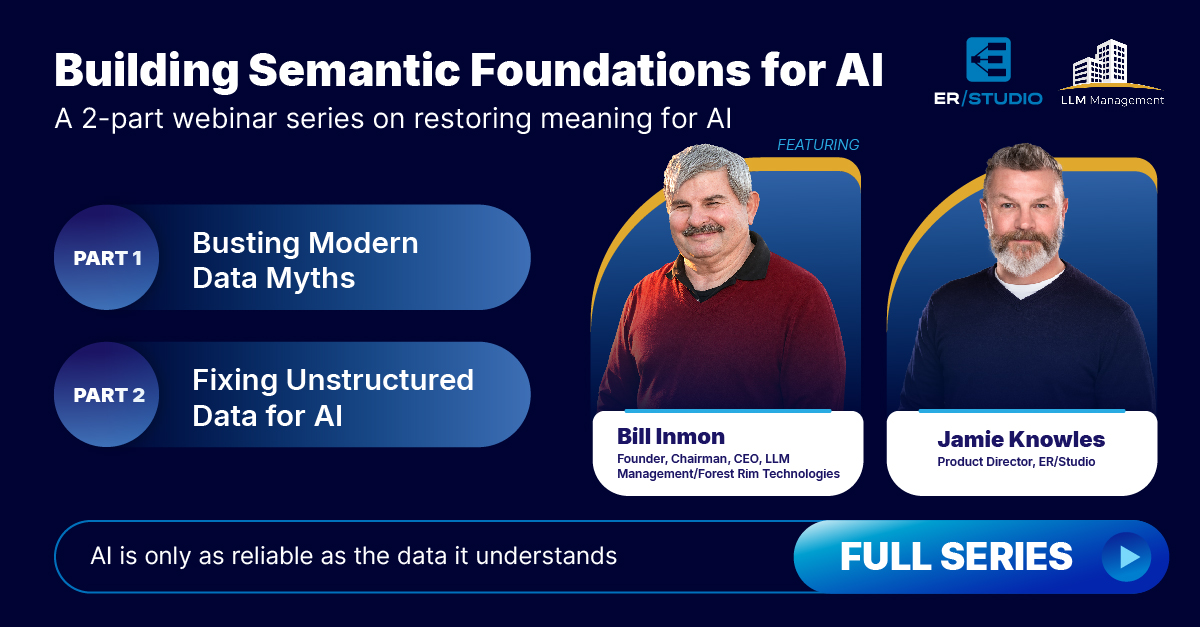
Watch the full 2-part on-demand series with Bill Inmon and Jamie Knowles and learn how to restore meaning, consistency, and trust across modern data environments.

Build a Data Foundation AI Can Trust

Modern data platforms have made it easier to move, transform, and scale data. But as organizations accelerate analytics and AI initiatives, one challenge becomes harder to ignore: data meaning often breaks down across systems.

Definitions drift. Context gets buried in pipelines. Metrics become inconsistent across dashboards, teams, and AI use cases.

This 2-part on-demand series explores why semantic consistency matters in modern data architecture and how organizations can rebuild a stronger foundation for analytics, governance, and AI.
Led by Bill Inmon, widely recognized as the father of data warehousing, and Jamie Knowles, Product Director at ER/Studio, the series combines foundational data architecture principles with practical approaches for today’s AI-driven data environments.
  • Understand why modern data strategies often create semantic drift
  • Identify where inconsistent meaning breaks trust in analytics and AI
  • Learn why AI amplifies poor data foundations instead of fixing them
  • Explore how structured, semi-structured, and unstructured data can align to a shared semantic model
  • Build a stronger foundation for reliable AI outcomes
Learn From Bill Inmon and ER/Studio

The Building Semantic Foundations for AI Webinar Series

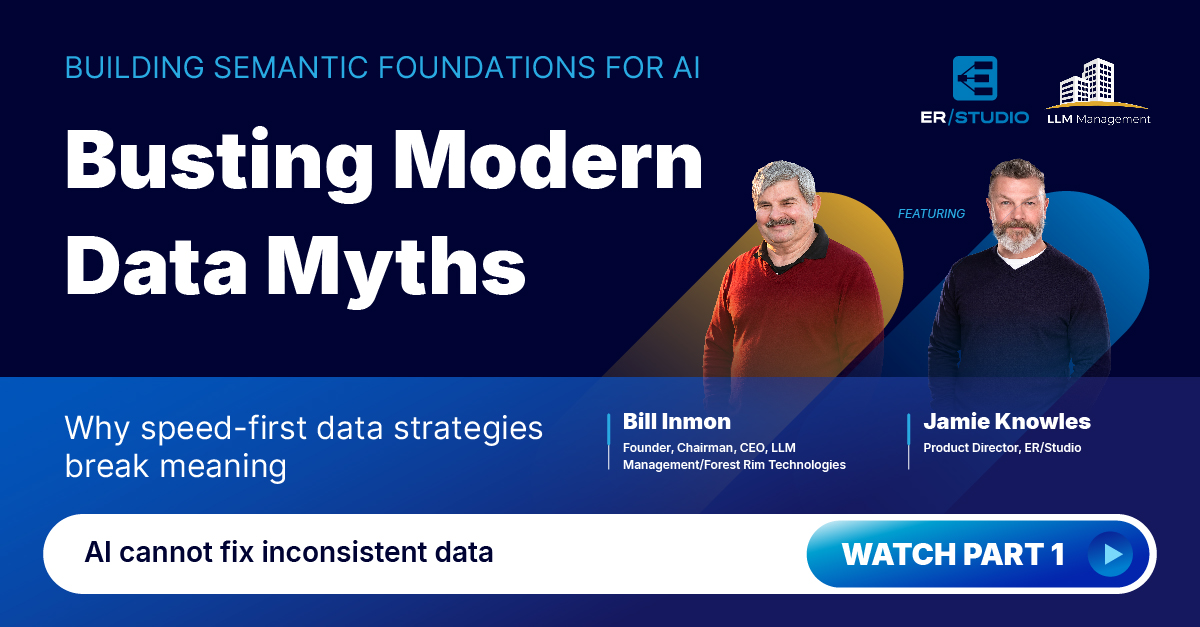
Part 1

Busting Modern Data Myths

Busting Modern Data Myths

Focus: Why pipeline-first strategies break meaning

Modern data approaches often prioritize speed, scalability, and delivery. But when shared meaning is handled downstream, semantic drift becomes harder to control.

In Part 1, Bill Inmon and Jamie Knowles examine common assumptions shaping modern data strategy and explain why AI makes inconsistent definitions more visible and more costly.

You’ll learn how to:
  • Identify where semantic drift begins
  • Understand why AI amplifies inconsistency
  • Challenge common pipeline-first assumptions
  • Restore shared meaning through stronger data modeling
Part 2

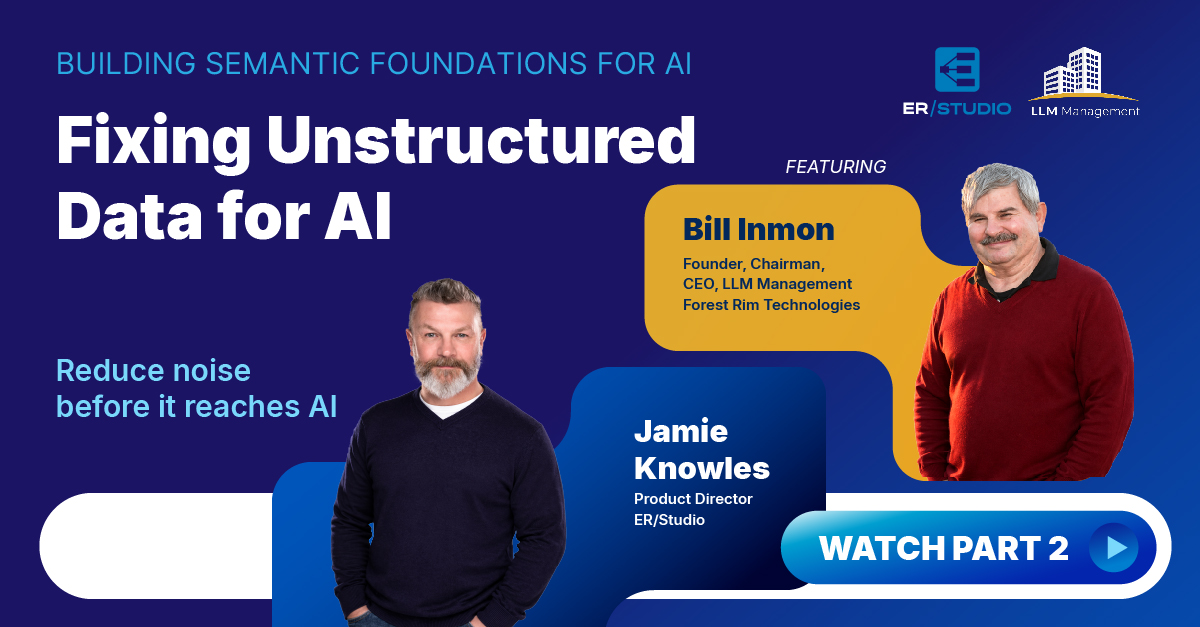
Why Unstructured Data Fails AI and How to Fix It

Busting Modern Data Myths

Focus: Preparing unstructured data for reliable AI

Unstructured data contains valuable business information, but pushing raw documents directly into AI systems introduces noise, increases cost, and reduces reliability.

In Part 2, Bill Inmon introduces Textual ETL, a deterministic approach to extracting meaning from unstructured data and aligning it to a shared semantic model.

You’ll learn how to:

  • Understand what Textual ETL is and how it works
  • Extract signal from large volumes of text
  • Reduce noise before data reaches AI systems
  • Align unstructured data to a semantic foundation

Who Should Watch

Data architects, data engineers, data modelers, governance leaders, analytics leaders, and AI stakeholders responsible for building, managing, or modernizing data environments.

Speakers

Bill Inmon

Bill Inmon

Founder, Chairman, CEO, LLM Management/Forest Rim Technologies. Widely recognized as the father of data warehousing
Jamie Knowles- ER/Studio

Jamie Knowles

Product Director, ER/Studio

Why It Matters

AI and analytics are only as reliable as the data they depend on.

Without a consistent semantic foundation:

  • Data definitions vary across systems
  • Analytics become harder to trust
  • AI outputs become inconsistent
  • Governance becomes harder to scale
  • Teams spend more time reconciling meaning than using data

This series shows how to address these challenges by aligning data meaning across your architecture.

Build a Stronger Foundation for Analytics and AI

Watch the full series to learn how to reduce semantic drift, align meaning across systems, and prepare structured and unstructured data for more reliable AI outcomes.
Learn About ER/Studio

ER/Studio Helps Teams Align Data Meaning Across the Enterprise

ER/Studio supports data teams working to improve consistency, governance, and collaboration across complex data environments.

  • Enterprise data modeling and metadata management
  • Support for modern, hybrid, and federated architectures
  • Integration with governance platforms like Collibra and Microsoft Purview
  • A shared foundation for aligning technical models with business meaning
Data Governance Tools
Copyright © 2026 Idera, Inc.