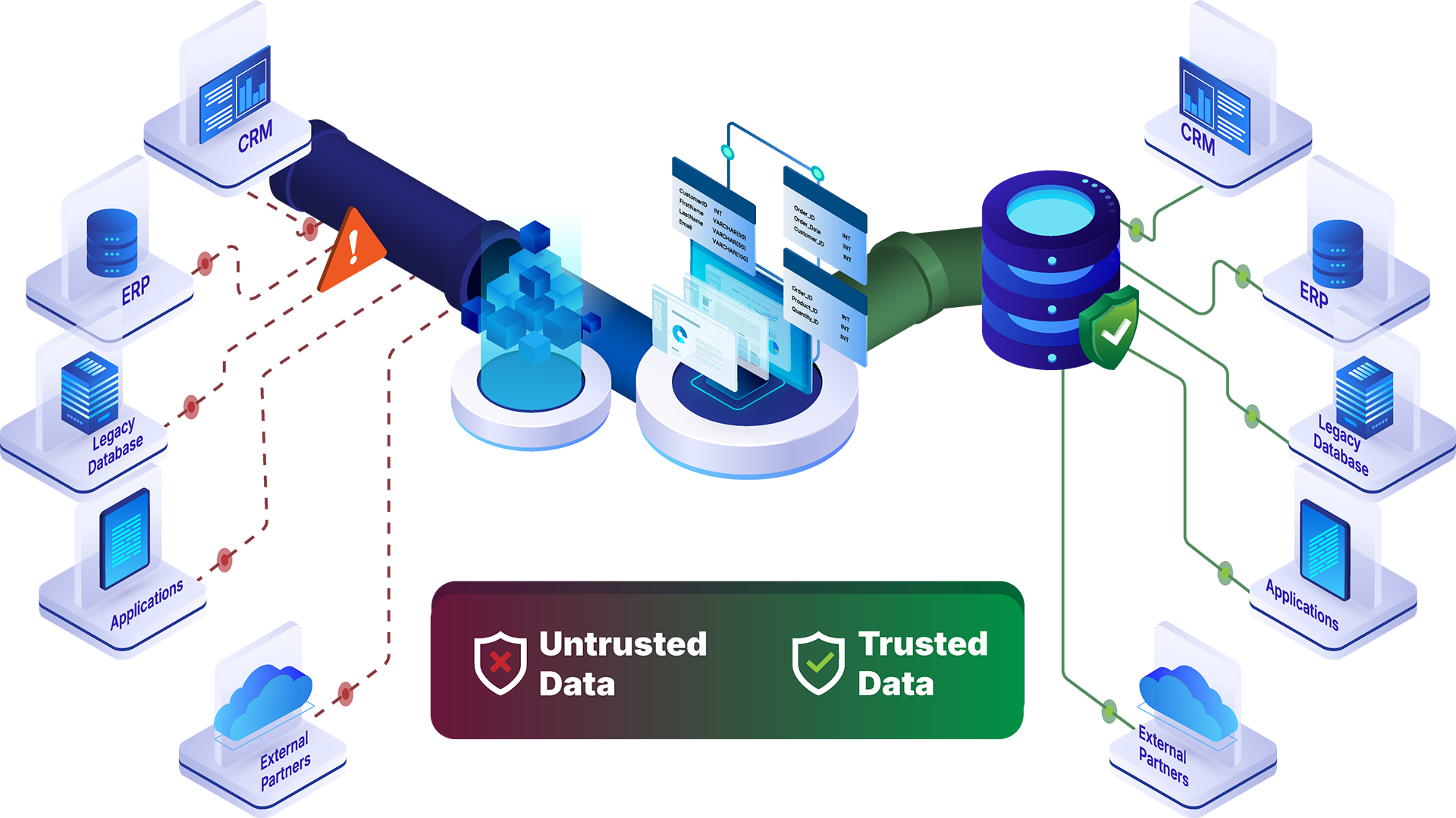
Organizations are moving more data than at any point in history. Cloud adoption, analytics initiatives, regulatory demands, and AI-driven use cases all depend on one core capability. Data must be available in the right place, in the right format, at the right time.
This is the role of data movement.
At a surface level, data movement sounds straightforward. It is often described as the process of transferring data from one system to another so that it can be used elsewhere. However, in modern enterprise environments, that definition hides a much deeper challenge. Data is not simply copied and pasted across systems. It is transformed, interpreted, and recontextualized at every step.
Many organizations invest heavily in pipelines, integration tools, and infrastructure to support this process. Yet despite those investments, data movement initiatives frequently fall short. Data arrives late, arrives incomplete, or arrives in a form that cannot be trusted. The root cause is rarely the movement mechanism itself.
The real issue is a lack of understanding of the data being moved.
This is where data modeling becomes essential. Not as an afterthought, but as a foundational step that determines whether data movement succeeds or fails.
Data movement refers to the process of transferring data between systems, platforms, or environments. This can include movement between on premises systems and cloud platforms, between operational databases and analytics platforms, or between internal systems and external partners.
The goal remains consistent. Data must be accessible where it is needed to support business operations, reporting, and decision making.
However, as data ecosystems have evolved, so has the complexity of this process. Organizations now operate across hybrid and multi cloud environments. Data exists in relational databases, NoSQL systems, data lakes, and streaming platforms. Different systems store and interpret data in different ways.
Even when the same business concept is represented across systems, the underlying structure, format, and meaning may differ. A customer record in a CRM system may not align cleanly with a customer entity in a billing system or an analytics platform.
Several forces are driving increased investment in data movement.
First, organizations are modernizing their technology stacks. Legacy systems are being replaced or augmented with cloud platforms that offer greater scalability and flexibility. Data must be migrated and continuously synchronized between old and new environments.
Second, data volumes continue to grow at an accelerating pace. Organizations are collecting more data from more sources, including applications, devices, and external partners. This creates pressure to move data into systems that can handle larger scale storage and processing.
Third, advanced analytics and AI initiatives require access to integrated and high quality data. Data must be aggregated from multiple sources and made available for analysis in near real time.
Finally, operational systems increasingly depend on shared data. Business processes such as customer engagement, fraud detection, and supply chain management rely on timely and consistent data across systems.
These drivers make data movement unavoidable. However, they also increase the consequences of getting it wrong.
Organizations use a range of techniques to move data, each suited to different requirements.
ETL, or extract transform load, has been a foundational approach for decades. Data is extracted from a source system, transformed into the required format, and then loaded into a target system. This approach provides control over transformation but can introduce latency and resource constraints.
ELT, or extract load transform, shifts the transformation step to the target environment. Data is first loaded into a destination system and then transformed. This approach is often used in cloud environments where scalable compute resources are available.
Change data capture focuses on moving only the data that has changed since the last update. This reduces overhead and supports more timely updates, especially in systems that require near real time data.
Data synchronization goes a step further by keeping systems aligned as changes occur. This is critical in scenarios where delays can impact business operations, such as financial transactions or inventory management.
Replication creates full or partial copies of data for purposes such as backup, disaster recovery, or high availability.
Each of these methods addresses how data is moved. None of them address whether the data being moved is understood, consistent, or usable.
The most common failure in data movement is not technical. It is conceptual.
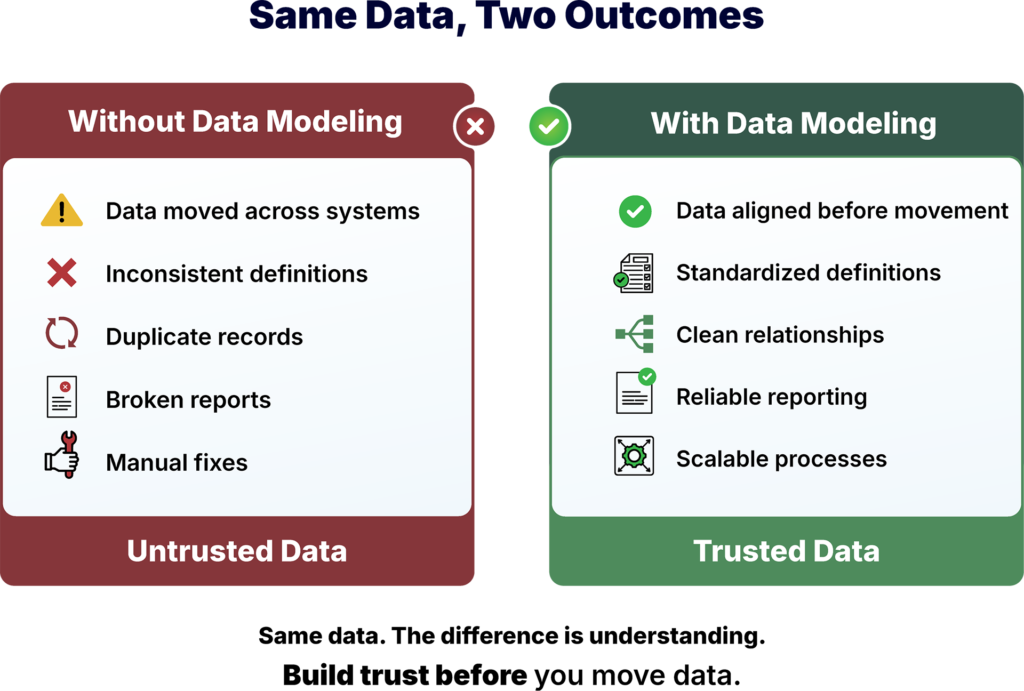
Organizations often move data without fully understanding its structure, meaning, and usage. This leads to a range of issues that surface during or after movement.
Data types may not align between systems. A numeric field in one system may not map cleanly to a corresponding field in another. This can result in loss of precision or failed transformations.
Data definitions may differ. A field labeled as customer status in one system may represent something different in another. Without alignment, combining these datasets produces misleading results.
Duplicate or conflicting records may emerge. When the same entity is represented differently across systems, movement can create inconsistencies that are difficult to reconcile.
Data lineage may be lost. As data moves and is transformed, it becomes difficult to trace its origin and understand how it has changed. This undermines trust and complicates compliance.
Data modeling provides a structured way to define and understand data. It represents data entities, attributes, and relationships in a way that can be shared across business and technical teams.
At its core, data modeling answers fundamental questions. What data exists? How is it structured? What does it mean? How is it related?
By answering these questions, data modeling establishes a common language for data across the organization.
When applied to data movement, this foundation becomes critical.
Before data is moved, modeling allows teams to identify inconsistencies and resolve them. It enables the design of transformations that preserve meaning and accuracy. It provides a framework for tracking lineage and ensuring compliance.
Without data modeling, data movement becomes a process of trial and error. With it, data movement becomes a controlled and predictable process.
Data quality is one of the most visible challenges in data movement. Poor quality data leads to incorrect insights, operational errors, and loss of trust.
Data modeling helps address quality issues at their source.
By defining data structures and constraints, models ensure that data conforms to expected formats and values. They highlight discrepancies between systems, such as different representations of the same attribute.
They also enable the identification of missing or inconsistent data. For example, if one system allows null values for a critical field while another requires it, this inconsistency can be resolved before movement.
This proactive approach reduces the need for downstream corrections and improves the reliability of data.
Different systems often store data in different formats. A single concept may be represented using different data types, lengths, or structures.
Data modeling provides a way to map these differences and design appropriate transformations.
For example, a numeric identifier in one system may need to be converted to a string in another. A composite field may need to be split into multiple attributes. Without a model, these transformations are discovered late and implemented inconsistently.
With a model, they are defined upfront and applied consistently across all movement processes.
This reduces errors and ensures that data retains its intended meaning.
As data moves across systems, it is transformed and enriched. Understanding where data comes from and how it has changed is essential for both operational and regulatory reasons.
Data modeling supports lineage by documenting the relationships between data elements and systems. It provides a blueprint that can be used to trace data from its origin to its destination.
This is particularly important in regulated industries where organizations must demonstrate the accuracy and integrity of their data.
Without lineage, it becomes difficult to explain how data was derived or to identify the source of errors. With lineage, organizations gain transparency and control.
One of the most challenging aspects of data movement is semantic alignment. Different teams and systems may use the same terms to mean different things.
Data modeling forces organizations to define these terms clearly.
For example, the concept of a customer may vary depending on context. In one system, it may refer to an individual. In another, it may refer to an organization. In a third, it may include both.
Without clear definitions, combining these datasets leads to confusion and incorrect conclusions.
Data modeling establishes a shared understanding of these concepts, ensuring that data retains its meaning as it moves across systems.
Data governance is closely tied to data movement. As data is transferred between systems, it must be protected, controlled, and used appropriately.
Data modeling supports governance by identifying sensitive data and defining how it should be handled. It enables organizations to classify data and apply policies that control access and usage.
This is particularly important for personally identifiable information and other regulated data types.
By integrating modeling and governance, organizations can ensure that data movement complies with internal policies and external regulations.
ER/Studio provides a comprehensive platform for data modeling that supports modern data movement initiatives.
It enables organizations to visualize their data environments and understand how data is structured across systems. This visibility is essential for identifying risks and designing effective movement strategies.
ER/Studio supports reverse engineering of existing systems, allowing teams to capture current data structures and incorporate them into models. This helps bridge the gap between legacy and modern environments.
It also facilitates collaboration between business and technical stakeholders. By providing a shared view of data, it ensures that definitions and requirements are aligned before movement begins.
In addition, ER/Studio supports governance by enabling the identification and classification of sensitive data. This helps organizations enforce policies and maintain compliance as data moves across systems.
By integrating modeling into the data movement process, ER/Studio helps organizations move from reactive problem solving to proactive design.
Successful data movement requires more than the right tools. It requires a disciplined approach that starts with understanding.
Organizations should begin by developing a comprehensive data model that captures the structure and meaning of their data. This model should be used to guide all movement activities.
They should standardize definitions across systems to ensure consistency. This includes aligning data types, formats, and business meanings.
Transformations should be defined and tested before implementation. This reduces the risk of errors and ensures that data remains accurate.
Lineage should be tracked throughout the process to maintain visibility and support compliance.
Finally, governance should be integrated into every stage of data movement. This ensures that data is protected and used appropriately.
Data movement is a critical capability for modern organizations. It enables the integration, analysis, and use of data across increasingly complex environments.
However, data movement is not simply a technical process. It is fundamentally about understanding data.
Organizations that focus only on pipelines and infrastructure will continue to encounter issues with quality, consistency, and trust.
Those that start with data modeling build a foundation that supports accurate, reliable, and scalable data movement.
Data modeling is not an optional step. It is the key to ensuring that data arrives not just where it is needed, but in a form that can be trusted and used.
With ER/Studio, organizations can make data modeling a central part of their data strategy and unlock the full value of their data movement initiatives.
See how ER/Studio can help you model, understand, and move your data with confidence. Request a demo today.
Data movement is the process of transferring data between systems, platforms, or environments so it can be accessed and used where it is needed. This includes moving data between on premises and cloud systems, operational and analytical platforms, and across different database technologies. The goal is to ensure data is available, accurate, and timely for business operations and decision making.
Data movement projects often fail because organizations focus too heavily on tools and pipelines while overlooking the structure and meaning of the data itself. Common causes of failure include inconsistent data definitions, poor data quality, mismatched data types, and lack of data lineage. Without a clear understanding of the data, movement processes introduce errors that reduce trust and usability.
Data modeling improves data movement by providing a clear definition of data structures, relationships, and business meaning before data is transferred. It helps identify inconsistencies, standardize data definitions, and design accurate transformations. This ensures that data remains consistent and usable as it moves across systems, reducing errors and rework.
ER/Studio helps organizations improve data movement by providing a clear, visual understanding of their data before it is transferred. It enables teams to reverse-engineer existing systems, standardize data definitions, and align structures across platforms. By identifying data quality issues, mapping transformations, and supporting data governance, ER/Studio reduces risk and ensures that data movement initiatives deliver accurate and reliable results.
ETL extracts data from a source, transforms it into the required format, and then loads it into a target system. ELT loads data first and performs transformations within the target environment, which is often more scalable in cloud architectures. Change data capture focuses on moving only the data that has changed, enabling more efficient and near real time updates. Each method addresses how data is moved, but not how it is defined or understood.




