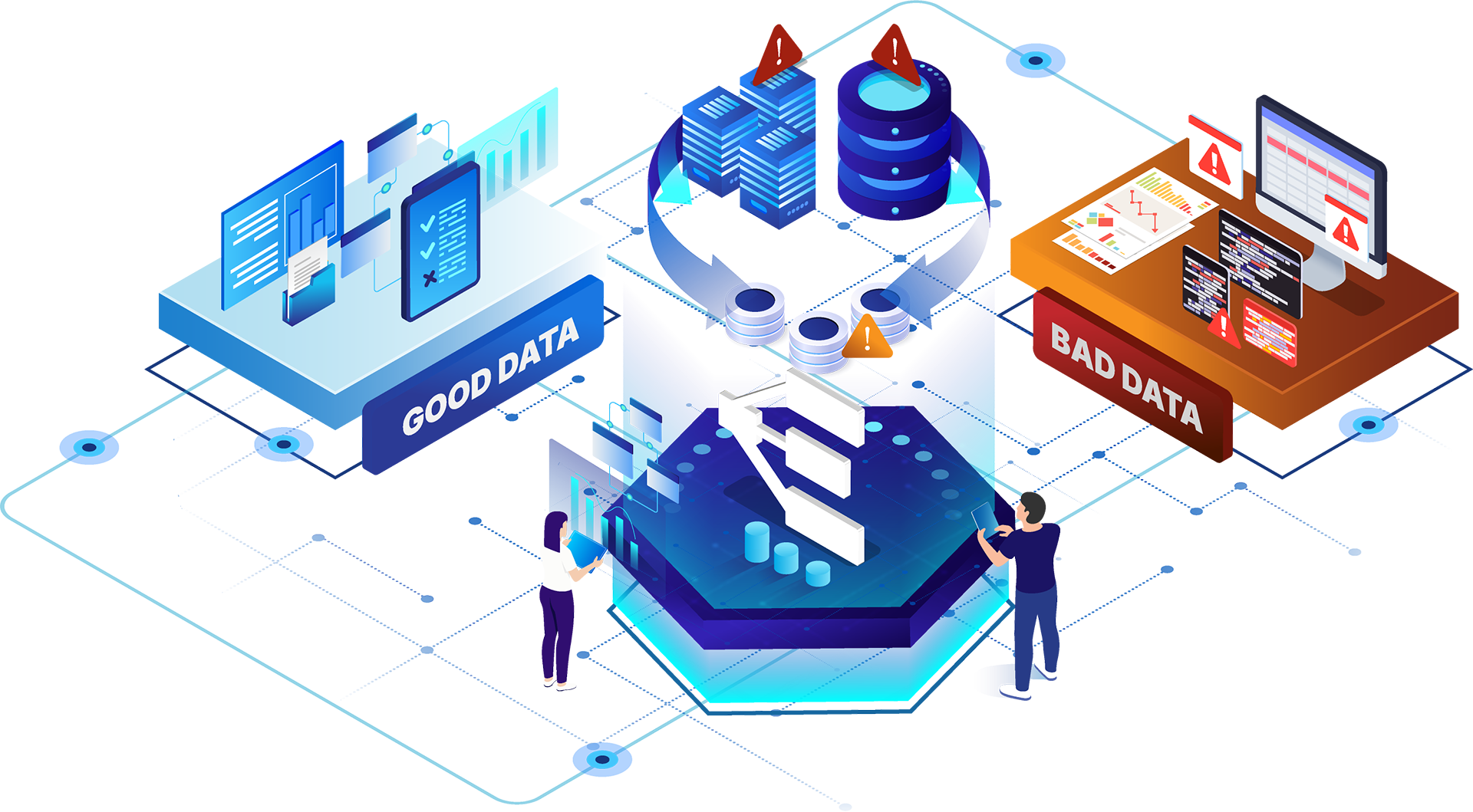
Data quality has become one of the most important challenges facing modern organizations. Companies invest heavily in analytics platforms, artificial intelligence systems, and real time dashboards, yet many still struggle with a fundamental issue. The data powering those systems is often inconsistent, incomplete, or difficult to trust.
Poor data quality affects every part of the business. Analysts spend hours validating datasets before running reports. Engineers struggle to trace errors through complex pipelines. Business leaders make decisions based on numbers that may not reflect reality. In highly regulated industries, poor data quality can even introduce compliance risks.
At the same time, enterprise data environments continue to grow more complex. Data now flows across operational databases, cloud warehouses, application platforms, and machine learning environments. Each system introduces new schemas, new transformations, and new governance requirements.
In this landscape, maintaining high data quality requires more than cleaning datasets after problems appear. Organizations need a structured way to define, document, and govern their data from the beginning.
This is where data modeling platforms such as ER/Studio play a critical role. By providing a unified framework for designing, documenting, and governing data architecture, ER/Studio helps organizations maintain consistent, reliable data across complex environments.
Understanding how this works begins with understanding what data quality really means in modern enterprises.

Data quality is often misunderstood as a simple technical issue. Many people associate it with duplicate records, missing values, or formatting errors. While these problems certainly affect data quality, they represent only a small part of the broader picture.
In practice, data quality reflects whether data is accurate, consistent, complete, and trustworthy enough to support business decisions.
Several characteristics typically define high quality data.
Accuracy means the data reflects real world conditions. If a customer record contains the wrong address or a financial dataset contains incorrect values, the data cannot be trusted.
Consistency means the same data is represented the same way across systems. If one platform stores customer status codes differently from another, reports may produce conflicting results.
Completeness refers to whether required information is present. Missing attributes often make datasets difficult to analyze or integrate.
Traceability ensures organizations understand where data originates and how it flows through systems. Without clear lineage, it becomes difficult to verify whether data remains trustworthy.
These characteristics are not created by accident. They emerge when organizations build strong data architecture and governance practices.
Maintaining data quality has become more difficult as enterprise data ecosystems expand.
In the past, organizations often relied on a handful of relational databases to support their applications and reporting systems. Today, a single enterprise may operate dozens of different data platforms.
Operational systems may run on SQL Server, Oracle, or PostgreSQL. Analytics teams may build warehouses in Snowflake or BigQuery. Application developers might store data in MongoDB or other document databases. Machine learning teams may rely on Databricks lakehouse environments.
Each platform introduces new schemas, new pipelines, and new transformation layers. Data moves continuously between these systems through ETL processes, APIs, and streaming pipelines.
The more systems involved, the greater the risk of inconsistency.
A field that appears in one system may be transformed or renamed in another. Data may be copied into analytics platforms without preserving documentation. Business definitions may diverge across departments.
When these issues accumulate, data quality problems begin to appear throughout the organization.
Reports may produce conflicting numbers. Analytics teams may struggle to reconcile datasets. Data governance teams may lack visibility into how sensitive information is used.
Solving these challenges requires an architectural approach rather than a reactive one.
“Poor data quality costs organizations an average of $12.9 million per year.”
– Gartner
One of the most effective ways to improve data quality is to define data structures and relationships clearly before systems are built.
Data modeling provides the blueprint that guides how data is structured, stored, and integrated across systems. It defines entities, attributes, relationships, and rules that ensure data remains consistent as systems evolve.
When organizations maintain strong data models, they gain several advantages.
First, teams share a common understanding of data definitions. Business concepts such as customer, order, or product are represented consistently across systems.
Second, data models document relationships between entities. This helps developers understand how systems interact and prevents structural inconsistencies.
Third, modeling helps enforce standards such as naming conventions, attribute definitions, and data types. These standards play an important role in maintaining data quality as environments grow.
Finally, models create transparency. When analysts or engineers examine a dataset, they can refer to the model to understand its meaning and structure.
Platforms like ER/Studio provide the tools needed to build and maintain these models across modern data environments.
ER/Studio helps organizations maintain high data quality by bringing structure, governance, and visibility to complex data environments.
Instead of allowing each system to evolve independently, ER/Studio allows teams to define a unified data architecture that spans operational databases, cloud warehouses, and analytics platforms.
This unified architecture provides several benefits that directly support data quality.
One of the most common sources of data quality issues is inconsistent definitions. Different teams may interpret the same data elements in different ways.
ER/Studio allows organizations to define clear data entities and attributes within centralized models. These models document what each element represents, how it should be structured, and how it relates to other data within the organization.
When these definitions are shared across teams, systems remain aligned and misunderstandings are reduced.
Enterprise environments often include multiple database platforms. Maintaining consistent standards across these systems can be difficult without a central framework.
ER/Studio helps enforce standards for naming conventions, relationships, and structural design across databases such as SQL Server, Oracle, PostgreSQL, Snowflake, and others.
By aligning schemas with enterprise models, organizations reduce the likelihood of inconsistent structures that degrade data quality.
Data governance initiatives rely on accurate metadata and clear documentation. Governance platforms often struggle when underlying data structures are poorly defined or undocumented.
ER/Studio provides detailed metadata and model documentation that can be integrated with governance platforms such as Collibra or Microsoft Purview. This alignment ensures that business definitions, stewardship policies, and technical structures remain consistent.
When governance teams have clear visibility into data architecture, they can maintain stronger oversight of data quality across the enterprise.
Understanding where data originates and how it moves through systems is essential for maintaining trust in analytics and reporting.
ER/Studio helps document relationships between datasets and systems so teams can trace how data flows from operational sources into analytics environments. This lineage visibility helps organizations identify where transformations occur and where quality issues may be introduced.
Clear lineage also improves regulatory compliance by demonstrating how sensitive data is handled throughout the organization.
Database changes are another common source of data quality problems. When schema updates are implemented without proper documentation or coordination, inconsistencies can appear across systems.
ER/Studio integrates with development workflows and version control platforms such as GitHub and Azure Repos. This allows teams to manage schema changes through structured review processes while maintaining alignment with enterprise models.
When database updates follow a controlled process, organizations can reduce the risk of introducing structural inconsistencies that affect data quality.
High quality data is essential for modern analytics and artificial intelligence initiatives.
Machine learning models rely on large volumes of training data. If those datasets contain inconsistencies or errors, the models may produce inaccurate predictions. Similarly, business intelligence dashboards rely on reliable metrics. If those metrics are derived from inconsistent sources, decision makers may lose confidence in analytics results.
By maintaining strong data architecture and governance, organizations can ensure that analytics platforms receive consistent, trustworthy inputs.
ER/Studio plays a key role in this process by helping teams design data structures that remain reliable across operational systems, analytics warehouses, and machine learning environments.
Improving data quality is not a one time project. It requires a long term commitment to strong data architecture, governance, and collaboration between teams.
Organizations that invest in these practices gain a significant advantage. Their analytics are more reliable, their systems are easier to maintain, and their decision makers can trust the information they use.
ER/Studio helps make this possible by providing the modeling foundation that keeps complex data environments organized, documented, and governed.
In a world where organizations depend on data more than ever, that foundation is essential for maintaining the trust and reliability that modern enterprises require.
Learn how ER/Studio can help you build a data foundation your organization can trust. Speak with an expert today.
Data quality refers to the accuracy, consistency, completeness, and reliability of data within an organization. High quality data supports reliable analytics, operational processes, and decision making.
Analytics systems rely on trustworthy datasets to produce meaningful insights. Poor data quality can lead to incorrect reports, misleading dashboards, and unreliable machine learning models.
Data modeling improves data quality by defining consistent structures, relationships, and standards for how data should be stored and managed. This reduces inconsistencies and improves transparency across systems.
ER/Studio helps improve data quality by providing a unified framework for designing and documenting data architecture. It supports consistent definitions, governance integration, lineage documentation, and controlled schema changes.
Yes. Data modeling tools provide the structural metadata needed for governance platforms to maintain catalogs, stewardship policies, and compliance oversight.




