
In large and complex organisations, data rarely lives in one system, one model, or one definition. It travels across environments, platforms, business teams, and regulatory frameworks. Along the way, meaning can shift, structures can change, and critical information about lineage can disappear. When that happens, trust in the data begins to erode.
Many teams try to manage this through scattered documentation, tribal knowledge, or manual diagrams that age rapidly. Over time, it becomes difficult to answer even the most basic questions about the origin and purpose of key data elements. This slows delivery, introduces risk, and makes compliance difficult to achieve.
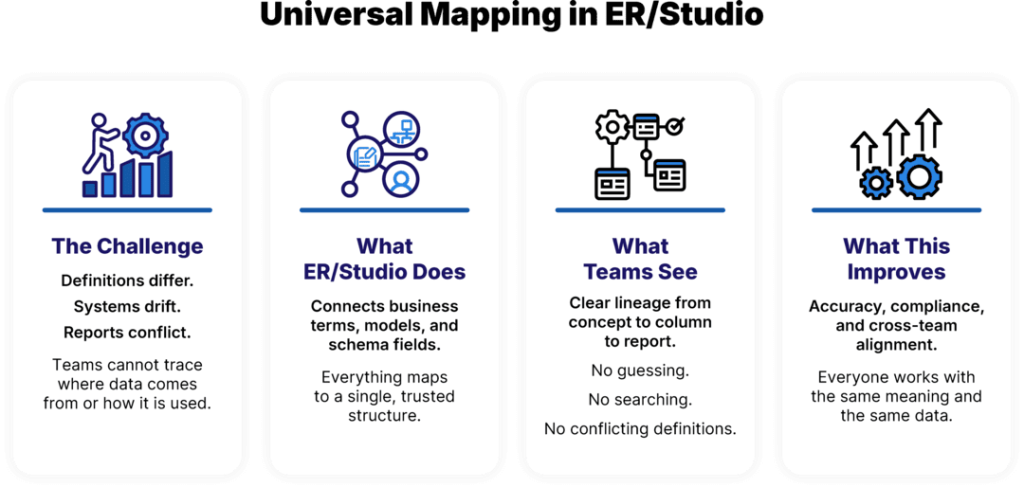
ER/Studio’s Universal Mapping and Traceability capabilities address this challenge by connecting business terms, conceptual models, logical structures, physical schemas, and downstream systems into a single, traceable view. Instead of treating each layer of the data architecture as a separate effort, ER/Studio unifies them in a way that allows any user to understand where information came from, how it is defined, and where it flows.
Universal mapping creates a foundation for trust, clarity, and governance throughout the entire data lifecycle.
Enterprise data ecosystems evolve over years, sometimes decades. New applications get added. Old systems linger because they are hard to replace. Cloud platforms introduce new structures that do not map easily to legacy ones. As technologies change, the definitions used by business groups change as well.
Consider the concept of Customer. Marketing focuses on loyalty profiles, lending relies on borrower information, compliance uses KYC records, and analytics interprets it through a warehouse dimension. Each version is valid in its own context, but without a unified framework, it becomes difficult to understand how these definitions relate. This results in reporting inconsistencies, mismatched KPIs, and confusion during audits.
These issues become amplified as organisations adopt hybrid and multi-cloud environments. Data becomes more distributed, and relationships between systems become harder to trace. Without a structured mapping capability, teams spend excessive time reconciling definitions, reviewing structures, and validating reports. As models drift and documentation falls behind, trust in the data decreases.
Universal mapping prevents this drift by centralising the relationship between business meaning and technical implementation.
“Transparency about data is essential for any organization using data to drive decision-making or shape business strategies.”
– IBM
Universal Mapping in ER/Studio connects the essential pieces of your data architecture, including:
By creating direct, visual links across these layers, ER/Studio allows teams to see how business meaning flows into technical structures and how those structures support real-world reports and systems. These relationships do not live in spreadsheets or shared drives. They live inside the modeling environment where they belong.
Universal mapping also supports both forward engineering and reverse engineering. When you add a new field, you can map it back to its business meaning. When you ingest metadata from a source system, you can map it forward into your models and glossary. This creates a continuous, traceable thread from requirements to implementation.
Architects and engineers often carry the responsibility of understanding how systems connect, how changes ripple through the landscape, and how models should evolve to stay consistent. Universal mapping makes their work faster and more accurate by providing end-to-end visibility.
With ER/Studio, architects and engineers can:
Technical teams gain confidence in the stability of the environment, and development cycles become smoother because fewer surprises appear late in the process.
Governance leaders often face the challenge of tracing sensitive or regulated data across environments. When classification metadata is disconnected from technical structures, it becomes difficult to validate whether the organisation is meeting regulatory expectations.
Universal mapping gives governance teams the ability to:
This reduces compliance risk while also improving the accuracy and reliability of the information used in reporting.
Analysts, product managers, and business stakeholders do not always have the time or background to trace technical metadata across systems. When definitions are unclear or inconsistent, trust in dashboards and KPIs declines.
Universal mapping provides:
Better understanding leads to better decisions and fewer disputes about the meaning of data.
A regional bank undergoing digital transformation discovered that each department used a slightly different definition of Customer in its systems and reporting. These differences created conflicting dashboards and caused friction during regulatory reviews.
Using ER/Studio, the bank created a unified glossary entry for Customer and linked that definition to attributes across logical and physical models. Naming inconsistencies became visible immediately. Downstream analytics maintained the correct interpretation. During the next compliance review, the bank provided complete traceability without relying on manual discovery.
Universal mapping gave the bank a clear, documented structure that strengthened trust between teams and improved the accuracy of its reporting.
Universal mapping in ER/Studio follows a clear and structured workflow:
1. Import or create your models
Conceptual, logical, and physical models can be built natively or ingested from external systems.
2. Build or synchronise your glossary
Business terms become the semantic anchor across the architecture.
3. Map terms to models
Mappings connect concepts to real technical elements.
4. Visualise the relationships
Interactive diagrams display upstream and downstream paths.
5. Conduct impact analysis
Teams can see the consequences of changes before they are implemented.
6. Collaborate in Team Server
Mappings and definitions are shared across the organisation to maintain clarity.
This creates a connected structure that evolves with your systems and supports long-term governance.
Universal mapping is not just a feature. It is a strategic approach to building a data architecture that is reliable, transparent, and aligned with business meaning. ER/Studio provides the tools to connect every layer of your models and metadata so that teams can work with confidence, make informed decisions, and maintain compliance throughout the data lifecycle.
If your organisation needs clarity across systems, alignment between teams, and a trustworthy view of how information flows, universal mapping provides the foundation.
Explore how ER/Studio can help you build a connected and traceable data architecture with a personalized consultation.
Universal mapping allows organizations to link business terms, models, schemas, and system assets in a single, traceable structure. This creates a unified view of how data is defined, stored, and used across environments.
By connecting business meaning to technical implementation, governance teams can trace sensitive fields, validate terminology, document lineage paths, and produce audit evidence without manual searching.
Yes. Universal mapping ensures that business definitions align with the underlying database fields and analytical structures. Analysts and business users gain clarity about the source and meaning of metrics, which improves reporting accuracy.
Yes. ER/Studio works across relational databases, cloud platforms, warehouses, lakehouses, NoSQL systems, and legacy environments. Mappings remain consistent even in hybrid or multi-cloud architectures.
Mappings reveal upstream and downstream dependencies, allowing teams to predict how changes to models or fields will affect other systems and reports. This prevents breakage and reduces rework.
Data architects, engineers, governance leaders, compliance teams, analysts, and business stakeholders all benefit. Each group gains visibility into the structure and meaning of data at the level they need.




