
Every modern enterprise holds a vast array of digital assets. These include logical, physical, and conceptual data models, business glossaries, metadata registries, diagrams, dependencies, and rich documentation. While this wealth of data represents an opportunity for insight and competitive advantage, it also creates a challenge. Much of the power of these assets goes untapped because people cannot easily find the data they need when they need it.
This is where advanced search capabilities become a strategic differentiator. ER/Studio’s Advanced Search brings unparalleled discoverability to complex metadata landscapes. It allows technical and business users alike to locate relevant information instantly across the entire enterprise. This capability turns data models, metadata, and glossary terms into accessible, actionable assets rather than buried references stored in silos. With Advanced Search, your organization gains the ability to find trusted data quickly, understand its meaning, and act confidently.
In this blog we explore how ER/Studio’s advanced search empowers data professionals and business users, why it matters for governance and compliance, and how it elevates data management practice within the enterprise.
In many organizations, knowledge about data is fragmented. Data dictionaries exist in one repository. Glossaries live in another. Data models are created by architects, but analysts must guess which version is authoritative. Business terms are defined, but rarely linked back to the technical artifacts they describe. This fragmentation creates a discovery gap between what data exists and what users can actually find.
Metadata helps close that gap because it captures context about data elements, their relationships, their lineage, and how they are defined across systems. When metadata is indexed and searchable, it becomes possible to locate the right information without guesswork. Comprehensive metadata discovery supports a shared understanding of enterprise data assets and delivers a single, indexed source of truth that reduces ambiguity for teams. Because metadata is fundamentally information about information, it enables discoverability and accessibility that would otherwise be impossible without manual intervention.
ER/Studio’s Advanced Search brings this discovery to life by linking technical structures like tables and attributes with business terms, processes, and glossary definitions, empowering users to navigate complex data environments with ease.
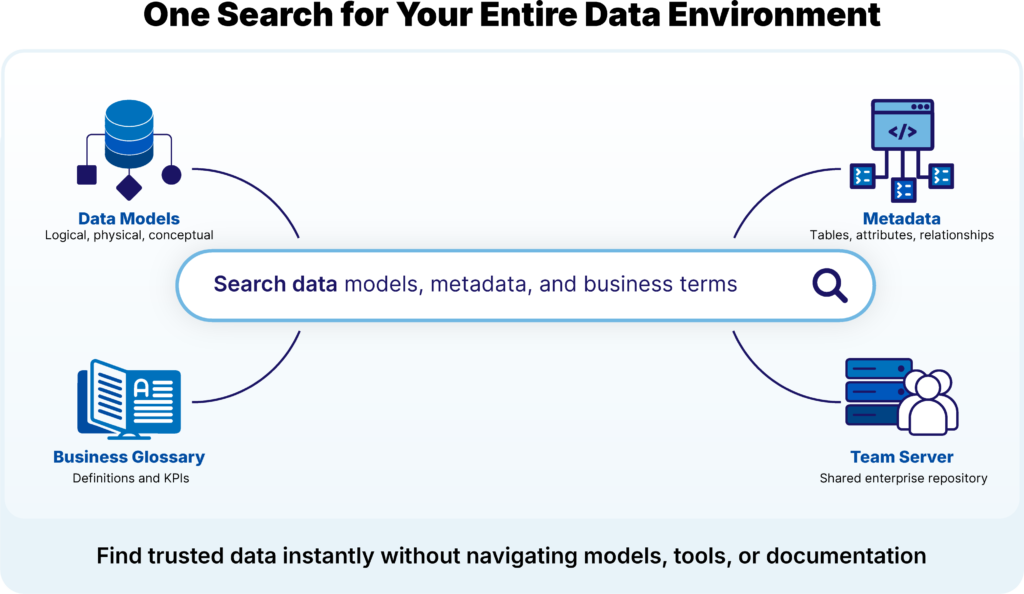
Advanced Search in ER/Studio is built to be comprehensive and performance oriented. Users can enter keywords or phrases and receive highly relevant results that span models of all types, glossary terms, metadata objects, and related documentation. Unlike basic search functions that might only find items within a single model or tool screen, ER/Studio’s Advanced Search indexes the entire repository so users can locate:
This breadth of search ensures users are not simply cataloging names, but accessing associated metadata and context that bring meaning to the results. It unifies both business and technical perspectives so that everyone finds what they need in one place.
“Employees can spend nearly two hours a day searching for information in fragmented systems, which highlights why advanced search and indexed access are strategic for productivity.”
– Meilisearch
Large enterprises rarely operate with only one type of data model. Logical models define business concepts and structures without concern for system-specific implementation. Physical models focus on database schema and performance considerations. Conceptual models may capture high-level business domains and their relationships. Traditionally, each of these model types lives in separate diagrams, files, or repositories. Searching them individually is time consuming and error prone.
Advanced Search removes that barrier by indexing all models from one interface. Rather than opening multiple diagrams, teams can execute a single query that returns matches across every model type. This capability provides a panoramic view of how a term, attribute, or entity appears across systems. For example, a user searching for “Customer Identifier” will instantly see all the logical definitions, physical implementations, and any related glossary terms that describe its usage, ownership, and governance context.
This unified search function eliminates tedious manual navigation and supports a more cohesive understanding of the enterprise data landscape.
One of the greatest challenges in data management is bridging the language gap between business and technology. Business stakeholders often define key performance indicators, measurement standards, and domain concepts that do not map clearly to underlying data structures. ER/Studio solves this by linking glossary terms directly to technical metadata. When a user searches for a business concept, they get not just a definition, but also the tables, attributes, and models that implement that concept.
This linkage is critical because business users then see how the systems they rely on are structured, while technical teams can trace which business terms their work impacts. This unified view supports smarter decision making, reduces miscommunication, and aligns analytics with governance objectives.
Search results can be overwhelming in large enterprise environments with thousands of models and millions of metadata elements. ER/Studio Advanced Search recognizes this challenge and includes precision filters that make finding exact results easier. Users can refine results based on model type, object category, glossary segment, system, date range, owner, and more.
These filters are vital for both technical and business users. With them, a data steward can narrow searches to elements updated in a specific time period for audit purposes, while an architect can focus on models of a certain type to understand structural dependencies. This kind of refined control makes search both flexible and efficient, which is especially important when managing complex environments with diverse teams and users.
ER/Studio Advanced Search integrates deeply with ER/Studio Team Server to deliver centralized enterprise search. Team Server serves as the metadata hub where models, glossaries, and definitions are stored, managed, and governed. Users across the organization can access Team Server to perform search queries without needing standalone modeling tools installed locally.
Business analysts, data stewards, and architects can all search within the same indexed repository, providing a shared understanding of the environment. This centralized access encourages collaboration and ensures that everyone is working from a consistent foundation of data knowledge.
By removing siloed search experiences and replacing them with a unified discovery platform, ER/Studio helps organizations maintain metadata accuracy, reduce duplicated effort, and streamline data governance efforts across teams.
Architects and engineers are tasked with designing robust systems that scale and adapt over time. They spend countless hours understanding existing models to avoid redundancy, ensure accuracy, and reuse proven components. With Advanced Search, they can locate specific entities, dependencies, or patterns without needing to comb through multiple diagrams manually.
Rather than spending effort searching, they spend time creating solutions that improve the organization’s data architecture. This increases throughput, accelerates delivery, and elevates the overall quality of data modeling work.
Data governance depends on consistency and control. Governance teams need to validate that naming standards are enforced, that business terms are applied consistently, and that compliance obligations around sensitive data elements are met. ER/Studio’s Advanced Search allows stewards to locate compliance-related attributes and glossary terms at scale, verify whether definitions are consistently applied, and prepare for regulatory audits more confidently.
Because governance is fundamentally about trust in data, the ability to search for regulated fields and terms speeds audit preparation and reduces risk during compliance checks.
Business users and analysts often live in environments where reporting accuracy and speed are essential. They need trusted definitions that align with dashboards, KPIs, and reporting logic. Advanced Search provides a self-service approach to data understanding, helping business users find definitions and linked metadata without relying on technical teams for every query.
This democratization of data knowledge fosters better cross-team communication and less dependency on tribal knowledge or informal notes.
Imagine a global retail organization preparing a quarterly analysis of financial performance. A key question arises around how “Net Sales” is calculated and whether it is consistent across systems. Without a unified search capability, stakeholders may need to query multiple teams, cross reference models, and manually trace definitions and calculations across data environments.
With ER/Studio Advanced Search, an analyst enters “Net Sales” and almost instantly receives a comprehensive set of results containing glossary definitions, associated technical metadata, diagrams, and ownership context. Because the metadata is indexed centrally, the organization avoids email chains, needless meetings, and repeated clarification.
This level of discoverability accelerates business reviews and underpins confidence in the numbers that leadership relies on to make strategic decisions.
Having large volumes of data does not automatically translate into better decisions or stronger governance. What matters is whether people can reliably find the data they need, understand what it represents, and trust that it is being used consistently across the organization. When discovery is slow or fragmented, even well-designed models and glossaries lose their impact.
ER/Studio Advanced Search addresses this gap by turning metadata into an accessible, usable resource for everyone who works with data. By unifying search across models, glossaries, and shared repositories, it removes the friction that traditionally separates technical design from business understanding. Users spend less time navigating tools and more time applying data with confidence.
When discovery is centralized and intuitive, data stops being a static asset and becomes an active enabler of governance, analytics, and day-to-day decision making. ER/Studio Advanced Search makes that shift possible by ensuring the right information is always within reach.
Request a demo to see how ER/Studio Advanced Search simplifies metadata discovery across your organization.
ER/Studio Advanced Search is designed to locate both technical and business data assets across the entire modeling environment. This includes tables, entities, views, attributes, columns, relationships, domains, and diagrams found within logical, physical, and conceptual models. It also searches business glossary terms, definitions, categories, and associated metadata stored in ER/Studio Team Server. Because the search indexes documentation and notes as well, users can discover contextual information that explains how data is defined, used, and governed, not just where it exists.
Searching within a single model limits visibility to one diagram or schema at a time, which can create blind spots in large or distributed environments. ER/Studio Advanced Search spans the entire modeling ecosystem, including multiple models, shared repositories, and business glossaries. This allows users to see how a concept or data element appears across systems, how it has been implemented differently, and where it is reused. The result is a more complete and accurate understanding of enterprise data structures.
Yes. ER/Studio Advanced Search is built specifically for enterprise scale environments where thousands of models and metadata objects may exist. Users can apply precision filters such as model type, object type, system, glossary category, owner, or modification date to narrow results. These filters make it practical to search very large repositories while still returning highly relevant and targeted results, even in highly regulated or decentralized organizations.
Advanced Search plays a key role in governance by making it easier to locate and validate regulated data, sensitive fields, and compliance related terminology. Governance teams can quickly search for specific business terms, attributes, or policies and see where they appear across models and systems. This capability supports consistent application of naming standards, faster audit preparation, and greater confidence that governance rules are being followed throughout the data lifecycle.
Yes. Through ER/Studio Team Server, business users and analysts can use Advanced Search without needing to open or understand desktop data modeling tools. They can search for business terms, definitions, KPIs, and related metadata through a web based interface. This self service access helps reduce reliance on technical teams while improving overall data literacy across the organization.
ER/Studio Advanced Search links business glossary terms directly to the technical structures that implement them. When a user searches for a business concept, the results include not only the approved definition, but also the related tables, attributes, domains, and diagrams. This connection helps users understand how abstract business ideas map to physical systems and data models, which is essential for analytics accuracy, reporting consistency, and cross functional collaboration.




