A well-architected data warehouse sits at the heart of every modern data platform. It provides the foundation for trustworthy analytics, business intelligence, and AI-driven insights. Yet, despite decades of investment, many organizations still struggle to deliver a warehouse that scales and evolves with the business. The problem rarely lies in the technology itself,it lies in the architecture and the mindset that drives its design.
The objectives of a data warehouse have evolved. No longer is it sufficient to just consolidate data from source systems. A modern data warehouse must deliver reliable, governed, and reusable data assets that support a broad ecosystem of analytics tools and business users. The warehouse is no longer a project,it is a product.
Why did previous approaches fail? Too many data warehouses were built as IT-led, source-system driven projects. Teams began with the systems they could access, not with the questions the business needed answered. These projects often delivered quickly but became brittle and unscalable. When new needs emerged, teams were forced to rebuild or layer on patches. The result: technical debt disguised as progress.
Martin Fowler’s seminal article, “Is High Quality Software Worth the Cost?”, illustrates this point beautifully. He shows how low internal quality enables fast early progress, but cumulative functionality soon plateaus as complexity increases. High-quality, well-architected systems take longer initially, but deliver exponentially more value over time. In the world of data warehousing, this translates directly: rushed, unstructured designs deliver early dashboards, but collapse under the weight of governance and change.
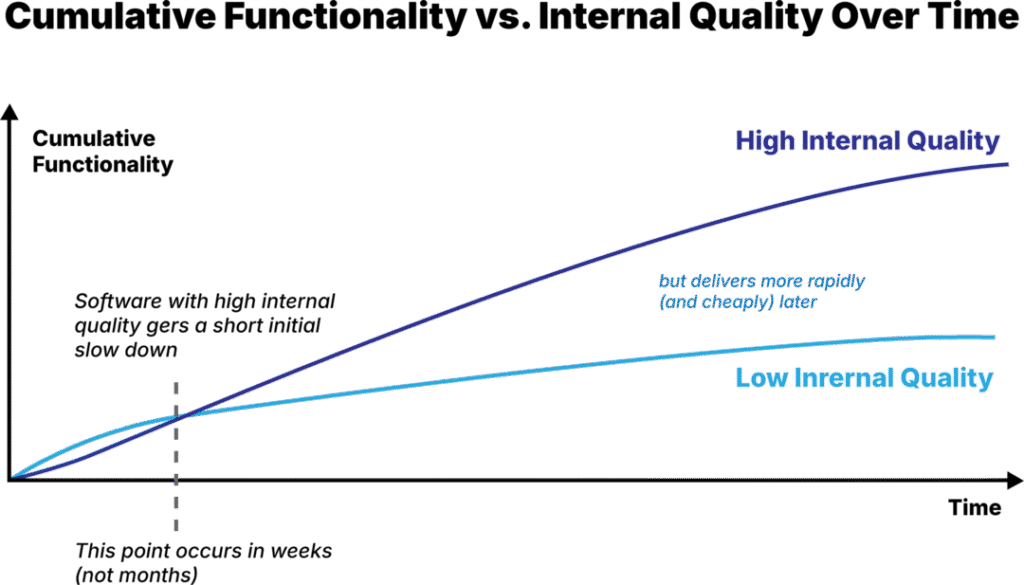
Good architecture is not about gold-plating,it’s about sustainable speed. A well-structured warehouse with clear separation of layers (bronze, silver, and gold) allows teams to scale, govern, and iterate efficiently.
The Medallion Architecture, popularized by Databricks, has become a cornerstone of modern data platforms. The bronze layer captures raw ingested data; the silver layer cleans, integrates, and applies business meaning; the gold layer delivers refined, analytic-ready data sets. The silver layer, often called the “single source of truth,” is where the real magic happens. It’s where consistency, data quality, and shared understanding are created.
In many ways, this silver layer echoes the purpose of traditional Inmon-style data warehouses. The difference is agility and ownership. Today’s silver layer can be implemented in 3NF (third normal form) or Data Vault, depending on governance and flexibility needs. Modern modeling tools such as ER/Studio make both approaches practical by accelerating schema design, automation, and documentation.
Defining data as a product requires deep business involvement. Subject Matter Experts (SMEs) must define what data means within their domains, how “Customer,” “Order,” or “Product” are represented and governed. This is where logical data models come into play. They provide a shared, unambiguous definition of information that everyone can understand. Logical models act as the contract for data products, specifying the data content which can be combined with policies around its use.
When logical models are reused across domains, organizations achieve genuine consistency. Data products become modular,like Lego blocks,each well-documented and interoperable. Governance tools such as Microsoft Purview and Collibra can publish these models directly, aligning technical and business perspectives effortlessly.
Once domain models and enterprise logical models exist, warehouse design becomes far simpler. Mapping source data assets to these standardized models makes discovery easy. The silver layer can be generated automatically, whether in 3NF or Data Vault. The gold layer then becomes a refactoring of these 3NF models, supporting analytical and visualization tools with clarity and speed.
“The most important output of a data warehouse is the set of consistent, conformed data.”
– Ralph Kimball, Data Warehousing Pioneer
Ultimately, the best data warehouse architectures share five traits: they are business-driven, not source-driven; they are built on solid logical foundations; they are integrated with governance programs; they are focused on long-term value; and they scale gracefully. These principles separate short-term wins from sustainable success.
In summary, the journey to a modern data warehouse is not about technology, it’s about architecture, collaboration, and clarity. When business users co-own the definition of data, and architects focus on quality and scalability, the result is an enduring data platform that supports growth, governance, and innovation.
Ready to transform your data architecture? Book your personal consultation today.
A modern data warehouse architecture combines raw data ingestion, standardized integration layers, and analytics-ready outputs. It supports governed, reusable data assets and aligns business definitions with technical models, often using frameworks like Medallion Architecture or 3NF/Data Vault design patterns.
Older warehouses were typically source-system driven instead of business-driven. Without clear logical models, governance, or standardized definitions, teams accumulated technical debt and struggled to adapt to new requirements, resulting in brittle, unscalable architectures.
The silver layer acts as the integrated, cleaned, standardized data layer and serves as the single source of truth. It applies business meaning, ensures consistency, and enables downstream analytics and data products to stay aligned across systems.
Logical models define business concepts clearly and consistently, creating shared understanding across domains. They help teams standardize “Customer,” “Order,” “Product,” and similar entities, enabling automation and ensuring that downstream warehouse layers remain accurate and governed.
Both 3NF and Data Vault provide structured approaches for integrating data in the silver layer. 3NF excels at standardization and governance, while Data Vault supports flexibility and parallel development. ER/Studio makes both approaches easier to design, document, and automate.
ER/Studio accelerates schema design, automates model generation, links business glossary terms to data structures, and integrates with governance platforms like Microsoft Purview and Collibra. This ensures that warehouse models remain consistent, auditable, and aligned with business goals.