
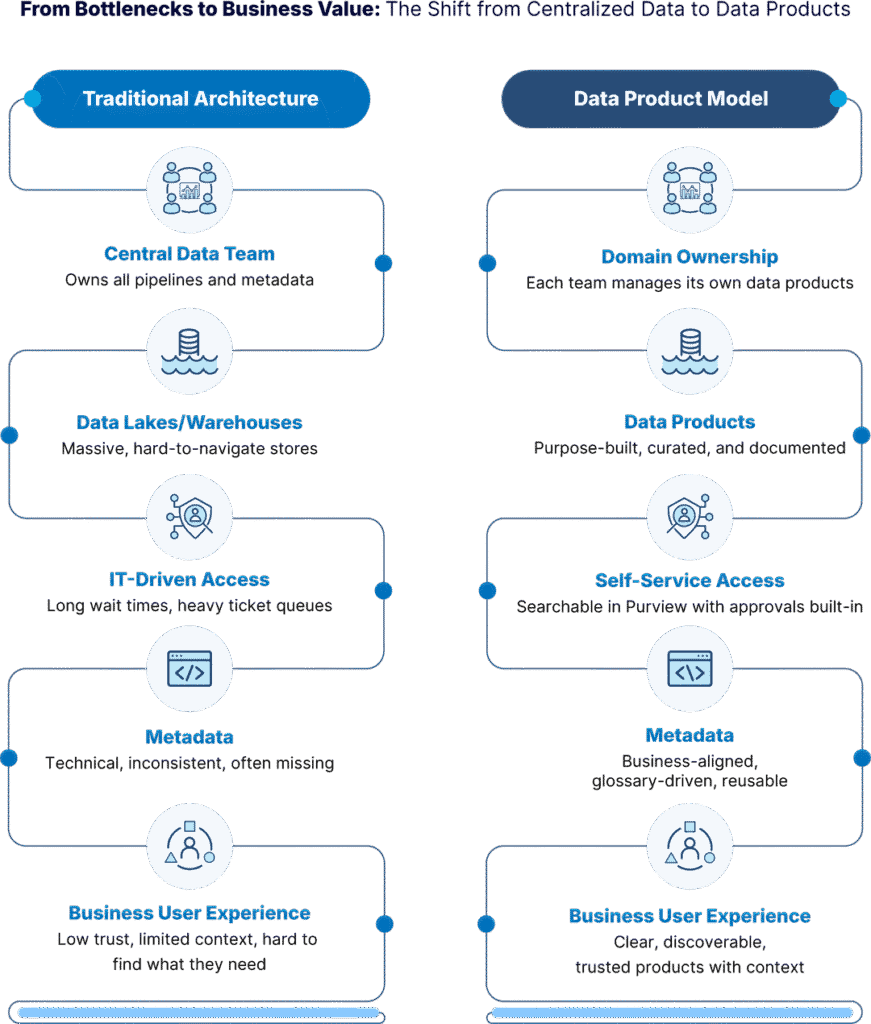
For decades, enterprise data architecture was largely centralized. Data teams collected everything into massive data lakes or warehouses, built pipelines, and cataloged assets with technical metadata. While this approach worked for IT-led reporting and some analytical workloads, it didn’t scale well across the organization. Business users struggled to find trusted data, and data teams were overwhelmed trying to manage every request, and governance became a challenge.
The “Data as a Product” (DaaP) model flips this approach on its head. Instead of treating data as a byproduct of operations—something captured and stored for someone else to make sense of—organizations now treat data as a purpose-built product. Each product is curated, governed, and delivered with clear intent: to serve a specific business purpose, meet quality standards, and be reusable across teams.
This means every data product has:
DaaP decentralizes responsibility while increasing accountability. It brings together data producers, stewards, and consumers under a shared understanding of what each product is meant to do. Unlike traditional models where metadata was applied retroactively (if at all), DaaP integrates governance from the beginning—starting with the model and glossary.
The benefits are measurable: faster time to delivery, better alignment with business needs, stronger data quality, and higher confidence in how data is used. And as Microsoft Purview shifts toward a Data Product-driven architecture, organizations that adopt DaaP principles stand to gain the most from the platform’s evolving capabilities.
Microsoft Purview is evolving from a traditional data catalog into a data governance and product delivery platform. That means new features, new roles, and new responsibilities for organizations—and a much tighter integration between modeling, governance, and business outcomes.
Let’s break down what’s changing and how ER/Studio enhances this transformation.
The Unified Catalog in Microsoft Purview has traditionally served as a technical inventory of available datasets. It indexed everything: warehouse tables, lake files, operational system extracts, and more. While comprehensive, it lacked curation. Users had to wade through inconsistent naming, unclear lineage, and missing context to find what they needed.
With the latest updates, the catalog is becoming a data product marketplace. Each listing is now framed not as a dataset but as a purpose-built product—with business-aligned metadata, quality indicators, and access workflows. Consumers don’t need to understand schema—they just need to find “Customer 360 for Marketing Analytics,” read a business description, and request access.
This aligns with how business users think and how product teams operate. Instead of navigating systems, users search for value—and get governed, approved access with context and confidence.
ER/Studio’s Role: ER/Studio enables teams to define, design, and standardize data products before they are built to ensure that requirements and content are well understood, improving quality. Logical models form the contracts for Data Products and physical models describe the implementation of them. These models are enriched with glossary terms and business rules, then published into Purview—ensuring every data product starts with a trusted, well-structured and governable foundation. The logical models, being in business language, then make it easier for consumers to understand the content of the Products before they request them.
Purview’s Data Map continues to function as the platform’s engine for scanning, classifying, and organizing data assets across hybrid environments. It collects metadata from databases, files, and analytics platforms and feeds it into the catalog. But Microsoft is now narrowing the focus of this map to prioritize consumption-layer assets—primarily warehouses, lakehouses, curated zones, and semantic models.
This strategic shift means Purview will no longer catalog operational systems that are never exposed to users. While this simplifies the platform and enhances product clarity, it also introduces a risk: organizations must now track operational data separately to ensure full data lineage and governance.
Jamie Knowles, Product Manager for ER/Studio, explains:
“Purview will no longer govern operational assets that are never consumed. The governance model is shifting to focus on the consumption layer.”
ER/Studio’s Role: ER/Studio fills this gap by modeling operational and analytical data assets together. Teams can document systems not tracked in Purview, link them to glossary terms, and map their relationships to analytical outputs. These models then inform the creation of consumption-ready data assets, which are published into the Purview catalog—complete with inherited metadata and governance context.
ER/Studio fills this gap by managing models of operational data assets mapped to the Purview Glossaries to help source data for the consumable Data Products. Any data asset that then becomes directly consumed can be scanned in Purview with ER/Studio adding documentation to that scanned asset.
“We recognize that a strong data culture is essential to engineering excellence…We focus on robust design, governed data products, and scalable, AI-ready solutions…This iterative approach empowers informed decisions, drives efficiency, and unlocks ongoing innovation.”
– Faisal Nasir, Principal Architect, Microsoft Digital
In tandem with its new catalog structure, Microsoft is introducing business glossaries tied to governance domains. These new glossaries are more than just term lists—they support federated ownership, enabling each business unit (e.g., Finance, Marketing, HR) to define its own vocabulary, data product taxonomy, and stewardship assignments. Microsoft has signaled its intent to downplay the older “classic glossaries,” although many customers still depend on them.
Jamie Knowles notes:
“There will be some challenges migrating from the classic data catalog to a domain based approach. A structured approach to federation is required to ensure consistency and data modeling can really help here.”
Many organizations are still trying to navigate the transition, often asking: What’s the difference between the classic and new glossaries? Can we use both? What happens to our existing metadata?
ER/Studio’s Role: ER/Studio supports both glossary types. It enables teams to manage a single authoritative glossary internally—then publish terms to classic or domain-based structures in Purview based on business needs. This gives data stewards the flexibility to migrate at their own pace, while maintaining consistency and alignment across the organization.
As organizations decentralize governance through domain-based ownership, they need tools that support autonomy without sacrificing standards. Microsoft Purview supports governance domains that reflect business lines like HR, Sales, and Risk—each with their own policies, glossaries, and stewards.
ER/Studio’s Role: ER/Studio allows teams to model each domain independently while sharing a central metadata layer. This hybrid approach supports Data Mesh-style scalability and governance without chaos.
Jamie Knowles notes:
“Organizations need to have a plan on how they will manage consistency across products and across domains. This could be complete autonomy or tightly federated, but an approach must be decided.”
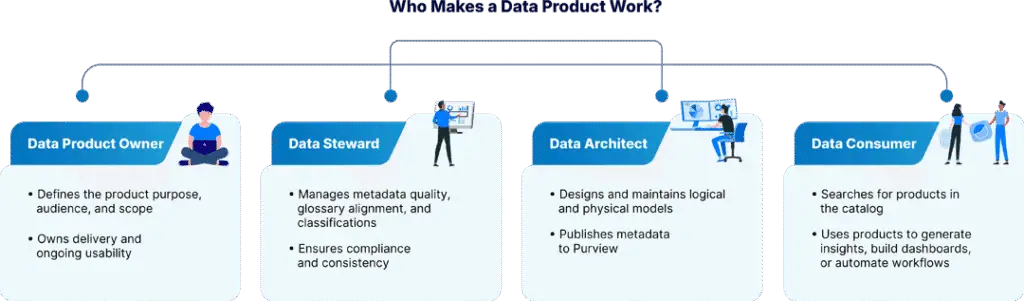
Microsoft is emphasizing two critical roles in its new model: data product owners and data stewards. These aren’t ceremonial titles—they are operational roles responsible for delivering usable, governed data products across domains.
The journey to realize Data Products goes further though. Although Product Owners as subject matter experts will define requirements for Data Products, those requirements need to be hardened
Jamie Knowles adds:
“We can really help here… we use our knowledge of operational data assets to design consumption data assets which would be published in the Purview Data Catalog and mapped to Data Products. Thus, ER/Studio + Purview gives you a complete suite of tools to catalog all aspects of your estate.”
ER/Studio’s Role: ER/Studio provides stewards and product owners with tooling to define models, apply glossary terms, track changes, and collaborate across teams. It gives these roles the context and control they need to enforce governance and deliver trustworthy, business-aligned products.
Microsoft Purview’s shift toward a product-based delivery model changes how organizations govern data—but it doesn’t eliminate the need for structure, standards, or planning. In fact, the move makes upstream modeling even more essential.
Purview catalogs what exists—but it doesn’t define how your data should be structured, named, or reused. It doesn’t decide which glossary terms apply, how entities relate, or where lineage begins. That foundational work still needs to happen before anything is published to the catalog—and that’s where ER/Studio comes in.
Think of it this way:
With ER/Studio, teams can create logical models that define core business concepts—Customer, Product, Policy—complete with attributes, relationships, and glossary terms. These models act as the semantic backbone of your data architecture, ensuring that what gets cataloged later in Purview is already aligned to your standards.
Then, those logical models can be extended into physical ones—mapped to specific platforms, constraints, and classifications. This step is critical now that Purview is narrowing its scope to focus primarily on consumption-layer assets. While operational systems may no longer be scanned directly, ER/Studio captures them in the model, maps their relationships, and maintains end-to-end lineage—bridging the visibility gap.
But here’s the real beauty: a domain-based approach decentralizes the process, but the goal is to avoid silos. Data in products should remain consistent from product to product and across domains. In ER/Studio, common catalogs of entities can be formulated and reused across products to ensure standardization—and with it, higher data quality.
It also enables metadata automation. Business terms, lineage, classifications, and descriptions defined in ER/Studio can be exported directly to Purview—ensuring that the assets users see in the Unified Catalog aren’t just labeled, but fully understood.
The result? Less manual clean-up. Fewer surprises. And a far smoother path from requirements to delivery with better quality.
Modeling isn’t just a diagramming step—it’s where governance begins. And with ER/Studio, that governance flows directly into Purview.
At a global financial institution, the compliance department was tasked with designing a new data product to help investigators identify fraud more quickly and with higher confidence. The goal was to create a consumable view of suspicious activity, blending data from internal banking systems and external fraud scoring vendors.
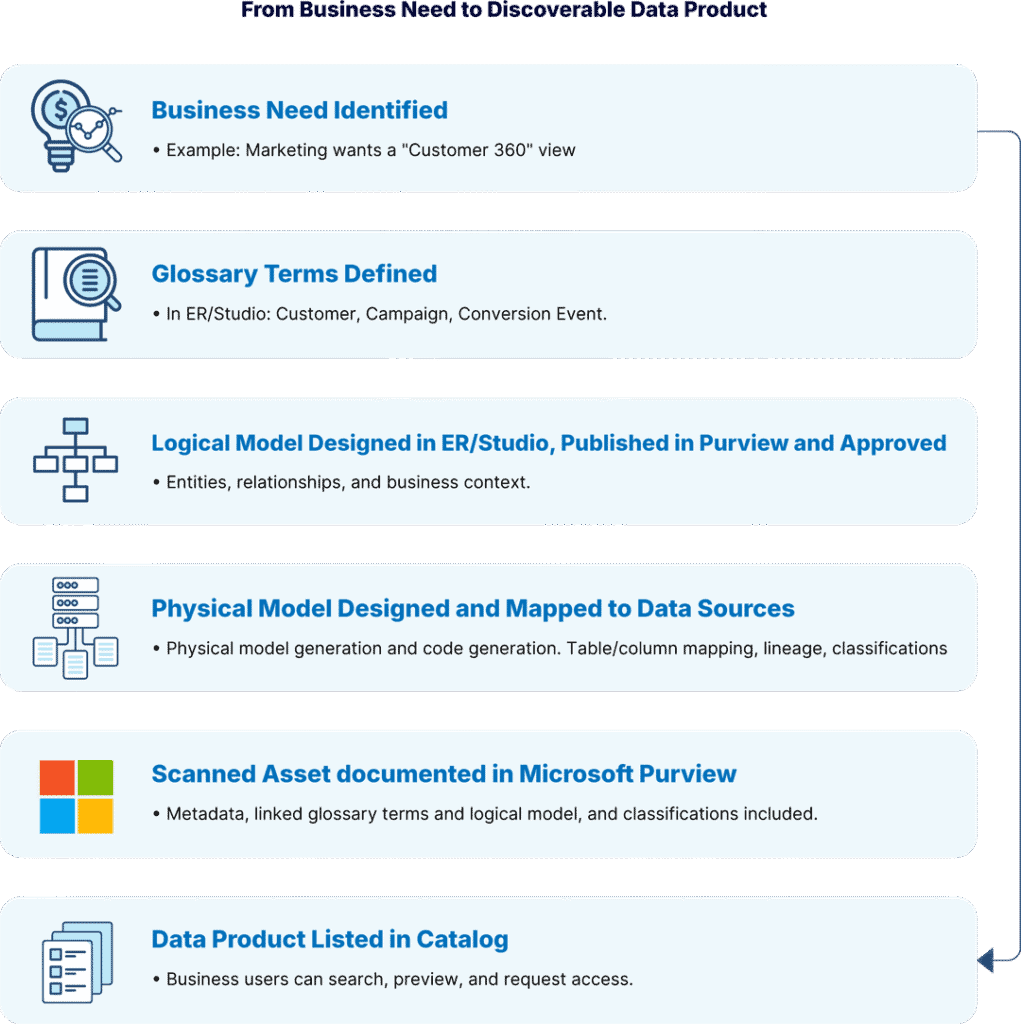
To begin, a data product owner was appointed from the compliance team to define the scope: aggregate transaction histories, link them to customer profiles, enrich with behavioral scoring, and track fraud alerts over time. The owner partnered with a data steward, who used ER/Studio to create and validate business terms like “Fraud Score,” “Anomaly Pattern,” and “Risk Event.”
Next, the modeling team used ER/Studio to build a logical model reflecting the relationships between transactions, account holders, score triggers, and external feeds. Each attribute was linked to glossary terms, and the model was extended into a physical layer mapped to real data sources. This helped the team spot inconsistencies in source data early—before anything hit production.
Once approved, the entire model—including metadata, glossary associations, classifications, and business definitions—was published into Microsoft Purview. The product was now live in the Unified Catalog, searchable using real-world terms and discoverable by any authorized analyst across compliance, audit, and fraud teams.
Let’s say your Risk & Compliance team needs a new data product for fraud detection.
This is metadata-driven, model-first Data Product delivery in action—and it starts with ER/Studio.
Microsoft Purview’s shift to a Data Product delivery platform represents the future of enterprise data governance. But it also requires organizations to rethink how they structure, standardize, and model data—long before it’s cataloged.
That’s where ER/Studio excels.
By using ER/Studio to model, define, and organize your metadata, you ensure that every data product in Purview starts from a place of clarity, consistency, and confidence.
Schedule a personalized demo with our experts to learn more.
ER/Studio gives you a central place to manage glossary terms, definitions, and relationships. You can choose whether to publish these terms to Purview’s classic global glossary or to the newer domain-based glossaries—based on your adoption strategy. It can even help migrate from old to new. This flexibility makes ER/Studio ideal for both legacy users and those embracing Data Product delivery.
ER/Studio is used to design the data product, define glossary terms, map sources, and ensure governance is well-defined. Once deployed, the metadata is pushed into Purview to ensure the Data Product is well-documented, so users can discover and request access to the right data product. This model-first approach ensures consistency, trust, and usability from day one. Good model-based design ensures Data Products are consistent in and across domains and meet requirements.
Yes—and in fact, modeling becomes even more important in a Data Product–driven Purview environment. While Purview catalogs assets and organizes metadata, it doesn’t design the structure or semantics of your data. That’s where ER/Studio comes in. Logical models define the business view of the data, including critical details such as how data concepts are identified, ensuring shared understanding across domains, which in turn improves quality and interoperability. Physical models map that intent to real-world sources, uncovering inconsistencies and ensuring traceability. Together, they give your data products a foundation of meaning, quality, and lineage that Purview can surface, govern, and operationalize.
ER/Studio can publish logical and physical model metadata—including tables, columns, domains, relationships, glossary terms, descriptions, and classifications. This ensures that what appears in Purview reflects the same trusted, standardized structure used by architects and modelers.
ER/Studio allows business domains to define and manage their own data models, glossaries, and assets within a shared repository. This supports decentralized ownership while maintaining enterprise-wide standards, version control, and metadata consistency.
You can continue to use the classic catalog while preparing for Data Product delivery. ER/Studio helps bridge the two by allowing you to manage metadata centrally and adapt to evolving structures. You don’t need to choose between “classic” and “new”—you can support both.




