The Data-as-a-Product movement has reshaped how organizations think about data. Instead of treating data as a side project for IT, companies are formalizing it into consumable products—carefully designed, governed, and delivered with the same respect and rigor as physical or digital goods. And like any other product, they have recognizable value and are driven by demand.
This shift makes sense. Data is a valuable commodity that has a cost to manage and, when treated improperly, can present risks to the organization. By having domain experts manage the creation, governance, and delivery of Data Products, organizations can ensure that critical business data is well-structured, reliable, and delivers value.
But defining Data Products is only part of the equation. How do you design them properly? How do you ensure consistency, quality, and alignment with business goals?
This is where data architecture plays a crucial role.
Data architects provide the structure and governance needed to turn raw data into reliable, reusable, and scalable products. Their role is twofold:

This is where companies often face difficult decisions. How much standardization is necessary? Should every domain operate independently, or should there be a common framework?
Here are three common approaches:
Choosing the right approach depends on business objectives, data complexity, and governance requirements. The key is to make a conscious decision rather than allowing inconsistencies to emerge organically.
“60% to 73% of enterprise data goes unused for analytics.”
– Forbes
Traditional top-down data modeling, where architects attempt to build an exhaustive enterprise model before implementation, is too rigid for today’s fast-paced environments. Instead, a more iterative approach is proving to be more effective:
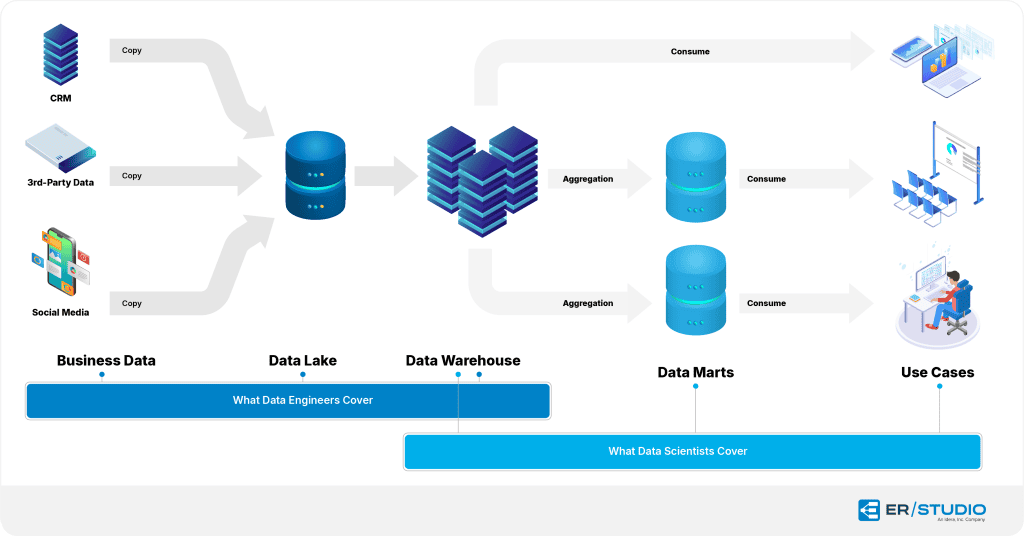
To design, document, and manage Data Products efficiently, organizations need the right tools. ER/Studio simplifies and accelerates the data architecture process by offering:
ER/Studio allows architects to create detailed data models that translate business concepts into database structures. The tool supports both logical models (for business-friendly views) and physical models (for implementation) followed by code generation.
Data models are created as graphical diagrams packed with business metadata that allow all stakeholders to contribute to the design process. ER/Studio takes care of the technical tasks behind the scenes allowing you to focus on the design process. This allows you to visualize and refine Data Products before implementation—reducing errors and ensuring alignment to requirements.
One of ER/Studio’s most powerful features is its tools to support the reuse of common patterns. You can build common models such as Enterprise and/or Domain Data Models that contain agreed and approved components. Tools, like Compare/Merge, allow you to include these components in your designs with universal mappings back to them to show traceability.
This ensures that Data Products remain consistent across environments and that any changes in the architecture are easily traced and analyzed before implementation.
Your Data Products may be realized in many different ways. ER/Studio supports most of them and allows you to design assets in a low-code environment where the tool takes care of the technicalities of the platform so you don’t have to, all generated from the same logical models.
Metadata is the backbone of Data Product governance. ER/Studio integrates with a wide range of data catalogs such as Collibra and Microsoft Purview, allowing teams to include governance concerns during the design of data products and ensure compliance.
As domain and enterprise teams build models of the information of the organization this knowledge can be used to kick-start the creation of your governance framework allowing architects and domain stewards to work together.
Data architecture isn’t a solo effort. ER/Studio enables teams to collaborate on models in real time through a centralized repository. Version control, branching, and role-based access ensure that changes are tracked, reviewed, and approved efficiently.
Outputs from ER/Studio can be committed to your Git repository to support your CI/CD processes.
“Organizations don’t have data problems, they have architecture problems.”
– Barry Devlin, Pioneer of Data Warehousing
Failing to establish clear architectural principles leads to:
According to a Gartner report, poor data quality costs businesses an average of $12.9 million annually, primarily due to misalignment, duplication, and lack of governance.
By investing in data modeling and architecture tools like ER/Studio, organizations can:
“Without a solid data architecture, you’re just collecting data, not using it.”
– Harvard Business Review
Data Products only succeed when they are well-designed, consistent, and governed effectively. Data architecture provides the foundation for this success.
By using tools like ER/Studio, organizations can take a structured, iterative, and scalable approach to data modeling, ensuring that every Data Product is built with clarity, reliability, and long-term usability in mind.
The result? Faster, smarter, and more reliable data-driven decisions.
To learn more about efficient data design, chat with our team.