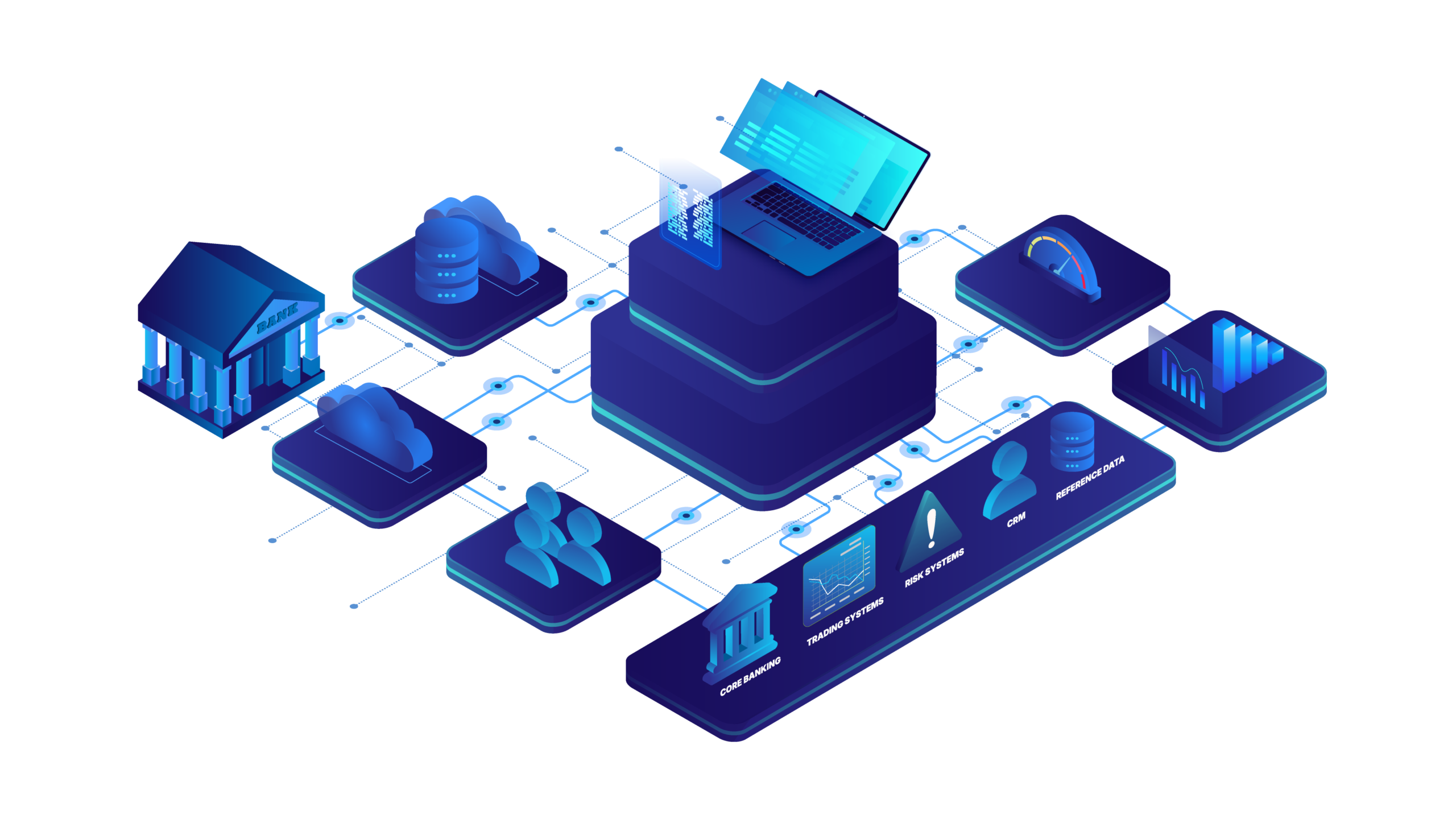
Enterprise financial institutions have plenty of data platforms. What most of them lack is clarity about which platform solves which problem, and where one tool ends and another begins. Between Basel III capital requirements, BCBS 239 risk data aggregation principles, Dodd-Frank audit expectations, and PCI DSS control frameworks, all layered on top of legacy core banking infrastructure migrating to cloud, these institutions need financial data management solutions built for structured, governed, and high-stakes environments.
This comparison covers six financial data management solutions that serve the structural and architectural layer of enterprise finance. Each entry covers what the platform does, where it fits, and where it falls short.
Core strength: Single source of truth for regulatory reporting and risk analytics
OFSDF is Oracle’s analytical data warehouse platform for financial institutions. It ships with a pre-built physical data model covering two layers: a staging model that pulls from core operational systems, and a reporting model that structures outputs for BI and regulatory submission.
Its real value only materializes if you’re running multiple OFSAA applications. When you are, OFSDF prevents the data proliferation problem that plagues large institutions: different business units producing conflicting regulatory reports because each application maintains its own data structures. A single unified model feeds capital adequacy calculations, liquidity risk reporting, and regulatory submissions across jurisdictions. Without OFSDF holding that together, you’re reconciling outputs instead of trusting them.
Where it fits in the stack: OFSDF is a physical data warehouse platform. It doesn’t govern how data is modeled or defined at the conceptual and logical layers. It assumes that work is already done upstream. Institutions that haven’t established clear data model documentation and metadata standards will find OFSDF’s benefits constrained by whatever feeds into it.
Tradeoffs: OFSDF is deeply tied to the Oracle ecosystem. Institutions running mixed vendor environments will hit integration friction quickly, and the platform’s value is difficult to justify outside a broader OFSAA investment.
Deployment: On-premises and Oracle Cloud Infrastructure (with Autonomous Data Warehouse)
Core strength: Cloud-native data integration and quality at enterprise scale
Informatica IDMC covers the full data management lifecycle in one cloud-native platform: integration, quality, master data management, cataloging, governance, and privacy. For financial services, it includes pre-built accelerators: banking-specific data quality rules, legal entity data accelerators for aggregating risk exposure by counterparty, and broad metadata connectivity across thousands of enterprise data sources.
What separates IDMC from point-solution integration tools is CLAIRE, its metadata intelligence layer. Rather than requiring data stewards to write quality rules from scratch, CLAIRE analyzes how similar data has been used across the organization and surfaces recommendations. For teams already stretched across dozens of source systems with no bandwidth to build rules manually, that’s the difference between a stewardship team that keeps pace and one that’s permanently behind. IDMC also provides tooling that financial teams use within BCBS 239 and CCAR compliance workflows, and GLEIF enrichment for legal entity data helps when working against submission deadlines.
Where it fits in the stack: IDMC is strongest as an integration and quality layer. Its governance and catalog capabilities are solid, but it doesn’t define the physical structure of your data models. Teams deploying IDMC still need a separate enterprise data modeling layer to ensure what’s being integrated and governed is architecturally documented and sound.
Tradeoffs: Product complexity and licensing opacity come up consistently in user reviews. The Processing Units model is flexible but makes cost forecasting difficult at scale. Some teams also report gaps in pipeline connectors for niche source systems.
Deployment: Cloud-native (multi-cloud and hybrid)
Core strength: Enterprise master data management across multiple domains
When a global bank runs customer data through fifteen different operational systems, InfoSphere MDM‘s job is to reconcile those versions into a single trusted golden record. Its probabilistic matching engine is the core differentiator: rather than requiring exact-match rules, it evaluates multiple attributes in combination to identify and deduplicate records. That capability matters in environments where names, addresses, and identifiers are inconsistently formatted across decades of legacy systems.
InfoSphere MDM handles multiple domains in a single deployment, including customers, counterparties, legal entities, locations, and accounts. It supports transaction-oriented MDM, collaborative authoring, and workflow management. For institutions managing KYC obligations or counterparty exposure aggregation under BCBS 239, a properly implemented MDM hub is foundational infrastructure.
Where it fits in the stack: InfoSphere MDM is a runtime operational system. It manages the golden record in production and distributes it downstream. It doesn’t define the conceptual or logical data architecture that determines how those master data domains are structured and related. Without that upstream model documentation in place, organizations often discover mid-implementation that domain boundaries and attribute hierarchies were never clearly defined. That’s one of the reasons InfoSphere MDM implementations are historically complex and resource-intensive.
Tradeoffs: Reviewers consistently flag the UI as lagging behind more modern MDM solutions. Integration with other InfoSphere suite components can also be brittle. InfoSphere MDM has been in production at tier-one banks for over a decade, but it rewards organizations that invest in proper implementation planning before deployment, not during it.
Deployment: On-premises, cloud, and hybrid
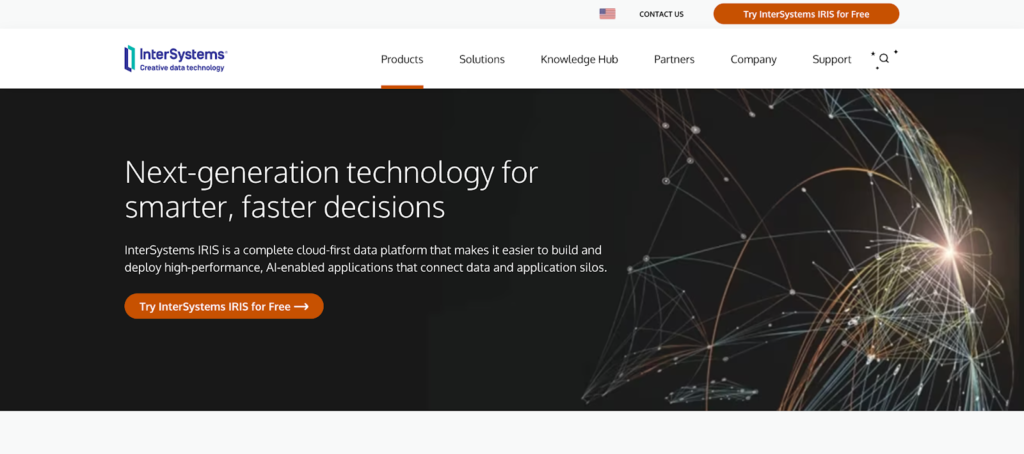
Core strength: Real-time data fabric and high-performance transactional analytics processing
Most platforms on this list manage data at rest. IRIS is built for data in motion. Its multi-model database engine supports relational, object, document, key-value, columnar, and vector data simultaneously, which means front- and middle-office applications that would otherwise require separate transactional and analytic databases can run on a single platform.
IRIS stores data in a proprietary multidimensional array structure that supports both transactional writes and analytic reads on the same dataset. That eliminates the ETL step between OLTP and OLAP systems, and with it, the latency that step introduces. The result: analytic queries running against live positions and trades, not against a stale copy loaded overnight.
For T+1 settlement workflows, real-time risk exposure monitoring, and liquidity ratio calculations that need to run against live position data, IRIS is the right tool. It also functions as a data fabric, connecting and normalizing distributed data across existing systems without replacing them.
Where it fits in the stack: IRIS excels at high-throughput, low-latency data serving and processing. It’s not a data modeling or metadata governance platform, and it doesn’t try to be.
Tradeoffs: IRIS is a specialized platform and implementation complexity reflects that. It’s not a natural fit for institutions without strong in-house engineering capability. Governance, modeling, and metadata management all require separate tooling.
Deployment: Cloud, on-premises, and hybrid
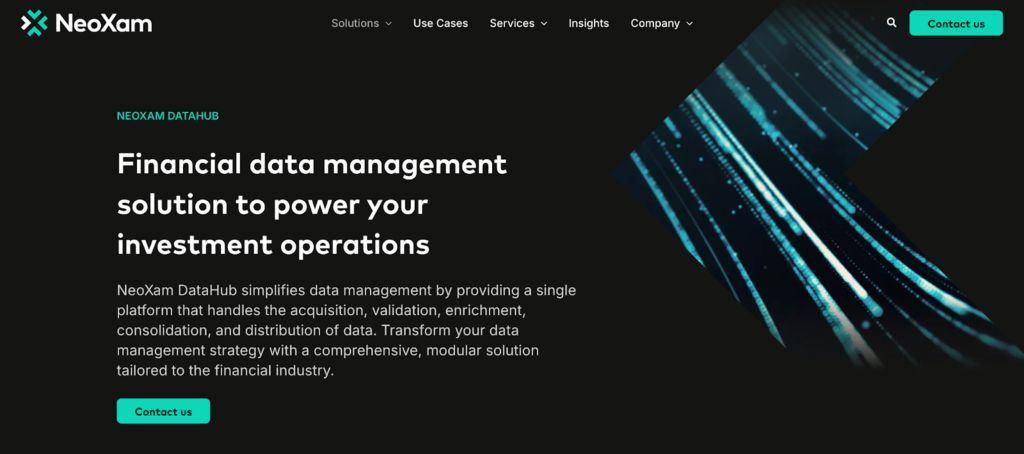
Core strength: Investment and market data management for buy-side and sell-side institutions
Generic MDM platforms struggle with the volume and specificity of investment data. DataHub is designed around that reality. It ships with pre-configured data schemas and accelerators covering instrument master data (ISIN, CUSIP, SEDOL), corporate action processing (Bloomberg, SIX, SWIFT feeds), fund hierarchies and NAV, ESG data, and benchmark data, covering the domains that buy-side and sell-side institutions actually manage.
The golden copy model is DataHub’s operational core. It consolidates multiple market data vendor feeds, applies validation and enrichment rules, and produces a single authoritative version of each data element for downstream distribution. For asset managers paying for multiple data vendors to cross-validate pricing, ratings, and reference data, DataHub automates the reconciliation and exception management that teams otherwise handle manually. Its market and risk data management module is built around BCBS 239, IOSCO, and FRTB requirements, not retrofitted for them.
Where it fits in the stack: DataHub operates at the operational data management layer for investment-specific data. Like most financial data management solutions on this list, it consumes and manages data structures rather than defining them architecturally. Organizations relying on DataHub still benefit from having formal data models and governance frameworks established upstream to maintain consistency as the platform scales.
Tradeoffs: DataHub is purpose-built for investment management use cases, which is a strength and a constraint. Retail banking, insurance, and other financial verticals will find less out-of-the-box relevance. Institutions outside the buy-side and sell-side world are better served by a more domain-agnostic MDM platform.
Deployment: Cloud-native (AWS, Azure, OpenShift) and private cloud
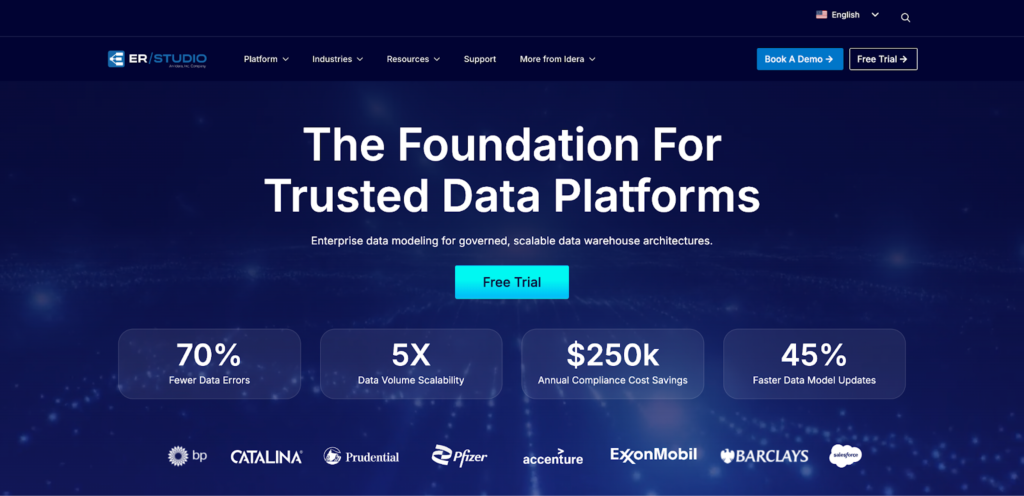
Core strength: Enterprise data modeling, metadata governance, and business glossary management
Every platform on this list manages, integrates, or processes financial data. ER/Studio defines what that data means, how it’s structured, and how it relates, before any of those platforms are deployed. Cataloging tools document what exists. ER/Studio defines what should exist and why. Those are different jobs, and conflating them is how enterprises end up with well-cataloged data that nobody agrees on.
When an Oracle OFSDF staging model, an Informatica integration pipeline, and an IBM MDM golden record all claim to represent “counterparty exposure,” someone needs to have formally defined what that means across the enterprise and where the canonical definition lives. That’s the work ER/Studio was built for.
For financial institutions, this matters for compliance mapping. BCBS 239 and related regulatory frameworks require institutions to demonstrate end-to-end data traceability from reported figures back through the data transformations that produced them. That traceability starts with a well-documented logical data model. Without it, teams rely on tribal knowledge and point-in-time documentation that rarely survives organizational change.
Team Server Core provides a centralized, browser-based portal where technical and business stakeholders can access, discuss, and validate model content together. Version control and audit trails within the repository support the change management documentation that regulated institutions need when they modify data structures.
Where it fits in the stack: ER/Studio sits at the foundational layer. It defines the architecture that the other financial data management solutions on this list implement, integrate, or serve. OFSDF’s staging model is more reliable when the structures feeding it are documented in a governed logical model. Informatica IDMC’s pipelines are more auditable when source and target structures have formal definitions. InfoSphere MDM’s golden records are more trustworthy when the domain model has been formally designed. It’s how enterprise data architecture works in regulated environments.
Tradeoffs: ER/Studio is a data modeling and governance platform, not an integration or operational data tool. Teams looking for a single platform to also move, catalog, or serve data will need complementary tooling alongside it. That’s by design. The platforms it works alongside handle execution. ER/Studio handles architecture.
Deployment: On-premises and cloud-compatible
| Platform | Primary Use Case | Ideal Buyer | Deployment Model | Core Differentiator |
|---|---|---|---|---|
| Oracle OFSDF | Regulatory reporting and risk analytics | Large retail/commercial banks | On-prem, Oracle Cloud | Pre-built financial data model for OFSAA suite integration |
| Informatica IDMC | Cloud-native data integration and quality | Enterprise-wide, multi-cloud environments | Cloud-native (multi-cloud/hybrid) | AI-assisted metadata intelligence across extensive enterprise connectors |
| IBM InfoSphere MDM | Master data management | Banks managing complex customer/counterparty data | On-prem, cloud, hybrid | Probabilistic matching for multi-domain golden record management |
| InterSystems IRIS | Real-time data fabric and high-throughput analytics | Capital markets, sell-side, fintech platforms | Cloud, on-prem, hybrid | Concurrent transactional-analytic processing on live data |
| NeoXam DataHub | Investment and market data management | Asset managers, asset servicers, investment banks | Cloud-native, private cloud | Pre-configured schemas and accelerators for buy-side/sell-side data management |
| ER/Studio | Enterprise data modeling and metadata governance | Enterprise architects, compliance teams, digital transformation leads | On-prem, cloud-compatible | Three-layer modeling with business glossary, cross-platform support, and governance integration |
OFSDF runs your regulatory reporting. IDMC moves and validates your data. InfoSphere MDM reconciles your master records. IRIS serves your real-time analytics. NeoXam DataHub manages your investment data. None of them defines the common data language that makes those activities coherent, traceable, and auditable across the enterprise.
ER/Studio handles that. For financial institutions managing regulatory obligations that demand traceability, integrating legacy core banking with modern cloud environments, or working through a SAP PowerDesigner migration, a governed data architecture layer is what makes everything else reliable.
If your data architecture isn’t formally defined, every platform sitting on top of it is working from assumptions.
Request a demo to see how ER/Studio documents what the rest of your stack depends on.




