Every organisation talks about becoming data-driven. Few can prove it. The difference between ambition and reality often comes down to structure, governance, and the ability to connect meaning across complex systems.
That is where ER/Studio stands apart. It is not simply a data modelling tool. It is a framework for making data understandable, traceable, and trustworthy across the enterprise. From healthcare and finance to energy, mining, and telecommunications, ER/Studio users are turning once-fragmented data ecosystems into unified, governed assets that deliver tangible business results.
This is not theory. These are verified outcomes from teams who have used ER/Studio to standardise metadata, eliminate manual work, and deliver data models that scale with growth.
For most data teams, growth creates complexity. More systems mean more duplication, inconsistent definitions, and longer audit trails. Documentation becomes a burden instead of a benefit. Reporting slows, errors multiply, and confidence fades.
ER/Studio changes that dynamic. It brings data architecture, governance, and modelling into one environment, connecting the technical and business perspectives of data. By linking logical and physical models with business glossaries and metadata, teams spend less time reconciling and more time improving.
Across industries, that clarity translates directly into savings, productivity, and compliance.
“Nothing else we looked at compared to ER/Studio. Describing source systems, managing data stores, maintaining master references and proving lineage to the data — ER/Studio can do all that.”
– Protective Life
Below is a snapshot of what organisations are achieving with ER/Studio. These numbers reflect measurable improvements in quality, efficiency, and governance; not incremental gains, but transformative ones.
Healthcare organisations live under constant compliance pressure, and every manual step increases the risk of inconsistency. Accolade used ER/Studio to centralise its data definitions and automate documentation. The result:
The difference was not just faster reporting, but greater confidence in every number submitted.
Financial institutions depend on precision. At Protective Life, ER/Studio became the foundation for consistent modelling and data governance. The team reported:
A Protective Life leader summarised the impact clearly:
“Nothing else we looked at compared to ER/Studio. Describing source systems, managing data stores, maintaining master references and proving lineage to the data — ER/Studio can do all that.”
Accuracy became a measurable asset, not an aspiration.
For a global mining company like Newmont, data lives across continents and systems. Coordination used to require hours of manual work each month. ER/Studio streamlined collaboration and governance across geographies, saving:
A unified metadata layer helped engineers and analysts speak the same data language, whether they were in Denver or Perth.
Retail data moves fast. Catalina adopted ER/Studio to align marketing analytics with corporate data governance. The results show how structure improves speed and trust:
By connecting marketing systems with enterprise data definitions, Catalina’s teams gained both agility and confidence.
In cybersecurity, documentation accuracy is non-negotiable. Entrust automated its model documentation with ER/Studio, eliminating manual bottlenecks and improving quality across its security data architecture:
Faster, cleaner documentation meant more time for actual security work.
Telecom operators often manage some of the most complex data environments. TalkTalk used ER/Studio to reduce manual quality checks and streamline delivery:
That improvement in time-to-market helped TalkTalk support new service launches more efficiently and reduce operational overhead.
Energy data is both regulated and dynamic. Correla implemented ER/Studio to create consistent models and reduce the manual workload tied to data management. The team achieved:
Standardizing metadata brought people and systems into alignment, creating smoother audits and faster delivery cycles.
In logistics, seconds matter and so does data quality. Werner Enterprises adopted ER/Studio to integrate multiple data sources and streamline its modelling process. Outcomes included:
By improving access and structure, Werner turned data into a driver of daily performance.
Financial technology companies depend on speed without sacrificing accuracy. FNZ used ER/Studio to optimize data model governance and reduce rework. The team reported:
Better collaboration between development and governance teams helped FNZ maintain control while scaling its platform.
LabCorp handles vast amounts of sensitive data under strict compliance requirements. With ER/Studio, the company achieved:
Consistency and compliance now work together rather than competing priorities.
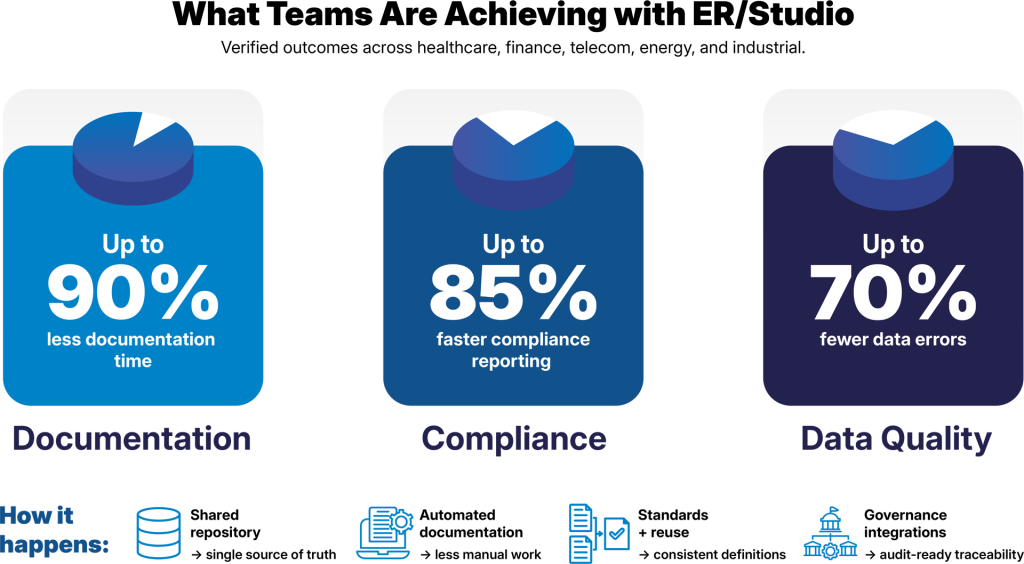
Behind every success story is a consistent set of themes that show how ER/Studio translates technical efficiency into business value.
By housing models, glossaries, and metadata in one repository, ER/Studio eliminates version confusion. Everyone references the same standards, definitions, and structures. That single source of truth simplifies audits, improves collaboration, and strengthens data confidence across the organisation.
Manual documentation is slow, error-prone, and difficult to maintain. ER/Studio automates model documentation and keeps it synchronised with production systems. Teams no longer waste hours updating spreadsheets or diagrams; they can focus on improving data quality and delivery.
ER/Studio connects to all major relational, NoSQL, and cloud databases, including Oracle, SQL Server, Snowflake, PostgreSQL, MongoDB, BigQuery, and Redshift. It fits naturally into hybrid and multi-cloud architectures, ensuring models remain consistent across environments.
ER/Studio works alongside platforms such as Microsoft Purview, Collibra, Jira, and Git-based repositories. This connectivity allows metadata and governance rules to flow through the entire data lifecycle, from modelling to deployment, maintaining traceability and compliance.
With multi-user repositories and web-based access, ER/Studio removes silos between data architects, analysts, and compliance teams. Everyone can see model changes, share feedback, and work from a single version of truth.
Whether an organization must meet HIPAA, GDPR, SOX, or internal audit requirements, ER/Studio provides visibility into data lineage and classification. That visibility helps compliance teams verify data usage and protect sensitive information before it becomes a risk.
“With its easy-to-navigate interface, everyone can understand and contribute to the data architecture, aligning goals across the company.”
– TalkTalk
When organisations adopt ER/Studio, the benefits extend beyond the data team.
Across every role, ER/Studio replaces uncertainty with control and guesswork with confidence.
ER/Studio’s results speak for themselves. Teams have cut compliance reporting cycles from months to minutes, reduced data errors by more than 70%, and eliminated hundreds of hours of manual documentation work each year. These are not isolated wins but repeatable outcomes achieved across industries and geographies.
When data becomes clear, connected, and governed, performance follows. ER/Studio enables that transformation by combining data architecture, metadata management, and governance within one scalable framework.
The potential is vast: faster reporting, lower compliance costs, more accurate insights, and greater trust in every decision made from data.
Every organisation faces different challenges, but the goal is the same: better data, better decisions, and better results. ER/Studio helps make that possible.
If your team is ready to replace disconnected tools and manual processes with a unified platform for data architecture and governance, it is time to see what ER/Studio can do.
Book a demo and discover how ER/Studio can help your organisation achieve real, measurable results.
ER/Studio combines logical and physical modeling, metadata management, and governance in one platform. It gives teams a shared repository, automated documentation, and consistent definitions across systems, which reduces rework and improves data quality. Many modeling tools stop at diagramming, but ER/Studio supports the entire data architecture lifecycle.
Yes. ER/Studio supports major relational, NoSQL, and cloud platforms, including Oracle, SQL Server, Snowflake, BigQuery, PostgreSQL, MongoDB, and Redshift. It fits naturally into hybrid and multi-cloud strategies and keeps models consistent regardless of where data lives.
ER/Studio links business glossaries, metadata, and models in one place, making data definitions clear and consistent. It gives governance and compliance teams visibility into how data is structured and used. This alignment reduces errors, strengthens data quality, and simplifies regulatory reporting.
Yes. ER/Studio integrates with platforms such as Microsoft Purview, Collibra, Jira, Git-based repositories, Denodo, and other metadata and DevOps tools. These integrations help organisations maintain traceability, automate documentation, and connect modeling work with broader data workflows.
ER/Studio automates documentation, model updates, and metadata publishing. It centralises standards and definitions, which eliminates duplicate work and prevents teams from rebuilding models from scratch. As a result, users report significant gains in productivity and accuracy.
Yes. ER/Studio is built for scale, with multi-user repositories, web-based collaboration, and support for complex enterprise architectures. Customers across healthcare, finance, energy, telecommunications, and technology use ER/Studio to manage growth while keeping governance and quality under control.