
Most data warehouse governance initiatives produce the same outcome: detailed policy documents that nobody follows. Teams bypass approval processes. Quality issues surface in production. Auditors find compliance gaps. The framework exists, but it doesn’t govern anything. It’s documentation theater: policies that look good in an audit deck but don’t change how anyone actually works.
Governance that works looks different. It lives in the tools where architects and engineers already work, catching problems at design time instead of documenting them after deployment. Build governance into your data modeling process, and you prevent quality issues, security gaps, and compliance violations before they reach your warehouse.
Governance initiatives create the exact bottlenecks they’re meant to prevent. Data teams wait days for approvals. Security policies conflict with analytics requirements. Quality checks run after data already contains errors.
The root problem is timing. Organizations implement governance downstream: after schemas are designed, after pipelines are built, after data is loaded. By that point, you’re fixing problems instead of preventing them.
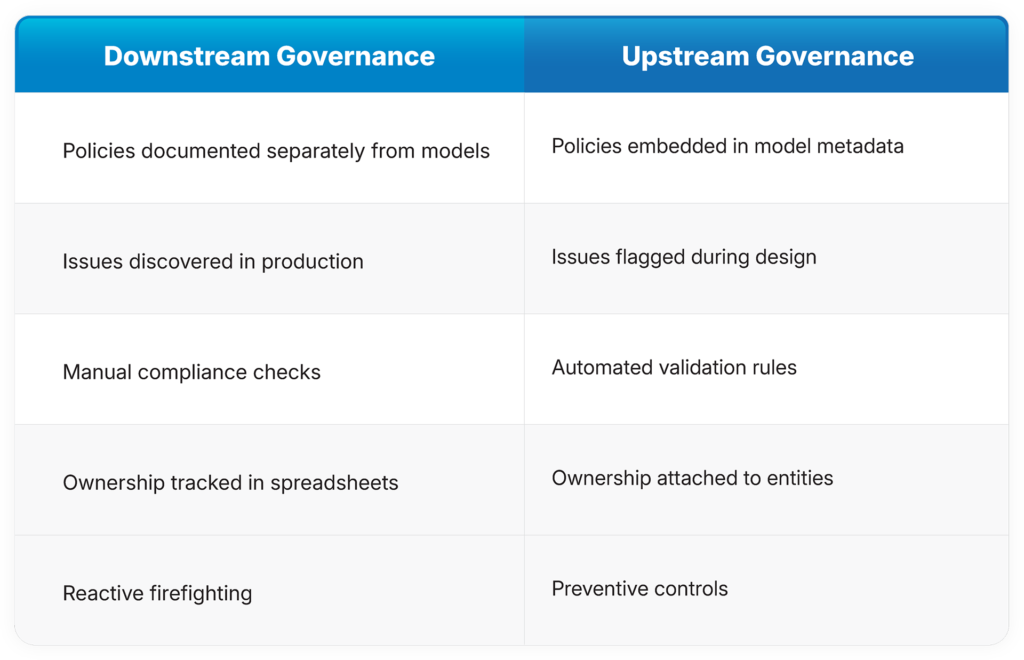
Picture a data architect designing a new fact table without governance guardrails. They choose column names that conflict with existing standards, create relationships that violate the security model, add fields that should be masked for compliance but aren’t flagged. None of this surfaces until the table is in production and analysts start querying it.
Upstream governance integrates controls into the design phase through your modeling tool. It enforces naming standards, validates security classifications, and checks compliance requirements as you work. Problems get caught when they’re easy to fix.
Your data modeling decisions determine governance outcomes. The schemas you design, the relationships you establish, and the metadata you capture create the foundation for quality, security, and compliance.
Quality management starts in the logical model, not in production monitoring. Define what “valid” means for each attribute: required fields, acceptable ranges, referential integrity rules, data type constraints. Constraints in the design get enforced consistently in downstream implementations.
Metadata management follows the same principle. Capture business definitions, data owners, sensitivity classifications, and compliance requirements as model attributes. This metadata travels with your design through development, testing, and production, rather than living in separate documentation that drifts out of sync.
Lineage tracking starts here, too. When you document source-to-target mappings and transformation logic in the model, you create an auditable trail that answers “where did this data come from?” without digging through code. Purview and Collibra consume this lineage metadata directly from ER/Studio, so your data catalog reflects actual design decisions rather than manually maintained diagrams that become outdated.
Classify tables and columns by sensitivity level as part of the schema design. Define access policies based on these classifications. Security rules get implemented consistently across environments because they’re specified in the design.
ER/Studio integrates data modeling directly with enterprise governance platforms through Microsoft Purview and Collibra. ER/Studio serves as the authoritative design and metadata source, while governance platforms operationalize those decisions across the data estate. Design decisions made in ER/Studio (naming standards, security classifications, compliance tags) feed directly into organization-wide governance frameworks. Modeling becomes the foundation for governance instead of overhead on top of it.
Ownership information that sits in a different system from the work itself fails consistently.
You assign an owner in a spreadsheet. Someone changes the schema. The owner finds out three weeks later when something breaks.
Ownership that works isn’t separate from the data.
The owner is an attribute of the entity itself. Document data owners at the entity and attribute level in your data models, and ownership becomes part of the technical specification.
When ownership lives in metadata instead of documentation, workflows route automatically.
Schema changes trigger notifications to the owner. Access requests go to the right approver. Quality issues have a clear escalation path.
Purview and Collibra make this operational. Ownership information captured in your data models synchronizes with enterprise governance tools where workflows, approvals, and accountability mechanisms live. The person who owns the Customer entity in your model becomes the owner in Purview, with all the associated responsibilities and workflows.
Most teams discover quality issues the same way: a report breaks, an analyst complains, someone investigates. You’re already in firefighting mode. The data quality check that should have happened at design time is now a post-mortem.
Automated quality validation starts in the model. Define constraints that new designs must satisfy: required attributes, allowed data types, mandatory relationships, and naming conventions. When an architect creates a table that violates these rules, the modeling tool flags it immediately.
Define validation rules in ER/Studio, and violations get flagged before anything ships. You can configure these rules to block model changes until they’re resolved. No policy document to reference, no manual checklist. The constraint is part of the design environment.
Before a schema change deploys, ER/Studio’s impact analysis shows exactly what downstream objects, reports, and processes depend on the element you’re modifying. Rename a column, and you see every ETL job, view, and dashboard that references it. Drop a table, and you know which downstream systems break. This visibility turns schema changes from risky guesswork into informed decisions.
Purview and Collibra extend this into runtime monitoring. Quality rules defined in models become runtime checks that execute against actual data. Values that violate constraints trace back to the specific model element where the rule originated.
Security policies that block legitimate work get circumvented. Overly permissive policies create compliance risk. Granular controls based on actual data sensitivity strike the balance.
Classify data at the column level during modeling. Customer email addresses have different security requirements than aggregated purchase totals. Column-level classification lets you define access policies that are both secure and practical.
Sensitivity labels applied to model attributes propagate to the actual database columns through downstream implementation. Access policies defined in your governance platform apply automatically based on these classifications. An analyst can query aggregated sales data while being restricted from viewing individual customer details, all controlled by the classifications you set during modeling.
Compliance violations happen when teams don’t know which data is subject to which regulations. An engineer working on a new feature doesn’t realize they’re handling HIPAA-protected health information. An analyst exports a dataset that contains personal data covered by GDPR.
Tag compliance requirements at the model level. Mark which tables and columns contain regulated data, document retention requirements, and specify geographic restrictions. Compliance becomes part of the technical spec, not separate documentation.
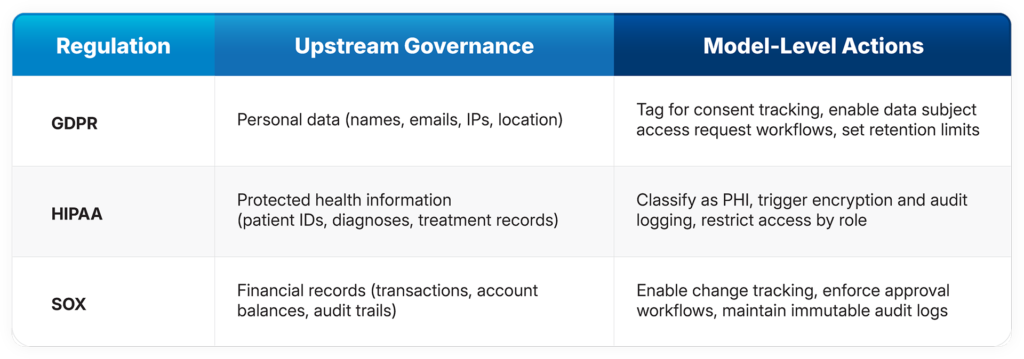
Consider a healthcare data warehouse with patient encounter data. Tag the patient_id and diagnosis_code columns as HIPAA-protected during modeling. When the table deploys to production, those classifications sync to Purview, which applies the appropriate policies that drive encryption, access controls, and audit logging in the underlying data platforms. The architect who designed the table doesn’t configure any of that. The classification drives it.
Compliance tags in your models feed into Purview and Collibra where they trigger the appropriate controls. Data marked as GDPR-covered enables required workflows for data subject access requests. HIPAA-protected information enables the required audit logging. SOX-relevant financial data triggers the controls auditors expect to see.
Governance approaches that work for ten tables fail at a thousand. Manual reviews don’t scale, spreadsheet-based documentation becomes unmaintainable, and one-off solutions for each new use case create chaos.
Scalable governance requires standardization and automation. Standard design patterns that new models follow. Automated validation that checks compliance with those patterns. Templates that make it easy to do things the right way.
ER/Studio provides this foundation through:
Your team builds new data marts or extends existing warehouses starting from templates that embed governance requirements. The modeling tool enforces standards during design. Deviations get flagged before deployment.
As your warehouse grows, governance coverage grows with it. New tables modeled in ER/Studio automatically appear in Purview or Collibra with the appropriate metadata, classifications, and policies. You don’t need separate processes to onboard new data into governance. It happens as part of a normal modeling workflow.
Data warehouse governance that actually works doesn’t live in policy documents. It lives in the modeling tools where architects make design decisions. Organizations that succeed build governance into the design phase, where problems can be prevented instead of documented.
This approach eliminates the bottlenecks that plague traditional governance: no approval queues for changes that already meet standards, no back-and-forth between data teams and compliance reviewers, no production fires from issues that should have been caught in design.
ER/Studio positions governance at the design phase, where it has the most impact, with integrations to Purview and Collibra that extend controls across your entire governance lifecycle.
Request a free demo to see how it works in your environment.




