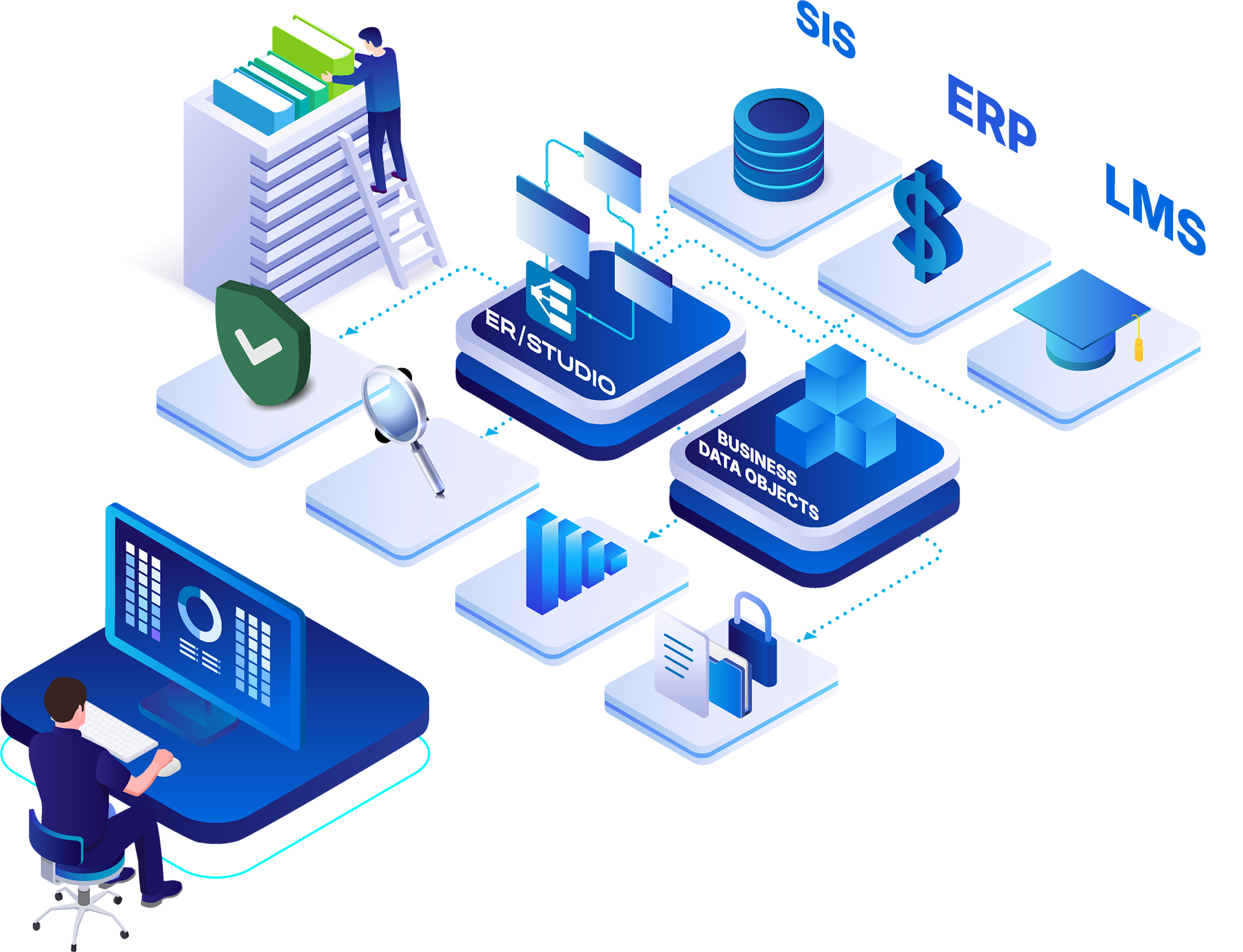
Most colleges cannot say when data modernization work will be finished, and the software explains why.
Data management in higher education runs on platforms purchased across decades, one at a time, each bought to solve a single problem. Student records sit in one system and payroll in a second. Documentation on the connections rarely exists, and the staff who built those links have retired.
This guide covers why modernization stalls there and what gets the work moving again.
Data management in higher education is the practice of governing student, financial, academic, and operational data across the systems that hold it, primarily the student information system (SIS), the ERP platform, and the learning management system (LMS), so that departments can trust it and act on it.
Four obligations define the work.
The pressure is measurable. The 2025 EDUCAUSE QuickPoll on data modernization, a poll of 165 higher education IT staff and leaders, found that 43% of respondents reported that leadership expectations exceed their institution’s current data capabilities. Among institutions still in early discussions about modernization, that figure climbs to 59%. Presidents and boards are asking for predictive enrollment models and AI-assisted student success interventions while IT teams are still reconciling which system holds the authoritative version of a student’s program of study.
The named causes are familiar. Respondents to the same QuickPoll ranked the primary barriers to advancing data strategy:
Institutions know these problems, and most have a governance committee chartered to address them.
Budget and staffing constraints are real, and no software resolves them. The barriers that architecture does reach, though, are the ones colleges and universities most often misdiagnose. Definitional drift between departments is a modeling problem before it becomes a coordination problem: the registrar’s definition of an enrolled student and the provost office’s definition diverge because no logical model has ever been established to determine which one is authoritative. Governance policy enforces standards that cannot be verified against undocumented structures. Skill gaps and turnover hit hardest when institutional knowledge lives only in individual memory, and a versioned model in a shared repository is what survives a departure.
This is why ER/Studio positions the documented model as the first deliverable in a modernization program, ahead of the policy work it must support. Layering committees and policy documents atop an undocumented foundation produces activity without progress, which explains why so much modernization work remains permanently in progress.
A registrar’s SIS that has been in production since the late 1990s, or an ERP platform that has undergone two upgrades and one acquisition, frequently lacks a current data model. There may be a diagram from the original implementation, three schema changes ago. The DBAs who understood why the enrollment table has four status columns have retired or moved to another campus, leaving the schema itself as the only remaining record of how institutional data is structured.
Reverse engineering is how data architects establish an authoritative baseline. ER/Studio reverse engineers live databases into documented physical models, capturing the tables, relationships, dependencies, and constraints that exist in production today. That model is the prerequisite for any credible governance, migration, or reporting initiative.
Timelines scale with schema complexity and the availability of subject matter experts. At Entrust, a digital security company running thousands of interrelated tables across multiple legacy systems, a business architect reported that documentation work that had taken six months could be finished in a week.
A column named stu_enrl_stat_cd still tells nobody who counts as enrolled. Financial aid treats one of its values as enrolled; the registrar does not. ER/Studio’s Business Data Objects resolve three recurring institutional conflicts by representing concepts at a business-meaningful level before expanding into entity-relationship detail.
| Business Data Object | What it spans | Why it matters |
| A student | Applicant, matriculated, and alumni records living in different tables and sometimes different systems | Gives every department the same object to reason about, with all three record types resolved into one |
| An enrollment term | The three overlapping calendar structures the SIS, LMS, and billing system each maintain | Resolves census-date (the point at which enrollment is locked for billing and reporting) and billing-cycle conflicts before they reach a report |
| A financial aid award | A defined lifecycle covering packaging, disbursement, and refund states | Surfaces award status as a single lifecycle state, resolved from the system-specific flags underneath |
A Business Data Object gives the registrar, IT, and provost teams a single shared concept to work from, so a migration or consolidation project starts with institutional knowledge already embedded in the schema. Compare and Merge then keeps that model synchronized as the live system changes, so the documentation still matches production a year later.
When the original architects of an SIS or ERP system leave, the schema is all that remains. ER/Studio’s reverse engineering converts it into a documented physical model, and the corresponding logical model records what each entity represents, how it relates to institutional processes, and which definitions the organization has agreed to.
This documented model becomes an institutional asset, preserved in a shared repository with version history. It matters most at universities where a single retirement can otherwise erase a decade of undocumented design decisions.
Governance policies and data catalogs both need an accurate foundation. A policy that says student PII must be classified and access-controlled requires knowing where that student data resides at the column level. A catalog populated with unverified or stale metadata gives stakeholders a searchable interface to the same uncertainty they had before, leaving the original problem in place while creating the impression that it has been solved.
ER/Studio bridges modeling and data cataloging. It syncs governed models bi-directionally with Microsoft Purview and Collibra, feeding technical and business metadata into the catalog and pulling changes back into the model. Institutions already invested in Purview or Collibra keep that investment. The catalog then reflects structures verified against production, which removes the manual-entry burden and the errors it introduces. When institutional metadata is stored in an SAP or Oracle ERP system, ER/Studio’s connectors import it directly.
FERPA is where this becomes concrete. The compliance questions a general counsel or registrar asks are specific:
ER/Studio’s lineage documentation, tied to a governed model, answers those questions from evidence. Manual investigation across undocumented systems answers them slowly, and with a margin of error no institution wants to defend.
Registrars, financial aid officers, provosts, and IT staff routinely use different terms for the same underlying concept, and identical terms for different concepts. Three examples recur:
Each department encodes its own version into reports, and the institution ends up with three retention rates. Terminology drift presents as a governance problem, and the fix sits in the modeling layer.
ER/Studio’s Team Server publishes models and an enterprise glossary to a web portal, so provosts, registrars, and financial aid staff can view authoritative definitions without installing modeling software or holding a Data Architect license. Three capabilities make it a system of record.
ER/Studio’s data modeling for education covers the enrollment, financial aid, and academic reporting requirements these environments entail, along with the FERPA obligations associated with student records.
SIS migrations, ERP consolidations, and new AI initiatives all carry a common risk. They break downstream reports, dashboards, and compliance processes that were never mapped to the systems being changed. The discovery usually happens after deployment, when the IPEDS extract fails or a dean’s dashboard returns null values.
ER/Studio’s universal mapping capabilities help institutions trace how data moves and relates across models, systems, and downstream environments. By documenting connections between source structures, warehouse models, and consuming systems, teams gain greater visibility into where data originates, how it is transformed, and where it is ultimately used. This traceability helps reduce uncertainty during SIS migrations, ERP consolidations, and other modernization projects by giving teams a clearer view of the relationships that need to be preserved as systems change.
Modernization at institutional scale remains a multi-year effort, and a governance baseline that pairs a glossary with documented lineage is measured in quarters, not weeks. No modeling platform changes that timeline. What it changes is the order of operations. Document the highest-stakes systems first, and governance, cataloging, and AI-assisted advising all get an accurate foundation to build on.
Most IT teams already know which system they would least like to migrate without documentation. Book a demo to see ER/Studio document that system, produce the lineage that answers the FERPA question, and map what a schema change would break.
It covers governance of student, financial, academic, and operational data across the SIS, ERP, and LMS platforms that host it, with enrollment and retention analysis, financial aid processing, accreditation and IPEDS reporting, and FERPA compliance as the recurring use cases. Ownership is often the harder question than scope. EDUCAUSE respondents describe the chief data officer role as poorly defined at many institutions, noting it cannot sit entirely with institutional research or with IT.
Data management is the broader discipline of designing, documenting, and maintaining data across systems, including the logical and physical models that describe it. Governance is the policy and stewardship layer that sits on top, defining ownership, access, and standards. Governance depends on data management, because policies need an accurate model of the underlying structures to enforce against.
A typical stack includes a data warehouse or lakehouse for reporting, ETL or ELT pipelines that move records between the SIS, ERP, and LMS, and a data catalog that holds the metadata describing it all. Each of those depends on an accurate model of the source structures. A pipeline built against an undocumented schema breaks when the schema changes, and a catalog inherits whatever the model got wrong.
Decades of schema changes accumulate, each made for a reason that made sense at the time and recorded nowhere, and staff turnover then removes the people who knew those reasons. A second problem compounds it. Departments often hold genuinely different definitions of the same term, so there is no single correct answer to write down. Reverse engineering captures the structure, and a logical model records which definition each department uses and how those definitions map to one another.
Reverse engineer the highest-stakes legacy system, usually the SIS or the ERP platform, into a documented baseline. Governance, cataloging, and AI work all rely on structures that must be documented before they can be trusted, so the glossary and governance integrations are built on top of that model. This is also the step that survives a constrained budget, which EDUCAUSE respondents ranked the second-largest barrier to data strategy, because the output is a reusable asset.