Data catalog tools let teams find, document, and govern their data assets by indexing metadata across databases, warehouses, and BI platforms. Most of them assume the systems they connect to are already well structured. In legacy environments, that assumption breaks down. The catalog harvests whatever cryptic column names and unowned tables happen to exist.
This comparison covers eleven platforms across enterprise governance, hyperscaler-native, collaborative, AI-native, and open-source categories, then identifies the right tool for your company size and governance priority.
Selection was based on four criteria.
Ratings, review counts, and implementation timelines were verified in July 2026. Where a product has no standalone listing on G2 or Gartner Peer Insights, the table says so rather than substituting a parent company or category-level score.
Disclosure. IDERA | ER/Studio publishes this article, and its Enterprise Data Catalog appears as item 6 of 11. Every tool here, including ER/Studio, was evaluated against the criteria above, with strengths and watch-outs drawn from public reviews and documented capabilities. The G2 figure shown for ER/Studio is the product-level score, not the Idera, Inc. parent company aggregate.
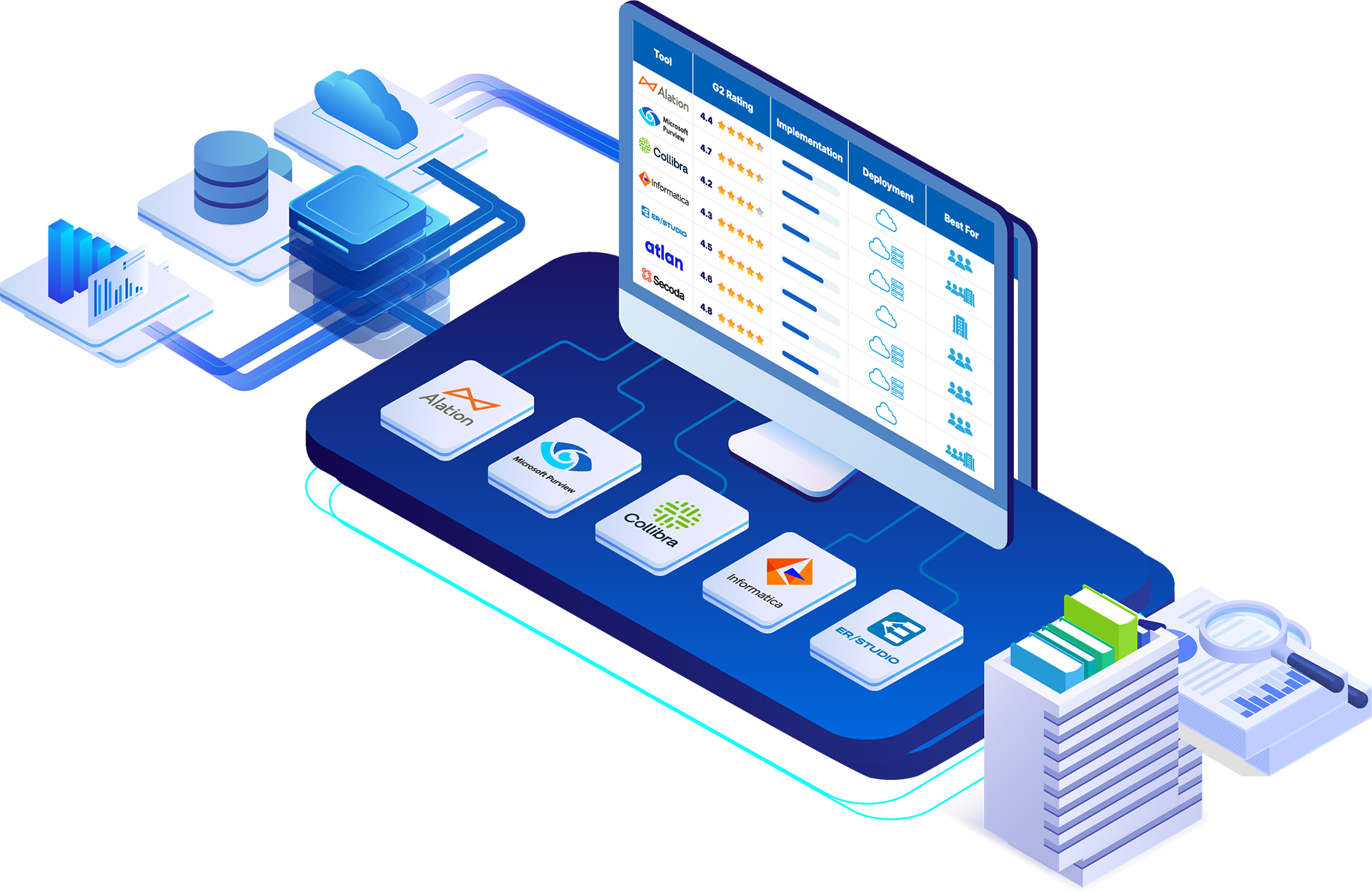
The table below summarizes all eleven platforms. Detailed evaluations follow.
| Tool | Best for | G2 rating | Avg. implementation | Pricing model | Deployment | Key differentiator |
|---|---|---|---|---|---|---|
| Alation | Large enterprises on one platform | 4.4/5 (92 reviews) | 5 months | Custom quote | Cloud, hybrid | Curation and stewardship workflow depth |
| Microsoft Purview | Microsoft-centric stacks | 4.7/5 (18 reviews) | Not reported | Consumption-based | Cloud, on-prem sources | Native Azure and Microsoft 365 integration |
| Collibra | Regulated industries | 4.2/5 (102 reviews) | 6 months | Custom quote | Cloud, hybrid | Workflow-driven stewardship |
| Informatica CDGC | Existing IDMC users | 4.3/5 (19 reviews) | Not reported | Bundled with IDMC | Cloud | Catalog inside the integration platform |
| data.world | Cross-functional collaboration | 4.2/5 (12 reviews) | Not reported | Tiered subscription | Cloud | Business-friendly collaboration layer |
| ER/Studio | Model-fed cataloging | 4.0/5 (16 reviews) | Not reported | From $2,687/user/year | Cloud, on-prem, hybrid | Catalog entries traceable to governed models |
| Atlan | Cloud-native data teams | 4.5/5 (131 reviews) | 3 months | Tiered subscription | Cloud | Active metadata with automated lineage |
| Select Star | Lean data teams | 4.5/5 (55 reviews) | Not reported | Tiered subscription | Cloud | Automated discovery with minimal setup |
| Secoda | Fast documentation | 4.5/5 (55 reviews) | 3 months | Tiered subscription | Cloud | AI-assisted search and documentation |
| AWS Glue Data Catalog | AWS-native pipelines | No standalone listing | Not reported | Consumption-based | AWS cloud | Serverless catalog inside AWS Glue |
| OpenMetadata | Engineering-led teams | No standalone listing | Not reported | Free, open source | Self-hosted | No licensing cost, active community |
Average implementation figures come from G2 reviewer data and are reported for four of the eleven platforms.
Alation is an enterprise data catalog and data intelligence platform that combines automated metadata harvesting, a searchable business glossary, and AI-assisted search across connected sources. Curation and stewardship workflows are built for organizations with named data stewards and formal review cycles.
Best for. Large enterprises consolidating discovery, glossary, and stewardship onto one platform.
What we like. Metadata harvesting reaches across a wide range of connected sources, and the stewardship and curation workflows hold up for programs with dozens of contributors. Analyst presence is strong, with 338 reviews on Gartner Peer Insights, and G2 reviewers single out search capability and customer service.
Watch out for
Pricing. Custom enterprise quote.
Rating. 4.4/5 across 92 G2 reviews.
If your organization already runs on Azure, Microsoft Purview unifies data governance, compliance, and security in one platform, with a native data catalog, a data map, and classification across cloud and on-premises sources.
Best for. Organizations running Azure, Microsoft Fabric, and Microsoft 365 as their primary data and security environment.
What we like
Watch out for. Reviewers report connectivity and implementation limitations outside the Microsoft ecosystem. Heavily multi-cloud environments should test coverage before adopting Purview as their primary catalog. The G2 review count is small at 18, which limits how much peer consensus you can read into the score.
Pricing. Consumption-based, tied to Azure pricing.
Rating. 4.7/5 across 18 G2 reviews.
Regulated enterprises are the core audience for Collibra, which provides a data catalog, business glossary, and workflow-driven stewardship designed for environments where approvals, ownership, and audit trails are requirements.
Best for. Financial services, healthcare, and other regulated sectors running formal governance programs under frameworks such as GDPR, HIPAA, and SOX.
What we like. The platform holds a 4.2/5 rating from 102 verified G2 reviews, and Gartner Peer Insights lists 291 reviews from practitioners across regulated industries. Workflow and stewardship capability is the strongest argument for it, since policies route to named owners who have to act on them.
Watch out for
Who should skip. Teams without a dedicated governance function will find the workflow depth heavier than their program needs.
Pricing. Custom enterprise quote.
Rating. 4.2/5 across 102 G2 reviews.
Informatica’s Cloud Data Governance and Catalog is a module inside the Informatica Intelligent Data Management Cloud, unifying discovery, lineage, profiling, and governance alongside the integration and quality tooling in the same environment. It supersedes the older Enterprise Data Catalog product, so buyer guides still listing EDC are describing a prior generation.
Best for. Teams already using Informatica for data integration and data quality who want cataloging in the same platform.
What we like. Because the catalog shares infrastructure with the integration layer, lineage reflects pipelines the platform already runs, down to the column level. G2 reviewers cite improved data trust, compliance support, and better decision-making, and the platform serves heavily regulated industries.
Watch out for. The value concentrates inside an existing Informatica ecosystem. Adopting IDMC for cataloging alone is a heavier lift than deploying a purpose-built catalog. G2 reviewers describe the platform as resource-intensive with a significant training requirement, and pricing is bundled into broader platform contracts rather than published.
Pricing. Custom enterprise quote.
Rating. 4.3/5 across 19 G2 reviews.
data.world is a collaborative data catalog built around an interface that both technical and non-technical users can work in, with discovery, documentation, and commentary on data assets in one place.
Best for. Organizations where analysts, business owners, and engineers all need to contribute to documentation.
What we like. Reviewers consistently cite ease of collaboration and interface usability, reflected in a 4.2/5 G2 rating across 12 reviews. For organizations pushing data literacy alongside cataloging, the collaboration layer carries real weight, since documentation only stays current when the people closest to the data will actually open the tool.
Watch out for
Pricing. Tiered subscription, contact for enterprise pricing.
Rating. 4.2/5 across 12 G2 reviews.
The ER/Studio Enterprise Data Catalog connects business terms, technical metadata, and governed logical and physical data models in one environment. ER/Studio syncs bi-directionally with Microsoft Purview and Collibra through its governance integrations, so catalog entries and glossary terms stay aligned with the platforms a governance team already runs.
Best for. Organizations that need catalog entries grounded in modeled, traceable structures with business meaning attached.
Key features
What we like. Catalog entries trace back to a governed logical model, which adds business meaning an auto-harvested schema cannot supply. The bi-directional sync extends governance investments already in place. G2 reviewers highlight how quickly enterprise-wide models can be created and published.
Watch out for
Pricing. Per-user annual subscription. Standard from $2,687 per user per year, Professional from $3,693, Enterprise by quote.
Rating. 4.0/5 across 16 G2 reviews.
Atlan is a cloud-native catalog built around active metadata, which syncs continuously with live systems and updates lineage as pipelines change. It connects to more than 80 platforms including Snowflake, Databricks, dbt, Fivetran, and the major BI tools.
Best for. Data teams operating primarily on cloud warehouses and modern BI stacks.
What we like
Watch out for. Atlan fits modern cloud-native stacks best, and its on-premises depth trails legacy enterprise governance platforms serving regulated hybrid environments. Governance workflows are also less formalized than platforms built around stewardship and policy enforcement. G2 data does put average implementation at three months, among the fastest on this list.
Pricing. Tiered subscription, contact for enterprise pricing.
Rating. 4.5/5 across 131 G2 reviews.
Select Star automatically catalogs datasets and traces lineage with minimal manual configuration, aimed at teams that want cataloging running in days.
Best for. Small data teams without a dedicated governance function.
What we like. It holds a 4.5/5 rating from 55 G2 reviews, with reviewers highlighting ease of use and precise data flow tracing, including column-level lineage and popular joins. Time-to-value is fast relative to heavier enterprise platforms, which matters when nobody on the team is assigned to catalog administration full time.
Watch out for
Pricing. Tiered subscription, contact for enterprise pricing.
Rating. 4.5/5 across 55 G2 reviews.
Secoda targets teams building documentation habits before formal governance with a modern data catalog and discovery platform that emphasizes AI-assisted search, documentation, and lineage in a layer they can adopt quickly. It connects to more than 75 data sources.
Best for. Mid-market teams building documentation habits before formal governance.
What we like. Reviewers cite ease of use and strong customer support, reflected in G2 feedback and a 4.6/5 Gartner Peer Insights rating from a small sample of 4 ratings. The AI automates documentation, tagging, glossary creation, and policy drafting, which cuts manual curation, and G2 data puts average implementation at three months.
Watch out for
Pricing. Tiered subscription, contact for enterprise pricing.
Rating. 4.5/5 across 55 G2 reviews.
The AWS Glue Data Catalog is a serverless metadata catalog built into AWS Glue, automatically indexing schemas and metadata for data stored across S3, Redshift, RDS, Athena, and EMR.
Best for. Teams whose pipelines already run natively on AWS.
What we like. Native integration with the AWS ecosystem means crawlers populate the catalog from the same infrastructure the pipelines use. Pricing is consumption-based with the first million metadata objects stored free, and G2 reviewers cite scalability, schema versioning, and cost-effectiveness at scale.
Watch out for. Business glossary, stewardship workflow, and cross-cloud governance depth are thinner than dedicated catalog platforms, and the value concentrates inside AWS-centric architectures. Teams operating across multiple clouds will need a second catalog layer for anything outside AWS. Business context and glossary capabilities are recent additions and less mature than standalone platforms.
Pricing. Consumption-based; first million metadata objects stored free.
Rating. No standalone G2 listing for the Data Catalog. G2 and Gartner Peer Insights reviews cover AWS Glue overall.
OpenMetadata is an open-source metadata and data catalog platform positioned as a context layer for discovery, cataloging, and metadata management, maintained by an active contributor community.
Best for. Engineering-led teams with capacity to run and extend their own infrastructure.
What we like. There is no licensing cost, the metadata framework is open and extensible, and the contributor community is large and active. Teams that want full control of deployment, schema, and connector behavior can get it.
Watch out for
Who should skip. Teams without internal engineering capacity to own infrastructure and maintenance should evaluate a managed commercial platform instead.
Pricing. Free, open source; self-hosted infrastructure cost applies.
Rating. Not listed on the major review platforms.
Company size determines how much governance depth and administrative overhead a catalog program can realistically absorb. Three segments emerge from the platforms on this list.
| Company size | Best-fit option | Why |
| SMB | Select Star | Fast automated discovery with minimal setup and lighter governance overhead |
| Mid-market | Secoda or Atlan | AI-assisted documentation and roughly three-month implementation without a heavy governance workflow burden |
| Enterprise | Collibra or Alation, with ER/Studio where definitions must stay tied to governed models | Formal stewardship and compliance workflows built for regulated, complex organizations |
Cost, governance depth, speed, and cloud alignment each point to a different tool on this list.
| Priority | Best-fit option | Why |
| Lowest cost | OpenMetadata | Free and open source, self-hosted |
| Catalog definitions connected to data models | ER/Studio | Entries traceable to governed logical and physical models, with bi-directional Purview and Collibra sync |
| Fastest time-to-value | Select Star or Secoda | Automated cataloging with minimal configuration, three-month average implementation |
| Deepest stewardship and compliance workflows | Collibra | Workflow engine, policy routing to named owners, compliance-grade lineage |
| Broadest hyperscaler-native integration | Microsoft Purview or AWS Glue Data Catalog | Choose based on primary cloud provider, Azure or AWS |
| Broadest connector coverage for heterogeneous stacks | Informatica Cloud Data Governance and Catalog | ML classification at scale, column-level lineage, broad platform support |
These eleven platforms serve different buyer situations, and the criteria that separate them are documented above. Add one more question to your shortlist review. Does this catalog assume a governed model already exists upstream, and if so, who builds it? A catalog indexes what is there, and the business meaning has to come from somewhere.
ER/Studio’s Enterprise Data Catalog gives data architects catalog entries grounded in governed logical and physical models, with enterprise glossary terms associated to the model objects that represent them and bi-directional sync to Purview and Collibra. See how model-fed cataloging works in practice on the ER/Studio data catalog page.
A data catalog automatically indexes metadata across the enterprise and makes it searchable, covering many systems at once, while a data dictionary is narrower and usually hand-maintained for a specific database. The practical split is in what each one answers. A catalog answers where data lives and what it connects to, and a dictionary answers what a column means and what type it holds. Catalogs also carry lineage tracking and stewardship workflows a dictionary does not.
Yes, catalogs harvest metadata from any source they can connect to. Auto-harvested metadata reflects whatever structure is already there, so a column named cust_acct_nbr stays cryptic to the business users searching for it and a table with no owner stays unowned after cataloging. A governed logical model, built separately, supplies the business definitions the catalog can then surface. Catalogs work without a model, and they are only as useful as the metadata they index.
Costs across this list span three models. OpenMetadata is free with self-hosted infrastructure cost. Microsoft Purview and AWS Glue charge on consumption. Alation, Collibra, Informatica, and data.world quote custom enterprise pricing, and ER/Studio publishes per-user rates starting at $2,687 per user per year.
G2 reviewer data across this list puts cloud-native platforms at roughly three months and governance-first platforms at five to six months, with Collibra at the top end. Timelines stretch when source systems are poorly documented, because someone has to supply the business definitions a harvester cannot infer.
No. A data modeling tool designs the structures in the first place, capturing business intent through the conceptual-to-logical-to-physical progression, while a catalog documents and indexes structures that already exist. The two roles are complementary, and the catalog is only as meaningful as the model feeding it.