
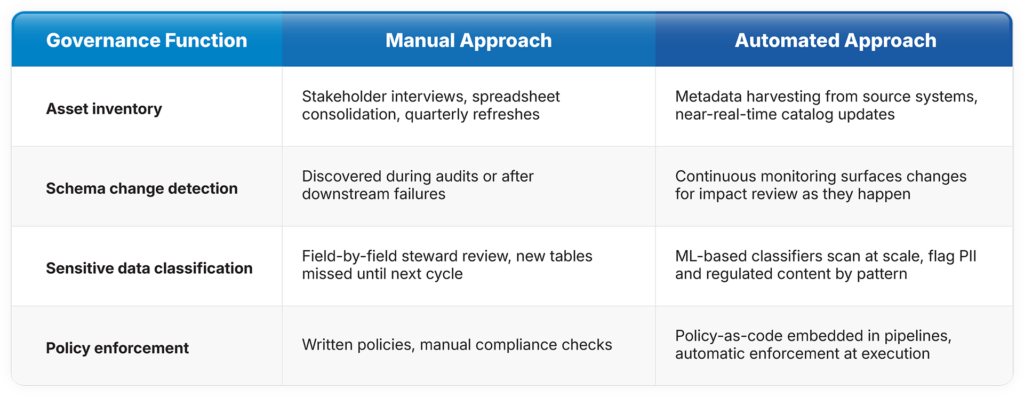
Manual governance worked when you had twelve core systems and quarterly release cycles. Most enterprises now run hundreds of systems with schema changes happening daily. The model broke.
Today’s enterprise data environments involve thousands of assets spread across dozens of platforms. Regulatory obligations under GDPR, BCBS 239, HIPAA, and regional frameworks like Brazil’s LGPD require demonstrable, ongoing control. And the pace of change means documentation written last quarter may already be wrong. Automated data governance addresses the fundamental mismatch between how fast data environments change and how fast humans can document them.
When was the last time your governance team proactively caught a schema change before it broke something downstream? If you’re thinking about it, the answer is probably never.
Asset inventories built through stakeholder interviews and spreadsheet consolidation start degrading the moment they’re finished. A schema change in a source system, a new field added by a developer, a table deprecated during a platform upgrade: none of these automatically update the catalog. Stewards find out during the next audit cycle, months later.
The documentation gap widens with scale. An enterprise running SAP, Oracle, Snowflake, and two dozen regional platforms can’t document fast enough to keep up. If you’re adding systems faster than you can document them, the gap doesn’t stay constant. It grows.
Manual audit cycles are retrospective by design. By the time a data quality issue or compliance gap is identified, it’s been compounding. That creates remediation work that is both urgent and expensive, exactly the opposite of what governance is meant to produce.
Regulators expect proactive controls. Demonstrating compliance retrospectively doesn’t satisfy that expectation.
Manual governance teams can protect a known, stable data estate reasonably well. What they can’t do is keep pace with growth. New domains get added. Business lines acquire new tools. Cloud migrations run in parallel with on-premise maintenance. Each system added to the environment is another manual documentation burden.
This is why organizations with mature governance programs still have gaps. The fundamental mismatch between the rate of change and the capacity of manual processes to track it creates gaps that staffing and process discipline alone can’t close.
Metadata harvesting pulls asset inventories directly from source systems. Automated connectors produce a near-real-time picture of what exists, where it lives, and how it’s structured. The catalog stays current because it reads from the source of truth, not a transcription of it. For enterprises managing dozens of systems, this eliminates weeks of recurring effort per governance cycle.
Schema change detection catches structural drift as it happens. Automated monitoring catches it as fields get added, types change, and tables get renamed. All of these surface for impact review before they become downstream quality failures. This matters most during platform migrations, where source and target schemas rarely align perfectly at cutover.
Sensitive data classification applies tagging rules at scale. ML-based classifiers identify PII, financial data, and regulated content based on patterns and context. They’re not perfect. They’ll tag fields incorrectly and require tuning. But they’re more consistent than field-by-field manual review and they don’t forget to check new tables. For organizations with EMEA/regional compliance obligations spanning multiple jurisdictions, automated classification is the only way to maintain current coverage.
There’s a counterargument worth addressing: some teams resist automated classification because early implementations tagged too much noise. Fair. But the alternative, asking stewards to manually review thousands of fields across dozens of systems, doesn’t scale.
ML classifiers deliver better results than what’s realistically achievable with manual review in most environments. Though that calculation shifts if you’re in a highly specialized domain with a small, stable data estate and deep institutional knowledge. Context matters.
Policy-as-code embeds governance rules directly into data pipelines. Enforcement happens automatically rather than depending on people following written policies at each step. This matters most for access controls, retention rules, and data quality thresholds where consistent enforcement is both operationally critical and a regulatory requirement. The difference shows up in audit findings: organizations with policy-as-code get flagged for configuration issues. Organizations relying on written policies get flagged for process failures. One is fixable in hours, the other takes months of remediation.
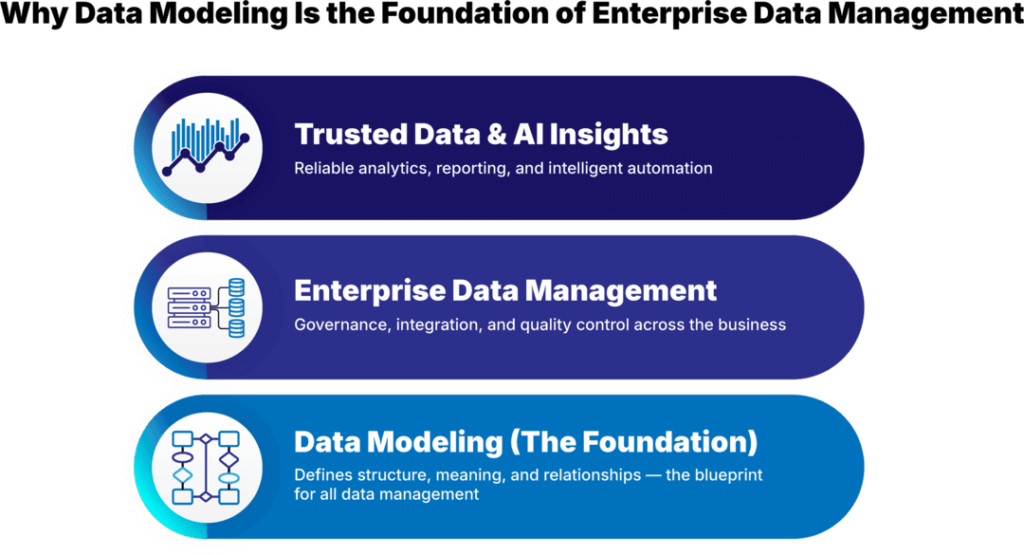
None of this works without accurate structural metadata. Most discussions of automated data governance skip this prerequisite entirely: governance tools need to know what tables exist, how they relate, and what they mean. Without current models showing these relationships, you’re automating governance of a system you don’t actually understand.
Governance tools, whether Microsoft Purview, Collibra, Alation, or a homegrown catalog, need to know what tables exist, what columns those tables contain, how entities relate to one another, and what business meaning those structures carry. Without accurate structural documentation, governance automation is operating on incomplete information.
This is the role of enterprise data modeling. And it’s often the weakest link in otherwise well-resourced governance programs.
Most large organizations are running databases that predate their current modeling practices. There’s no ER diagram. No logical model. Just the production schema and the two people who’ve been around since 2008 and know where everything is. And those two people don’t agree on what half the legacy tables actually represent.
Worse, the production schema includes tables with names like TEMP_CUSTOMER_FIX_2019 that are still in use five years later. Nobody knows what’s safe to deprecate.
Reverse engineering tools like ER/Studio connect directly to production databases and reconstruct accurate structural models automatically. What used to require weeks of analyst time now takes hours for most standard schemas. The resulting models are current, verified against the actual database, and immediately available as inputs to downstream governance processes.
Many PowerDesigner migrations stall because teams discover their .pdm files document a database that stopped existing in 2017. The current production schema has diverged so far that migration becomes archaeology. Reverse engineering your production databases gives you the actual baseline in hours instead of weeks. Whether that baseline matches what anyone thinks is in production is a different problem, but at least you’ll know what you’re actually working with.
The inverse problem is equally common: models exist, but they’ve drifted from production. Development teams modify schemas without updating documentation. Catalog entries point to structures that no longer exist or miss fields that were added informally.
Forward engineering maintains synchronization between the model and the database. Changes made in the model propagate through controlled DDL generation. Changes detected in the database surface for reconciliation. The model stays authoritative rather than becoming a historical artifact.
Before making structural changes, teams need to know what breaks. Which downstream systems consume this table? Which reports depend on that field? Which business processes reference this entity?
Impact analysis in ER/Studio maps these dependencies and surfaces them before a change is made, not after it causes a failure. Think of it as catching the changes that break quietly: a field removal that doesn’t throw an error but makes a critical report return null values, or a cardinality change that makes a join suddenly produce duplicates. These fail silently and compound for months.
For regulated environments where system changes require documented risk assessment, this capability is a compliance requirement, not just an operational convenience.
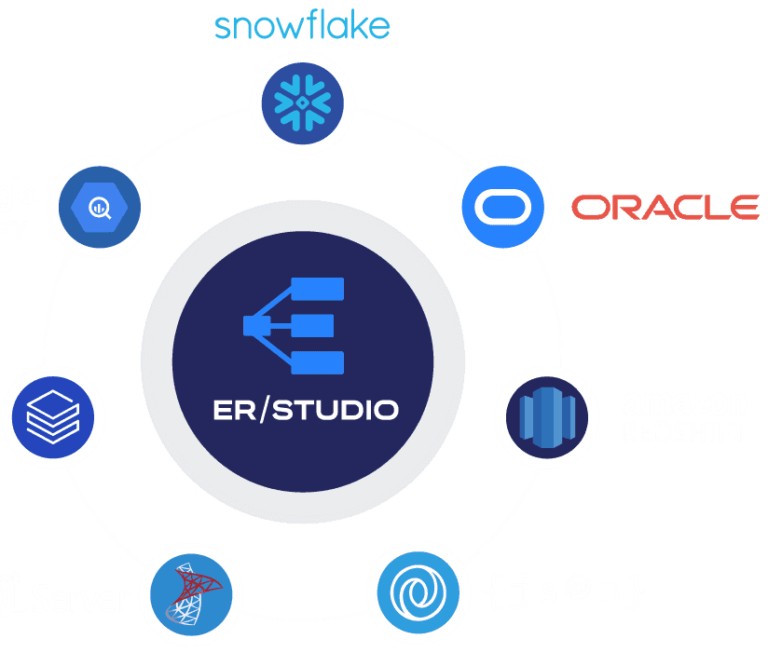
ER/Studio connects directly to production databases across Oracle, SQL Server, PostgreSQL, Snowflake, and others, and generates accurate ER models automatically. For organizations managing multi-platform environments, this means establishing current-state models without the manual effort that makes documentation projects stall six weeks in.
The models produced aren’t static exports. They stay connected to source systems, making it straightforward to detect and incorporate changes as the database evolves.
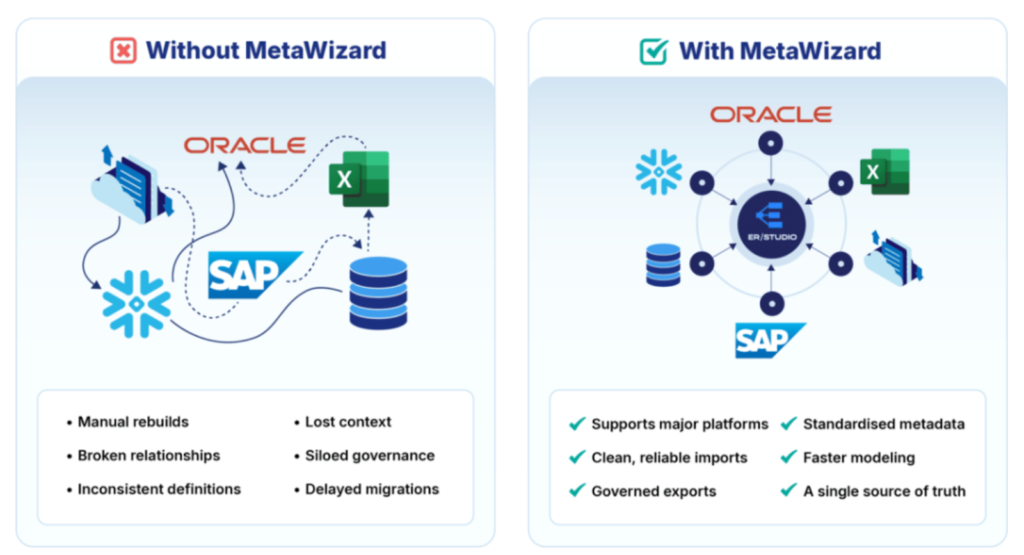
One of the most common friction points in governance programs is the manual step between modeling and cataloging. Analysts build models in one tool, then manually transcribe metadata into Purview, Collibra, or another catalog. That step introduces error and delay, and it creates two sources of truth that immediately start diverging.
The manual step creates predictable failures. A data architect updates the logical model to reflect a new customer dimension table. The update sits in the modeling tool. Three weeks later, a data steward manually transcribes it to Collibra, but mistypes the cardinality. A downstream team builds a report based on the catalog entry. The report logic is wrong. This happens constantly. One team spent three months troubleshooting why their data quality checks were failing intermittently before discovering the catalog had the wrong data type for a key column. The model had it right. The manual transcription got it wrong.
ER/Studio publishes metadata directly to leading catalogs without manual re-entry. The model becomes the authoritative source, and the catalog reflects it. This is the integration that makes the modeling layer actually useful to governance teams, not just to architects.
For new modeling work, ERbert uses natural language input to generate initial models from business requirements. What used to take days of manual modeling work compresses into hours, letting architects spend their time reviewing and refining rather than building from scratch.
The output integrates into ER/Studio’s standard modeling workflow without requiring a separate toolchain. Whether natural language adequately captures the nuance of complex data relationships is still an open question for some teams, but the time savings on straightforward modeling work are measurable.
Enterprise data modeling is a team discipline. Multiple architects, data stewards, and domain experts need to work on shared models without creating version conflicts or overwriting each other’s work. ER/Studio’s model sharing environment handles concurrent access, change tracking, and collaboration across distributed teams.
For multinationals with modeling teams across EMEA and other regions, this means a single governed model repository rather than a proliferation of local copies drifting from each other over time. In practice, achieving true single-source-of-truth across regions still requires organizational discipline around branching and merge practices, but the tooling at least makes it possible.
Accurate models feed accurate metadata governance, which enables meaningful classification, policy enforcement, and compliance reporting. That enforcement reduces the manual oversight burden. Reverse engineering keeps models current as systems change. The chain holds because each layer supports the next.
Each layer of automation makes the layers above it more effective. But it only works if the foundation is solid. Organizations that invest in automated data governance without addressing the modeling layer often find their catalogs populated with incomplete or outdated metadata, limiting the value of everything built on top.
Most teams try to stand up a catalog, implement classification, and enforce policies simultaneously. Then they wonder why nothing works six months later. A more practical approach stages automation in order of foundational dependency, though the sequence below assumes more organizational clarity than most teams actually have:
Phase 1: Establish accurate models. Reverse engineer production databases for high-priority domains. Identify where model-to-database drift is worst and address it. This creates the structural foundation everything else depends on.
Phase 2: Automate harvesting and catalog publishing. Connect ER/Studio to your governance catalog and establish direct metadata publishing. Eliminate the manual transcription step that creates drift between model and catalog.
Phase 3: Add classification and schema monitoring. Once catalog metadata is reliable, layer in automated sensitive data classification and schema change detection. These tools work best when the underlying structural documentation is accurate.
Phase 4: Implement policy-as-code for high-risk domains. Start with access controls and data quality thresholds in regulated domains. Expand once the pattern is established and the team has confidence in the enforcement logic.
This sequencing assumes you have executive support and clear ownership. Most organizations don’t.
If you’re building political capital while you build the capability, start with Phase 1 anyway. Reverse engineering production databases produces tangible artifacts, current-state models, that make subsequent budget conversations easier. You can show what you built, not what you promise to build. For organizations mid-transition from PowerDesigner or other legacy tools, this baseline becomes even more critical.
Metadata harvesting, schema synchronization, classification, and policy enforcement are all candidates for automation. Or rather, they’re the obvious candidates. What remains is the work that requires business context, regulatory interpretation, and organizational judgment: defining what data should mean, deciding how it should be protected, and determining what the enterprise’s obligations actually require. That’s where governance teams should be spending their time.
ER/Studio automates the modeling layer that makes all of this possible. Reverse engineer what exists, keep models and databases in sync, publish metadata directly to catalogs, and run impact analysis before changes go live. Everything else in the governance stack depends on that foundation being accurate.
See how ER/Studio fits your governance architecture. Schedule a demo to map it against your current environment.




