When a state DOI examiner asks where a loss reserve figure on a Schedule P came from, the answer should take minutes. For most carriers, it takes weeks.
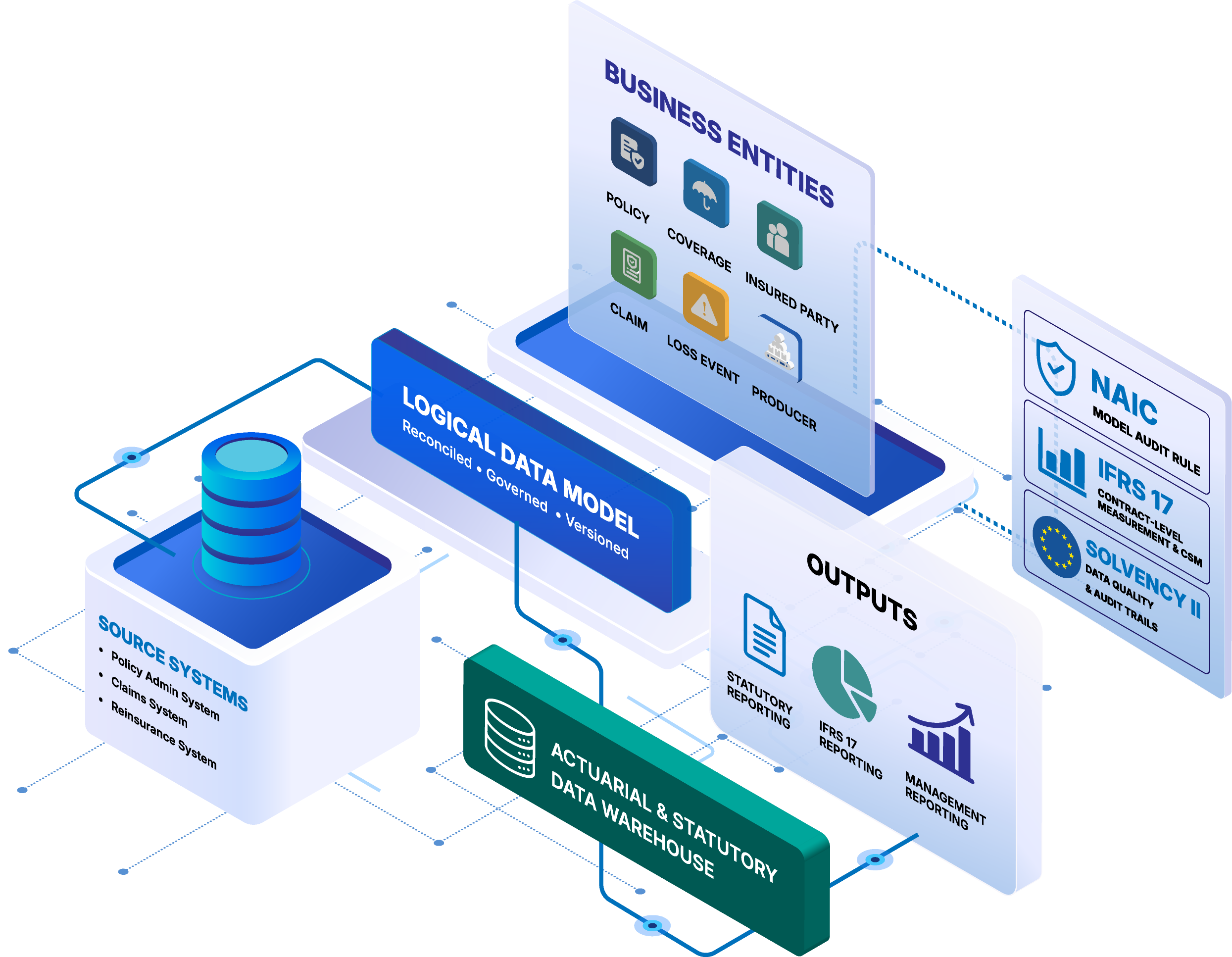
The PAS encodes one definition of an insured party. The claims system encodes another. The actuarial warehouse stitches the differences together with transformation logic written by people who left the company three reorgs ago. That is a data modeling problem, and carriers reporting under NAIC, IFRS 17, and Solvency II need a shared logical model that reconciles those definitions before an examiner finds them.
This guide covers why insurance data is structurally different from other verticals, what the major regulatory frameworks require from the underlying model, and how to modernize a legacy PAS without dragging decades of definitional debt into the next platform.
Not sure how your current model would hold up under exam? Walk us through your environment and we will show you where the reconciliation gaps tend to live in carrier stacks like yours. Talk to the ER/Studio team.
A policyholder is not a customer. The same individual can be the named insured on a personal auto policy, a claimant under a group health plan, a beneficiary on a life policy, and a counterparty in a reinsurance treaty. Each role carries its own regulatory obligations, retention requirements, and reporting definitions. If the data model conflates them, every downstream system inherits that ambiguity.
Source systems outlive their architects. Many policy administration systems still in production were designed in the 1980s or 1990s. Their schemas encode business rules that predate current product lines and reporting standards. The data team reconciles decades of structural assumptions, often with the schema itself as the only surviving specification.
The NAIC Model Audit Rule, IFRS 17, and Solvency II all ask the same underlying question: can you trace a number on a filing back to the column it came from? A carrier reporting under more than one framework needs a single logical model that satisfies all three.
| Framework | Core data requirement | Where carriers get caught |
|---|---|---|
| NAIC Model Audit Rule | Column-level lineage from statutory filing to source attribute, with documented internal controls. | High-level diagrams that say “PAS feeds the warehouse” fall apart when an examiner asks about a specific Schedule P cell. |
| IFRS 17 | Contract-level measurement, cohort grouping, and CSM tracked over the coverage period. | Policy, coverage, and endorsement data sit in systems with no shared definition of “insurance contract,” so CSM cannot be automated. |
| Solvency II | Documented data quality processes and audit trails from source data through Pillar III reporting. | Carriers reporting under both NAIC and Solvency II maintain two parallel audit trails, doubling the documentation burden and the risk of drift. |
Reporting under more than one framework? Carriers we work with use a single logical layer to satisfy NAIC, IFRS 17, and Solvency II without maintaining duplicate documentation chains. We can show you how that looks in your environment.
Insurance data modeling presents three structural challenges that compound on each other. Each one creates reconciliation work the others depend on.
ACORD reference: ACORD data standards.
ER/Studio has supported enterprise data architecture in regulated financial services and insurance environments for over thirty years. The capabilities below map directly to the modeling disciplines above.
| Capability | What it does for carrier teams |
|---|---|
| Business Data Objects | Represent ACORD entities (Party, Policy, Coverage, Claim) at the conceptual layer so actuaries and underwriting leads can validate definitions before they reach the physical schema. |
| Team Server | Publishes the enterprise glossary to a web portal so claims adjusters, actuaries, and compliance staff work from the same definition of “incurred loss” or “insured party” without needing a Data Architect license. |
| Data Governance | Pushes model definitions and metadata into enterprise governance catalogs like Microsoft Purview and Collibra, so architects and compliance teams work from the same definitions during exams. |
| Named Releases | Capture a model state at a point in time so the team can retrieve the exact model that was in production for last year’s rate filing within minutes. |
Reverse engineer first. Most legacy PAS platforms have no maintained data model. The first step in modernization is to reverse-engineer the existing schema and document what is actually running. ER/Studio connects to the source database, generates the entity-relationship diagram, and creates the baseline that the migration plan depends on. Without it, teams discover undocumented dependencies after go-live, when they are most expensive to find.
Cloud migration does not eliminate the modeling obligation. Moving from on-premises Oracle to Snowflake changes the physical target. Carriers who skip logical modeling during a cloud migration replicate the definitional inconsistencies of their legacy systems into the new platform and trade on-premises technical debt for cloud technical debt with the same reconciliation problems and a larger compute bill.
Mid-migration or planning one? We can sit down with your architects and walk through what gets reverse-engineered, what gets rebuilt, and what to preserve in the logical layer so you don’t carry the old definitions into the new platform. Book a working session.
The definitional inconsistencies that surface during a NAIC exam or an IFRS 17 audit are modeling failures: the absence of a shared, documented, versioned logical model that all systems and all teams reference. Carriers that establish that foundation before a cloud migration, before a filing cycle, and before an examiner arrives answer the hard questions without scrambling.
If that sounds like the environment you are working in, that is the conversation we have most often. We can review your current modeling setup, identify where definitional gaps typically occur in carrier stacks, and show you how ER/Studio handles reconciliation.
An insurance data model represents the key business entities in a carrier’s data environment: policies, coverages, claims, loss events, insured parties, producers, and reinsurance relationships. It defines what each entity means, how they relate, and how data from different systems maps to shared definitions. In a regulated context, it also functions as a governance artifact for statutory reporting and exams.
Carriers manage data across systems with fundamentally different entity definitions for the same business concept. The PAS defines policyholder differently than the claims system, which defines it differently than the reinsurance administration system. Add NAIC, IFRS 17, and Solvency II traceability requirements, and a formal data model is the only practical way to defend filed figures.
ACORD publishes data standards for insurance and financial services. The ACORD data model defines canonical entity structures for Party, Policy, Coverage, Claim, and related concepts. Carriers use it as a reference architecture so entity definitions align with industry interoperability standards and exchange cleanly with brokers, reinsurers, and regulators.
Most actuarial warehouses use a Data Vault pattern in the integration layer for auditability and historical traceability, with a dimensional model in the presentation layer for query performance against loss triangles and reserve estimates. Both patterns require a documented logical model as the starting point.




