
There’s a reason so many Data Vault projects start with high hopes and end with complexity fatigue. The methodology itself is solid—built for scale, auditability, and flexibility. But when teams model straight from source systems without a shared business foundation, things fall apart fast: duplicate Hubs, inconsistent keys, and layer upon layer of reconciliation logic.
ER/Studio takes a different approach. By aligning your Data Vault with enterprise business definitions from day one, it helps teams avoid the pitfalls of source-driven design—and builds a cleaner foundation for downstream layers like the Medallion Architecture. Whether you’re managing raw ingestion or delivering curated data products, starting with a business-aligned model ensures consistency all the way through.
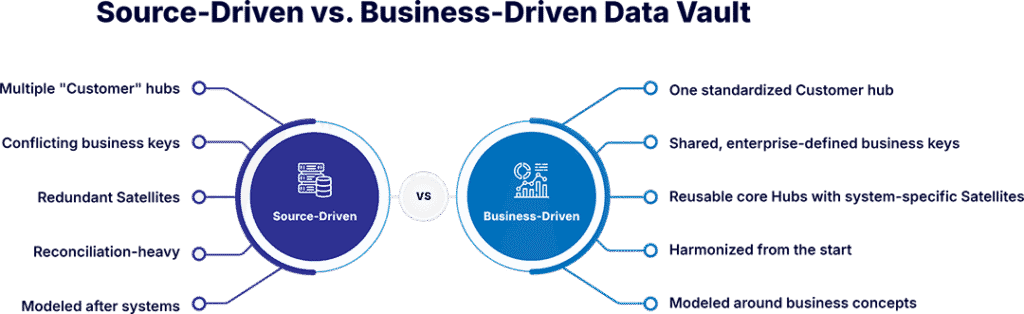
At its core, a source-driven Data Vault is built around the structure of the systems feeding into the warehouse. Each source gets its own set of Hubs and Satellites, and only after ingestion do architects try to consolidate, cleanse, and harmonize the data. The result? Multiple “Customer” hubs, conflicting business keys, and a tangled mess of reconciliation logic.
In contrast, a business-driven Data Vault starts with what matters: the business. Hubs represent core business concepts like Customer, Product, and Order, each defined once and reused across all sources. Data from every upstream system contributes Satellites to a single agreed-upon hub structure. This leads to a harmonized architecture where each concept has a standardized definition, a shared business key, and consistent lineage. This business-first approach dramatically reduces downstream integration work, speeds up delivery, and ensures higher-quality analytics.
ER/Studio is purpose-built to help organizations define the right structure upfront. Here’s how its features support the creation of an elegant, maintainable Data Vault:
The Enterprise Data Model in ER/Studio provides a centralized, governed definition of core business concepts. It includes:
This model becomes the blueprint for your Data Vault’s Hubs and Links. Instead of asking, “What does the source give us?”, your team asks, “How does this source contribute to our definition of Customer?”
ER/Studio allows architects to start with business-driven logical models, and then transform them into platform-specific physical models. Logical entities like Customer, Product, and Policy become the foundation for Hubs and Links, while Satellite tables store the change-tracked attributes from source systems.
This layered approach ensures separation of business logic and technical implementation, driving reuse and reducing redundant models.
A successful Data Vault implementation involves two key roles:
With ER/Studio, these roles are supported by separate models and workflows, ensuring a clear boundary between defining business concepts and implementing them technically.
With a centralized Repository and Team Server Core, ER/Studio allows cross-functional teams to collaborate on data models securely and efficiently:
Together, these features foster alignment between business and technical teams—crucial for any enterprise-wide architecture.
ER/Studio takes business-driven Data Vault design a step further by embedding automation directly into the modeling process—eliminating repetitive tasks and enforcing architectural consistency from day one. Rather than relying on manual templates or reverse-engineering from source systems, ER/Studio allows you to generate Hubs, Links, and Satellites from your logical business model with precision and speed.
Here’s how automation simplifies and strengthens your Data Vault implementation:

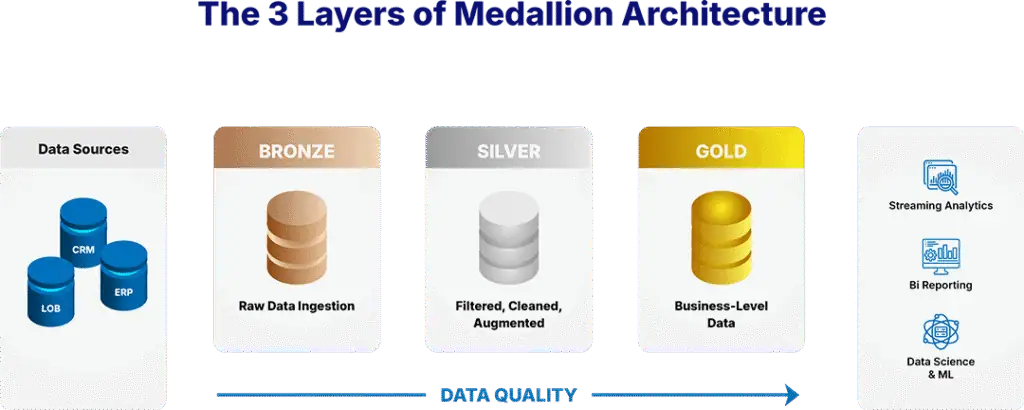
While the Data Vault methodology defines the structural foundation of your data warehouse—using Hubs, Links, and Satellites to organize raw data around core business concepts—the Medallion Architecture provides a layered framework for processing and delivering that data. In practice, Medallion layers are built on top of the Data Vault model. This layered design aligns the integrity of Data Vault with the agility of modern cloud environments like Databricks, Snowflake, and Synapse—allowing data teams to maintain governance and traceability while accelerating delivery and usability.
The Medallion Architecture structures data pipelines into three progressive layers:
Each layer builds on the last, delivering a controlled progression from raw ingestion to trusted analytics—while maintaining a clear lineage.
ER/Studio plays a crucial role in aligning these layers by providing the semantic definitions, governance structure, and automation needed to design each layer with intent:
By modeling this flow from the start—not retrofitting it after ingestion—ER/Studio ensures that Medallion Architecture is implemented as a governed, reusable delivery framework layered directly onto a business-aligned Data Vault. Pairing Medallion Architecture with a business-driven Data Vault—designed in ER/Studio—gives teams the best of both worlds: a flexible delivery mechanism layered on a rock-solid foundation of governed structure and semantics. Whether you’re designing for scale, agility, or compliance, this integrated approach ensures that your architecture delivers trusted, consistent, and business-ready data products at every stage.
80–95% of ETL code generation can be automated using Data Vault 2.0 methodologies—drastically reducing dev time and maintenance effort.
– data-vault.com
Let’s say a global insurance company has four different systems capturing customer data: CRM, claims, policy admin, and billing. In a source-driven Data Vault, each of these systems might generate its own Hub for Customer, with different business keys, different attributes, and different levels of quality.
Using ER/Studio, the Business Architect first defines a single Customer hub based on the enterprise model. The business key is the globally agreed Customer ID. Each system contributes Satellites to this Hub, storing attributes like contact info, policy history, and billing preferences.The result? One Customer definition. Multiple systems. No confusion. And a scalable architecture built to last.
Organizations implementing Medallion Architecture report 40–60% reductions in data processing costs and 70% improvement in data quality.
– Ilum
The Data Vault methodology is only as strong as the foundation it stands on. Without clear, agreed-upon definitions and governance, even the best warehouse designs can crumble under the weight of complexity. ER/Studio provides everything you need to shift from a reactive, source-centric design to a proactive, business-aligned architecture:
With ER/Studio, your Data Vault becomes more than a data warehouse framework—it becomes a strategic asset for delivering business-aligned, trusted, and actionable data products.
Want to see how ER/Studio can streamline your Data Vault design process? Speak with an ER/Studio expert today.
A source-driven approach mirrors the structure of each upstream system, often leading to duplicate Hubs and inconsistent keys. A business-driven approach, enabled by ER/Studio, defines Hubs around standardized business concepts—resulting in a cleaner, more scalable architecture.
ER/Studio’s enterprise data modeling capabilities let you define and reuse common business entities across domains. Macros and role-based workflows ensure new sources map to existing Hubs instead of creating duplicates.
Yes. ER/Studio allows you to design logical models that represent business concepts, and then transform them into physical models aligned to platform-specific constraints—ensuring consistency from design to deployment.
ER/Studio enforces governance at the modeling level. Business terms, data classifications, and lineage are all embedded in the model and can be exported to tools like Microsoft Purview for downstream visibility and compliance.
ER/Studio provides the semantic and structural foundation for each Medallion layer. It connects raw Bronze data to Silver integration logic and Gold-level business outputs—ensuring alignment across the entire architecture.
With Team Server and the central Repository, ER/Studio allows modelers, analysts, and engineers to work together—reviewing models, maintaining version control, and ensuring that the design reflects both business needs and technical feasibility.




