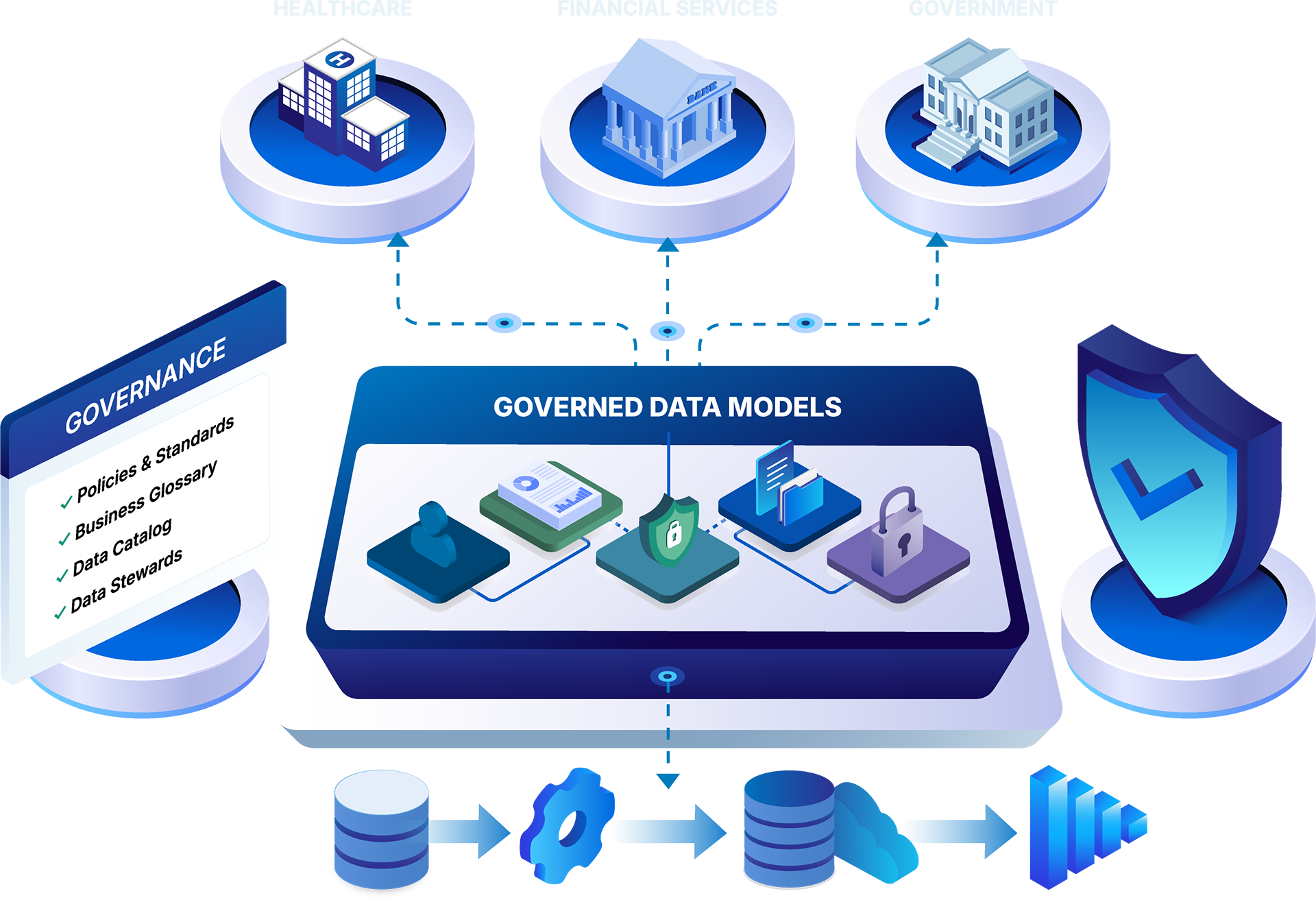
Most organizations entering a compliance audit have something in common: they have governance frameworks. They have data stewards, naming standards, a business glossary, maybe even a data catalog connected to Microsoft Purview or Collibra. What’s often missing is governance that extends all the way to the level where data is actually defined.
That gap is a primary failure point in data governance regulatory compliance programs.
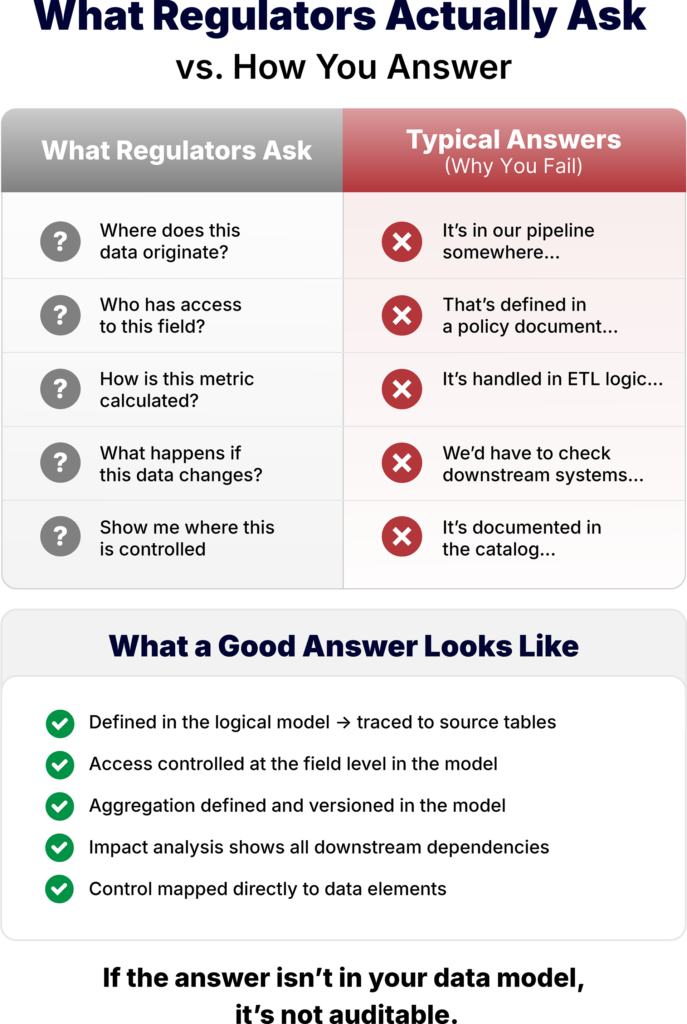
Compliance failures in healthcare, financial services, and government don’t usually happen because organizations ignored the regulations. They happen because the governance lives in documentation that sits above the data structures, not inside them. Governance ends up fragmented: policies in spreadsheets, access rules in slide decks, PHI classifications in catalogs that have no connection to the databases where PHI actually lives. When regulators ask you to demonstrate control, you can point to a framework, but you can’t trace it to the architecture.
Closing that gap requires governance embedded at the data model level, where every field definition, access boundary, and structural change is controlled, versioned, and auditable.
HIPAA’s minimum necessary standard sounds like a policy directive, but it resolves into a data architecture question: which fields, in which tables, accessible to which roles? If you can’t answer that at the model level, you can’t enforce it in the system.
The challenge compounds when health systems integrate. EHR platforms, claims processing systems, and population health analytics environments frequently share PHI across integration points, and each handoff is a potential compliance exposure if the receiving model hasn’t classified those fields correctly. De-identification adds another layer: HIPAA’s Safe Harbor method specifies 18 identifiers that must be removed or generalized for de-identification. Expert Determination requires statistical analysis. Neither is reliably scalable or auditable at enterprise scale without model-level classification of which attributes carry those identifiers and where they flow.
When health systems merge through acquisition, consent records from legacy platforms don’t automatically map to the new consolidated model. If the enterprise data model doesn’t represent consent or link to consent artifacts across systems, you’re managing consent in policy documents that have no connection to what’s actually implemented.
Consider a regional health network feeding EHR data into a third-party analytics platform. The data architect has to ensure PHI is classified in the source model, that de-identification happens at the right layer, and that role restrictions are enforced before anything crosses the integration boundary. When no governed logical model exists as the authoritative definition layer, each of those decisions is made independently, often inconsistently, and without a traceable record.
BCBS239 Principles 2 and 3 mandate that banks demonstrate data accuracy and integrity at the aggregation level. This is where many banks get caught: aggregation logic that lives in ETL scripts or transformation layers rather than governed data models is difficult to trace and harder to defend. When supervisors ask how a risk exposure figure was calculated, the answer is often a pipeline that no one has fully documented.
SOX Section 404 requires documented internal controls and auditable evidence that financial reporting systems are governed. Version-controlled data models with traceable change histories support that requirement directly. When a model change affects a reporting table, an auditor should be able to see who made that change, when, and what it affected downstream.
Dodd-Frank swap data reporting requires that counterparty exposures be accurately reported to trade repositories. Reporting correctness depends on the underlying data structures being well-defined and consistent. If your swap data model is undocumented or lives only in implementation artifacts, demonstrating that accuracy to regulators becomes significantly harder.
Take a global bank preparing for a BCBS239 review. The enterprise data architect needs to show that risk aggregation definitions are maintained in a governed model, not constructed ad hoc in ETL. Each aggregation rule needs to be traceable to a definition, and model changes need version history that an auditor can examine. In the absence of that foundation, the bank is defending its numbers with pipeline logic rather than governed architecture.
FedRAMP authorization boundaries are fundamentally a data architecture decision. Determining what data resides within an authorization boundary and what doesn’t requires knowing what that data is, where it lives, and how it connects to other systems. A data model is the artifact that can represent all three simultaneously in a single view, supporting regulatory clarity.
FISMA continuous monitoring requires that agencies demonstrate ongoing control over their information systems. NIST 800-53 controls like SC-28 (protection of information at rest) and AC-3 (access enforcement) are defined at the system and security architecture level, but they can be mapped and reinforced through the data model. A governed enterprise data model is what separates continuous monitoring that demonstrates systemic control from monitoring that only produces evidence of point-in-time compliance.
Public records retention mandates add another layer: specific record types must be retained for defined periods, and retention policies must be applied consistently. That’s not achievable if no authoritative model exists that classifies record types and maps them to retention schedules.
A federal agency undergoing FedRAMP authorization faces this directly. To demonstrate that its authorization boundary is well-defined and that controlled unclassified information (CUI) is handled according to NIST 800-53 requirements, the data architect needs an enterprise model that classifies data sensitivity, maps access controls to roles, and provides evidence of ongoing governance. A boundary diagram alone doesn’t satisfy that. A governed data model provides the level of detail regulators expect.
Five architectural pillars form the foundation of governance that regulators can actually trace, from logical model definitions through to role-based access at the modeling environment level.
A logical model should act as a central, governed definition layer for what a data element means, regardless of where it’s physically implemented. When “patient” or “counterparty” or “federal record” is defined in a logical model that’s connected to physical implementations, compliance definitions propagate through the architecture rather than being redefined at each system boundary.
Organizations must demonstrate where data originates and how it flows from source to consumption. This isn’t achievable through catalog tools alone if those catalogs aren’t connected to the models that define the actual structures.
In regulated environments, model changes carry compliance risk. Changing a field that feeds a regulatory report, or renaming an attribute that’s referenced in a HIPAA de-identification specification, can create compliance exposure that isn’t detected until an audit.
Impact analysis at the model level identifies those dependencies before a change is committed. The architect can see what downstream objects, reports, and integrations will be affected, and compliance teams can assess whether the change introduces new risk.
Regulatory frameworks use precise language that doesn’t always map naturally to physical data structures. HIPAA defines “protected health information” with specific criteria. BCBS239 defines what constitutes a “material risk exposure.” NIST 800-53 uses a specific definition of “system boundary.”
When a business glossary is integrated with the technical model, those regulatory definitions are attached to the attributes they govern. Business stewards can manage the definitions, architects can see which attributes fall under which regulatory terms, and auditors can follow the connection from regulation to data element to physical implementation.
Governance of the models themselves matters as much as governance of the data they describe. If anyone with access to the modeling environment can modify PHI classification attributes or change the definition of a regulatory data element, the integrity of the compliance framework is at risk.
Role-based access control in ER/Studio, enforced through Team Server Core, ensures that the right people have the right permissions within the modeling environment. Architects can edit models, compliance reviewers can approve changes before they’re promoted, and business stakeholders can view published definitions with no risk of modifying anything governed. Every change is logged and attributable.
Accolade, a healthcare company managing complex patient data across a hybrid environment, needed to meet HIPAA requirements while managing an expanding data landscape without a centralized modeling tool. Manual documentation was creating compliance risk: reporting processes that should have been governed were instead dependent on individual effort. After implementing ER/Studio, Accolade achieved $250,000 in annual compliance cost savings and reduced compliance reporting time by 85%. The metadata governance foundation that ER/Studio provided gave compliance documentation a structural home in the architecture, rather than a separate workstream running alongside it.
Entrust, operating across thousands of interconnected legacy database tables, faced undocumented complexity that couldn’t be communicated to leadership or audited effectively. Documentation processes that previously took six months were completed in a week after adopting ER/Studio’s reverse engineering and model documentation capabilities. The ability to visualize and document complex data structures gave auditors something concrete to examine, rather than a request that teams reconstruct evidence from scratch.
Regulatory pressure on AI systems is converging on the same problem: the data structures and inputs that produced a model output need to be documented, governed, and auditable.
The FDA’s guidance on software as a medical device (SaMD) and clinical decision support software establishes that AI systems used in clinical contexts may require documentation of the data structures and training inputs that produced a given output. OCC guidance and the Federal Reserve’s SR 11-7 on model risk management require financial institutions to maintain inventories of models, document their inputs and methodologies, and establish validation processes. These requirements ultimately resolve into questions about data structure, not just governance policy.
The data elements that feed a clinical decision support model need to be governed in the same way as the model’s other data inputs. The training data schemas, feature definitions, and output mappings for a financial risk model need to be documented in a maintainable artifact, not buried in a Jupyter notebook.
ER/Studio’s knowledge modeling capabilities allow organizations to represent these structures within the same governance environment used for operational data models. AI inputs can then be documented with the same rigor applied to any other regulated data element, and the artifacts required to support FDA or OCC compliance reviews become an output of the modeling process rather than a separate manual exercise.
Compliance fails when governance lives above the data structures rather than inside them. For healthcare, financial services, and government organizations, the cost of getting this wrong shows up in audit findings, remediation cycles, and eroded trust in the data program itself.
ER/Studio gives compliance programs their technical foundation: governed logical models, impact analysis, version-controlled changes, business glossary integration, and role-based access through Team Server Core, all connected to the catalog tools your organization already uses. It doesn’t replace legal counsel or compliance officers, but it gives their requirements a governed, traceable home in the architecture where they can actually be enforced. Governance defined at the model level doesn’t need to be reconciled with the catalog. It propagates into it.
Discover how ER/Studio supports data governance regulatory compliance across healthcare, financial services, and government environments. Request a demo to see it in action.




