
Data governance for banks fails because the infrastructure that was supposed to support it keeps working against them.
Most institutions have invested heavily in governance programs over the last decade. They have committees, stewardship frameworks, and regulatory reporting processes designed to ensure data accuracy. Yet when regulators ask banks to trace a number in a risk report back to its origin, the answer often requires hours of manual reconciliation across systems that define the same data differently.
The problem is not that governance frameworks are missing. The problem is that the underlying data architecture was never designed to support them.
Data governance for banks is the framework of policies, roles, and standards that control how a bank defines, stores, tracks, and reports its data across every system in the organization.
It establishes who owns each data asset, what each term means, where the data originates, and how it is transformed before it reaches a report or regulator.. Banks need it because regulations like BCBS 239, GDPR, Basel III, and Dodd-Frank all assume the institution can produce accurate, traceable data on demand.
Without a formal data governance program, banks risk inconsistent reporting, failed regulatory exams, and an inability to trace how any single number in a compliance report was derived from source systems.
Most banks have a data governance program in some form. They have a steering committee, a data office, maybe a chief data officer title on an org chart. What they often don’t have is a single, authoritative record of what their data means, where it originates, and how it’s transformed before it reaches a report or a regulator.
That gap is architectural. Core banking platforms, CRM systems, risk engines, and reporting tools were built at different points in time, by different vendors, with different metadata conventions. When those systems don’t share a common definitional layer, every team that touches data ends up maintaining its own interpretation. The compliance team’s calculation of counterparty exposure and the risk team’s aggregation logic can diverge in ways that are rarely documented. That inconsistency surfaces during regulatory exams, in reconciliation failures, and in the hours of manual work that precede any real analysis.
The root cause of data governance failure in banking is almost always a metadata problem: systems that define the same data element differently, with no shared layer to resolve the conflict.
The four regulatory frameworks that shape data governance obligations in banking each target a different failure mode, but they all assume the same thing: that banks can produce accurate, traceable, and timely data on demand.
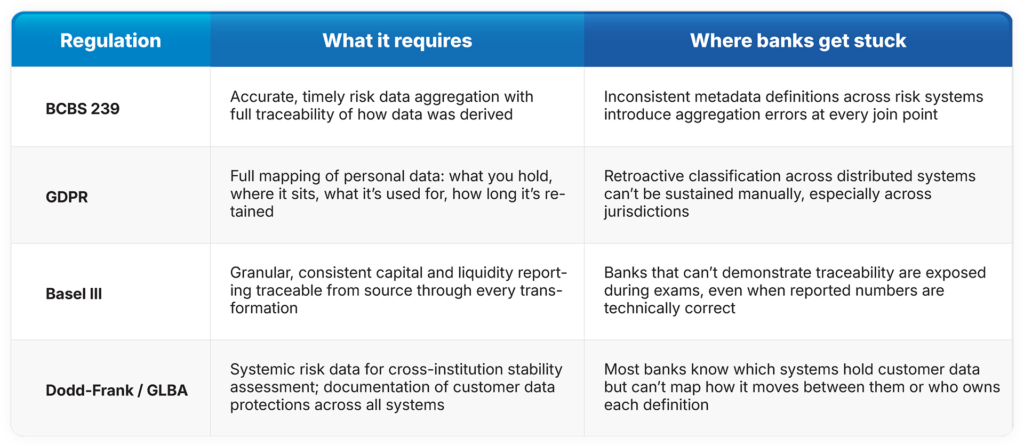
The BCBS introduced its principles for effective risk data aggregation and risk reporting because regulators discovered, during the 2008 financial crisis, that major institutions couldn’t produce accurate, consolidated risk positions fast enough to act on them. BCBS 239 doesn’t require a specific technology stack. It requires that banks demonstrate the ability to aggregate risk data accurately and quickly, with full understanding of how that data was derived.
Where most banks get stuck is metadata consistency. When risk data is aggregated across systems, the integrity of the output depends on whether each contributing system defines its inputs the same way. Without governed, enterprise-wide data definitions, aggregation introduces error at every join point. Complying with BCBS 239 means solving that problem at the architectural level, not the reporting level.
GDPR’s requirements hit from a different angle: banks must know exactly what personal data they hold, where it sits, what it’s used for, and how long it’s retained. That’s a metadata governance problem as much as a privacy problem. Institutions that can’t map their customer data across systems can’t demonstrate compliance, and they can’t respond to subject access requests or deletion requests within required timeframes.
For multinational banking groups, GDPR compliance has to coexist with local data residency rules, sector-specific regulations, and operational systems that weren’t designed with classification in mind. Retroactively classifying data across a distributed architecture is work that manual processes cannot sustain at scale.
Basel III capital and liquidity reporting requires granular, consistent data across risk categories, business lines, and legal entities. That level of consistency depends on metadata governance and supervisory reporting controls that most banks are still building.
The numbers in a regulatory report need to be traceable back through every transformation to their source, with consistent definitions applying across every contributing system. That traceability is where most institutions run into difficulty. Banks that can’t demonstrate that traceability are exposed during examinations, even when the reported numbers are technically accurate.
Dodd-Frank’s systemic risk reporting requirements, administered through the Office of Financial Research, require financial institutions to report data that regulators can use to assess system-wide stability. GLBA’s information security provisions require banks to document how customer financial information is protected across the systems that touch it.
Both frameworks assume banks can see their full data architecture clearly, and most cannot. Most can tell you which systems hold customer data. Far fewer can demonstrate how that data moves between them, how it’s transformed along the way, or who is accountable for each definition at each stage.
None of these regulations are one-time compliance exercises. They all require banks to maintain governed, auditable data definitions across an enterprise that keeps evolving.
A governance program that’s working reduces the proportion of time analysts spend cleaning and reconciling data versus actually analyzing it. If that ratio isn’t moving, the program isn’t producing operational value, regardless of how complete the documentation looks. The same failure modes show up across institutions:
The org chart says governance is unified. The tooling says otherwise, and the tooling wins.
The clearest signs a bank’s data governance program is failing are data owners with no enforcement authority, business glossaries disconnected from the modeling environment, and manual reconciliation embedded as a permanent step before every regulatory submission.
A bank data governance framework that works long-term ties definitions, ownership, and classification directly to the data model so that governance metadata stays current as the architecture changes, rather than drifting in a separate catalog.
Most banking institutions already do data modeling. They already do governance. The problem is those two functions run in separate systems. The metadata that should connect them stays siloed even after the organization has formally committed to integrated governance.
ER/Studio’s native integrations with governance platforms including Collibra and Microsoft Purview close that gap at the infrastructure level. Data definitions, classification rules, and model documentation flow between the modeling environment and the governance catalog without manual reconciliation. When an architect updates a model, the governance catalog reflects that change. When a compliance team tags an asset in Purview, that context is available in the modeling environment where the architecture is actually maintained.
ER/Studio integrates natively with Collibra and Microsoft Purview to synchronize data definitions, classification rules, and ownership metadata between the modeling environment and the governance catalog, eliminating the manual reconciliation step that undermines most bank governance programs.
That integration layer matters for regulatory compliance in a specific way. Banks relying on disconnected tools can still produce accurate reports, but they can’t demonstrate traceability from the reported figure back through every transformation to its source without manual reconstruction. ER/Studio produces audit-ready documentation because the model and the governance metadata live in the same connected environment. They’re not parallel artifacts that get reconciled on a schedule. They’re the same source.
For BCBS 239 compliance, that means risk data aggregation logic is documented where it actually lives, in the architecture, rather than in a separate specification that may or may not reflect current practice. For GDPR and GLBA, classification and ownership metadata travels with the model rather than requiring a separate tagging exercise every time the architecture changes.
Enterprise data modeling and regulatory compliance aren’t parallel efforts that occasionally need to sync. In a well-governed banking architecture, they’re the same workflow. Banks whose governance programs survive past the pilot phase have usually made the same architectural decision: they’ve stopped treating data models and governance catalogs as separate systems and started treating the model as the authoritative source of governance metadata.
ER/Studio is built to support that decision directly. Most tools do modeling well or governance well. Fewer connect both in a way that keeps metadata current across the architecture without manual intervention.
Banks that close that gap don’t just satisfy regulators more efficiently. They build governance infrastructure that holds as the architecture evolves, rather than documentation that starts drifting the moment the next system change goes in.
The difference between a bank governance program that survives and one that stalls is whether the data model itself carries the governance metadata, or whether that metadata lives in a separate system that falls out of sync every time the architecture changes.
Is your team still reconciling data models and governance catalogs by hand before every regulatory submission?
See how ER/Studio connects them natively with Collibra and Microsoft Purview so that traceability from origination to reporting stays current without the manual rebuild.




