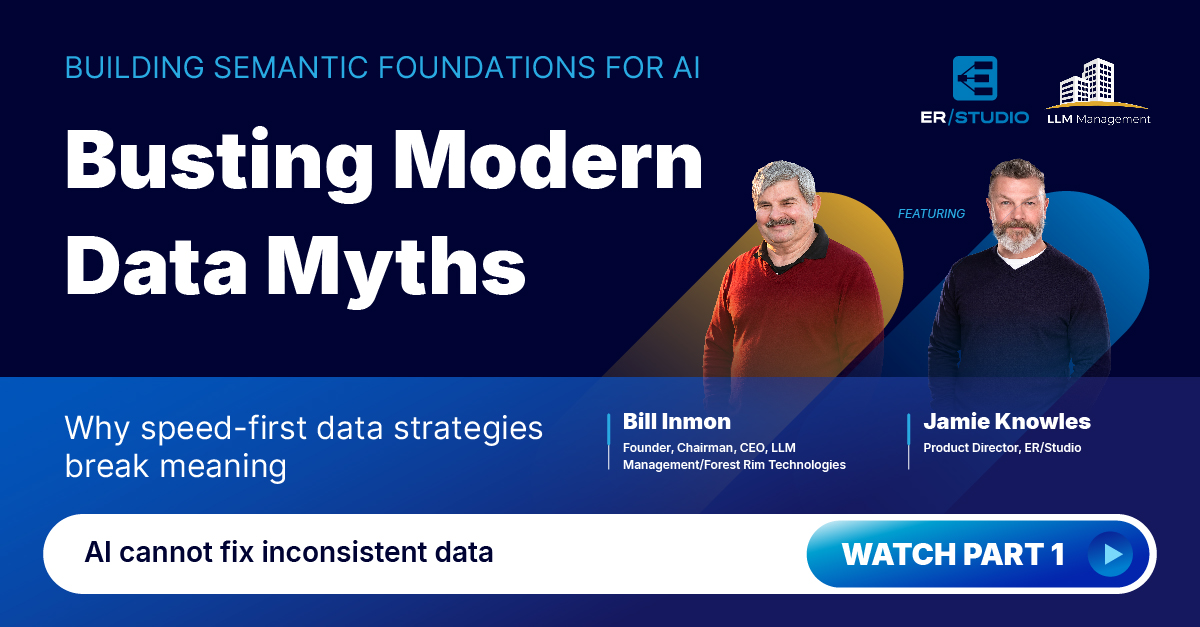
Modern data platforms are optimized for speed, scalability, and pipeline-driven delivery. But moving data faster does not guarantee that data remains consistent, trusted, or clearly understood.
As organizations scale analytics and adopt AI, inconsistent definitions and fragmented data models can lead to conflicting metrics, unreliable outputs, and reduced trust.
In Part 1 of this series, Bill Inmon and Jamie Knowles revisit foundational data architecture principles and challenge common assumptions shaping modern data strategy. They examine why approaches such as centralizing data first, refining meaning later, relying on downstream semantic layers, or expecting AI to resolve inconsistencies often introduce more complexity.
This session explores how semantic drift develops across pipelines, BI, and AI systems, why it becomes more problematic in AI use cases, and what it takes to restore a consistent data foundation.
Part 2: Why Unstructured Data Fails AI and How to Fix It
Part 2 builds on this foundation by exploring how Textual ETL helps prepare unstructured data for AI. Learn how to reduce noise, extract signal from text, and align unstructured data to a shared semantic model.
Data architects, data modelers, data engineers, governance leaders, analytics leaders, and AI stakeholders are responsible for building or modernizing data environments.
Bill Inmon
Founder, Chairman, CEO, LLM Management/Forest Rim Technologies
Widely recognized as the father of data warehousing
Jamie Knowles
Product Director, ER/Studio
Watch this on-demand session to learn how semantic drift develops across modern data environments and why shared meaning is essential for reliable analytics, governance, and AI.
Semantic drift occurs when data definitions, context, or meaning become inconsistent across systems, teams, or downstream uses.
Many modern strategies prioritize speed, pipelines, and platform consolidation. Without strong modeling and shared definitions, meaning can diverge as data moves and transforms.
AI depends on the data and context it receives. If definitions are inconsistent or meaning is unclear, AI outputs can reflect or amplify those inconsistencies.
Data modeling provides structure, definitions, and context. This helps teams align data meaning across systems and create a more reliable foundation for analytics and AI.
No. Many organizations can improve outcomes incrementally by strengthening modeling practices, aligning definitions, and improving semantic consistency across existing systems.
Connect with our team to explore how ER/Studio supports data modeling, governance, and AI-ready architecture.




