
Turning raw data into business value is no longer about pipelines and platforms alone, it’s about product thinking. “Data as a Product” (DaaP) is reshaping how organizations design, govern, and deliver data for real consumption, putting data stewards and business intelligence teams at the forefront of value creation.
But adopting a DaaP mindset isn’t just a change in labeling, it’s a fundamental shift in how your data is structured, managed, and served to stakeholders.
This post outlines how to set up the Data as a Product approach from the ground up, highlighting key roles, step-by-step guidance, real-world examples, and the tools that make it sustainable—especially ER/Studio, which provides the modeling and metadata foundation to make this approach repeatable, governable, and enterprise-ready.
Data as a Product means managing datasets not as internal tools or raw tables, but as discoverable, purpose-built products designed to serve a specific audience with a defined business outcome. Each product should be versioned, documented, stewarded, and easily consumed. This mirrors how software products are managed, designed for clarity, maintained over time, and shaped by user needs.

You can’t productize everything at once, nor should you. The first step is to carefully select a handful of high-value, high-visibility datasets and formally define them as data products.
Establishing strong, foundational data products sets the tone for the rest of your DaaP rollout. Picking use cases that are already well-known and in demand helps demonstrate quick wins and increases internal support.
A national retail company selects “Weekly Store Sales Snapshot” as its first data product. This dataset combines point-of-sale (POS) records, inventory data, and store metadata into a single, reusable view for regional managers and supply chain analysts.
Instead of asking IT to build ad hoc reports, stakeholders now access one trusted source with clear documentation, saving time and reducing reporting conflicts.
Using ER/Studio, you can model this product at the conceptual level, identifying core entities like Store, Transaction, Product, and Inventory, before implementing physical schemas. This alignment ensures stakeholders sign off early and reduces rework later.
Every data product must have a clearly defined owner (typically a data steward) who is responsible for maintaining its quality, understanding its meaning, and serving as the point of contact for business users.
Without stewardship, data products quickly lose trust. Unclear ownership leads to ambiguity about definitions, quality issues, and refresh cycles, all of which erode adoption.
A financial institution creates a “Customer Profitability Index” product. A senior analyst from the finance team is named steward and collaborates with IT to define margin calculations, threshold rules, and proper filters for account types.
When stakeholders have questions or suggestions, they know exactly who to ask, reducing cycles of revalidation and confusion.
ER/Studio supports assigning stewards directly within the model. Their names, contact info, and roles are displayed in Team Server and metadata exports, ensuring transparency across departments and tools.
A data product is only valuable if its structure and definitions are consistent across systems and users. That starts with building it on a foundation of shared metadata and a common enterprise vocabulary.
If every department defines “Revenue” or “Customer” differently, your data products will be misused and misinterpreted, no matter how well they’re built. Standardizing definitions avoids data silos and reconciliation nightmares.
Marketing defines “Active Customer” as anyone who has transacted in the past 90 days, while Sales defines it as anyone with a current contract. The two definitions are reconciled, agreed upon, and then published in the enterprise glossary and used in both teams’ data products.
Reduces rework, strengthens governance, and ensures that business intelligence tools reflect the same reality across functions.
ER/Studio’s Enterprise Glossary enables teams to define key terms and connect them to specific attributes in logical and physical models. This allows a single version of the truth to cascade through lineage diagrams, governance tools, and even BI outputs.
Designing a great product isn’t enough; it has to be discoverable, understandable, and easy to use. That means documenting it thoroughly and making it available where users are already working.
Self-service BI can only thrive if data products are served in a way that’s understandable and trustworthy. Otherwise, analysts will go back to shadow IT and spreadsheets.
An HR department releases a “Global Workforce Attrition” product to track trends across departments, tenure, and geography. The product includes a detailed definition of “attrition,” links to HR system fields, and is tagged by department in the catalog.
Saves hours of time answering repeat questions and helps analysts across regions pull the same, approved data into Power BI or Tableau.
ER/Studio integrates with data governance tools like Collibra and Microsoft Purview, allowing full metadata, including glossary terms, lineage, and steward roles, to be published alongside the data product. This ensures consistent definitions across all consumption platforms.
“What clearly stands out from our research is the need for companies to treat information as a product. Often, however, companies treat information as a by‑product; they focus on the systems or the events that produce the information instead of the information content.”
– MIT Sloan
Once a data product is live, the real work begins. Like any software product, it must be maintained, monitored, and evolved based on usage and user feedback.
Without feedback, products go stale or miss the mark. Keeping a pulse on adoption and usefulness is critical to maintaining trust and guiding the development roadmap.
The legal team’s “Contract Renewal Risk” product gets heavy use in Q4 but drops off afterward. Based on usage patterns, the steward adjusts the refresh cycle to quarterly and removes unused columns to streamline consumption.
Allows stewards to continuously improve and refine products based on how they’re used, not just how they were originally planned.
ER/Studio logs model version history and change tracking, helping teams monitor what’s been updated and why. Team Server’s collaborative environment allows users to leave feedback directly in the metadata environment for quick iteration.
Your data product isn’t fully successful until it seamlessly connects with the BI layer, so users can analyze it without reengineering logic or revalidating metrics.
BI tools are the front-end where data products meet their audience. If the definitions in Power BI or Tableau don’t match the source models, trust breaks down instantly.
A product manager uses a “Subscription Churn Cohort” product in Looker. It has been modeled to match the same definitions used in data warehouse views and customer-facing dashboards, ensuring consistency from internal reporting to board decks.
Drastically reduces duplication and rework in dashboard creation while improving trust and reuse of published metrics.
ER/Studio enables logical-to-physical mappings and supports downstream publishing workflows, ensuring alignment between what was modeled and what appears in your BI environment. This makes it easier to trace dashboard elements back to the original data product.
As your catalog of data products grows, automation, governance, and scalability become essential to maintain control and compliance.
Without governance, the DaaP approach risks becoming just another shadow system. Controls are needed to ensure every product meets quality and compliance standards.
A regulated utility company enforces a rule that any data product containing customer addresses must go through privacy review. The steward submits the new “Service Outage by ZIP Code” product to the data governance team for approval.
Mitigates risk, protects PII, and ensures every published product is trustworthy and compliant.
ER/Studio supports workflow automation and governance integrations, including Git version control, Jira for issue tracking, and metadata syncs with leading governance platforms. Changes are tracked, approved, and fully documented before deployment.
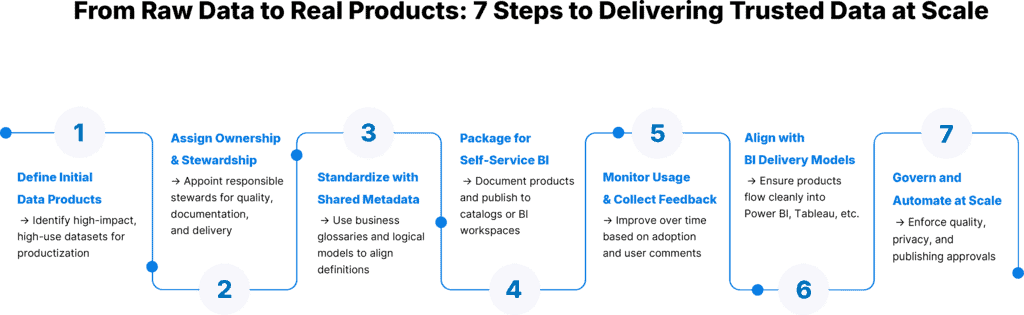
Data as a Product is more than a process, it’s a discipline. When implemented well, it brings together business, data, and IT teams to deliver real outcomes at scale.
ER/Studio is uniquely equipped to support this transformation, offering:
If you’re ready to stop treating data like a raw asset and start managing it like the strategic product it is, chat with an ER/Studio expert.
A data product is a curated, governed, and reusable dataset designed to serve a specific business purpose. Like any product, it has a defined audience, clear ownership, supporting documentation, and measurable value. It might be a dataset powering a KPI dashboard, a feed for a machine learning model, or a trusted report layer used across departments.
Each data product should have a dedicated data steward or product owner, someone who understands the data’s business purpose and is responsible for maintaining its quality, definition, and delivery. ER/Studio allows you to assign these roles directly in your data models and metadata repository.
Yes. ER/Studio integrates with governance platforms like Microsoft Purview, Collibra, and others, making it easy to publish data models, business glossaries, and product metadata into your existing catalog environment. Your organization can continue using existing tools while benefiting from ER/Studio’s modeling precision and stewardship features.
ER/Studio acts as the blueprint and governance layer for Data as a Product. It helps teams:
– Design business-aligned models (conceptual → logical → physical)
– Define and enforce business glossaries
– Assign data stewards and manage metadata
– Trace lineage from raw sources to dashboards
– Publish product documentation into catalogs or BI tools
It connects technical implementation with business understanding—ensuring that every product is not only built correctly, but also governed and trusted.
Start by identifying one or two business-critical datasets already being used across departments. Use ER/Studio to create a conceptual model, define the business terms in the glossary, and assign a data steward. From there, you can formalize delivery into BI tools or catalogs and treat it as your first real data product.