Organizations are moving quickly to adopt artificial intelligence, but AI readiness involves more than selecting models, platforms, or tools.
AI also depends on the quality and context of the enterprise data it is asked to interpret.
When information is distributed across different platforms, business definitions conflict, data relationships are undocumented, or critical knowledge exists only in the minds of employees, AI may be able to access that information without fully understanding what it represents.
That creates a fundamental challenge for organizations scaling AI:
Does your data provide enough context to support trustworthy interpretation?
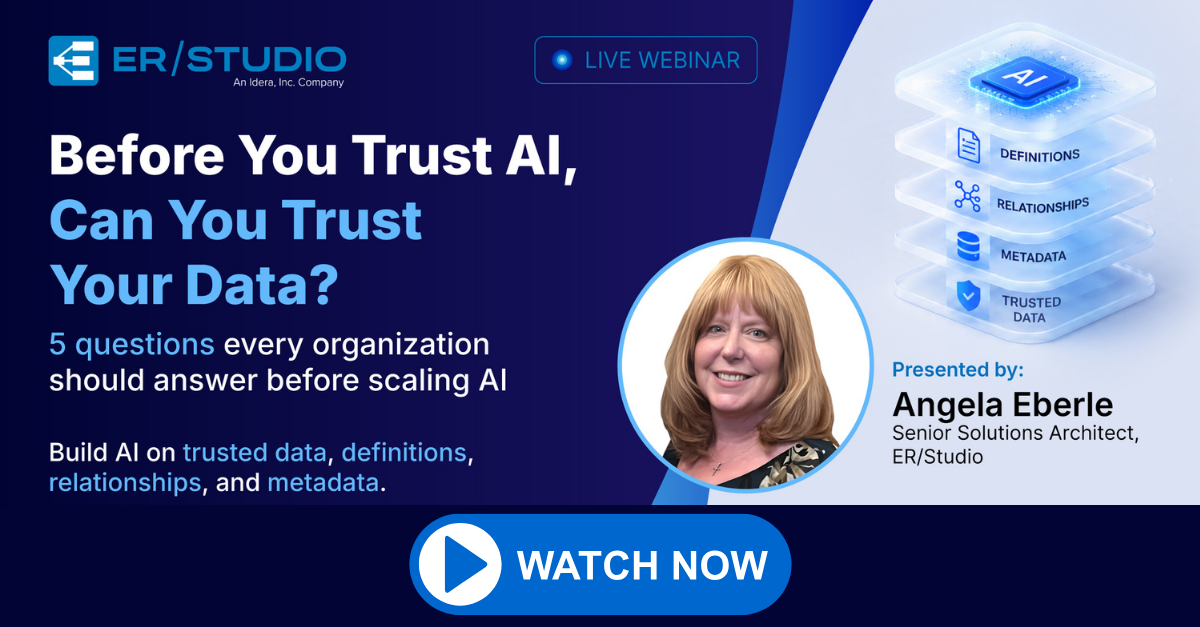
In this on-demand webinar, Angela Eberle, Senior Solutions Architect, ER/Studio, explores five questions organizations can use to evaluate their data foundation for AI.
The session examines how data modeling, business definitions, relationships, mappings, traceability, and metadata can make enterprise data easier to understand.
Angela also demonstrates ER/Studio 21.1 and highlights new capabilities designed to help organizations better leverage data architecture and metadata for AI initiatives.
By strengthening the connection between technical data structures and business meaning, organizations can create a more trusted foundation for AI.
This on-demand webinar is designed for data architects, enterprise architects, data modelers, data engineers, data governance leaders, metadata managers, analytics leaders, database designers, AI stakeholders, and technical leaders responsible for preparing enterprise data for AI initiatives.
Angela Eberle
Senior Solutions Architect, ER/Studio
Watch this recorded session with Angela Eberle to learn how data modeling, metadata, definitions, relationships, and mappings can help your organization build a stronger and more trusted foundation for AI.
This webinar explores five questions organizations should answer before scaling AI initiatives. It focuses on whether enterprise data has the definitions, relationships, traceability, mappings, and metadata needed to provide AI with meaningful context.
The webinar is presented by Angela Eberle, Senior Solutions Architect, ER/Studio.
AI can access large volumes of information, but access does not guarantee correct interpretation. Clear definitions, documented relationships, mappings, and metadata help explain what data means and how different information connects.
Data modeling documents important structures, entities, attributes, and relationships within enterprise data. This provides a clearer representation of how information is organized and connected and can contribute important context to AI initiatives.
Metadata provides information about data, including definitions, relationships, structure, ownership, and other context. This can help organizations make data easier for both people and AI-driven systems to understand.
The webinar demonstrates how ER/Studio can help teams document data models, definitions, relationships, mappings, and metadata. It also highlights new capabilities in ER/Studio 21.1 designed to help organizations better leverage their data architecture and metadata for AI.
The session is relevant to data architects, data modelers, governance professionals, enterprise architects, data engineers, analytics leaders, metadata teams, database designers, and AI stakeholders.
Explore ER/Studio resources or contact the ER/Studio team to discuss your data modeling, metadata management, governance, and AI-readiness requirements.
Connect with our team to explore how ER/Studio can help your organization strengthen data modeling, metadata, governance, and architecture as you prepare for AI initiatives.




