For many data teams, the idea of adopting an enterprise or common data model sounds like a long-term goal—an ideal state you can only reach by going back to the drawing board. And that assumption often wrongly leads to hesitation.
“If we didn’t define everything up front, doesn’t that mean we’ve already missed the boat?”
It’s one of the most common—and most damaging—myths in enterprise data architecture:
that building consistency and reuse across your data requires you to start over.
In reality, the best time to adopt a consistent, business-aligned modeling framework is now—regardless of whether you’re launching a new system, modernizing a legacy platform, or managing dozens of decentralized environments. Tools like ER/Studio are designed to work with your architecture as it exists today, supporting both greenfield and incremental adoption models.
In this post, we’ll walk through what enterprise and common data models really mean, how they relate to polyglot environments, and why you can start using ER/Studio no matter where you are in your architecture lifecycle.
“It isn’t practical to continuously redefine architecture from scratch, but neither is a quick fix bolt-on a sustainable approach. We need to be able to fit new concepts and components neatly into existing architecture—to adapt to changes without disruption.”
- Eckerson Group
In many organizations, terms like enterprise data model そして common data model are used interchangeably—but they’re not quite the same. They solve related problems and often work in tandem, but they operate at different scopes and serve different purposes.
Let’s unpack what they each mean, where they overlap, and how ER/Studio fully supports both—plus polyglot modeling environments where no single structure fits all.
アン enterprise data model (EDM) is a high-level, business-aligned framework that defines core data entities and relationships used throughout the organization. Think of it as the blueprint for how your business defines and understands information across domains.
EDMs are particularly valuable because they:
While EDMs don’t always define every table or field, they establish the critical patterns and terminology that shape how new data assets are designed. They ensure that the entire organization is building toward the same model—even when individual implementations vary.
A common data model (CDM) is more tactical. It typically refers to a specific set of reusable data definitions used across multiple applications or projects. Common models often reflect shared business objects—like invoice, shipment, service request, あるいは purchase order—that recur in different contexts.
The advantage of common models is that they’re:
You might have dozens of common models within a larger enterprise model. The two aren’t in conflict—they’re complementary building blocks. Where the enterprise model provides the framework, common models fill in the tactical details.
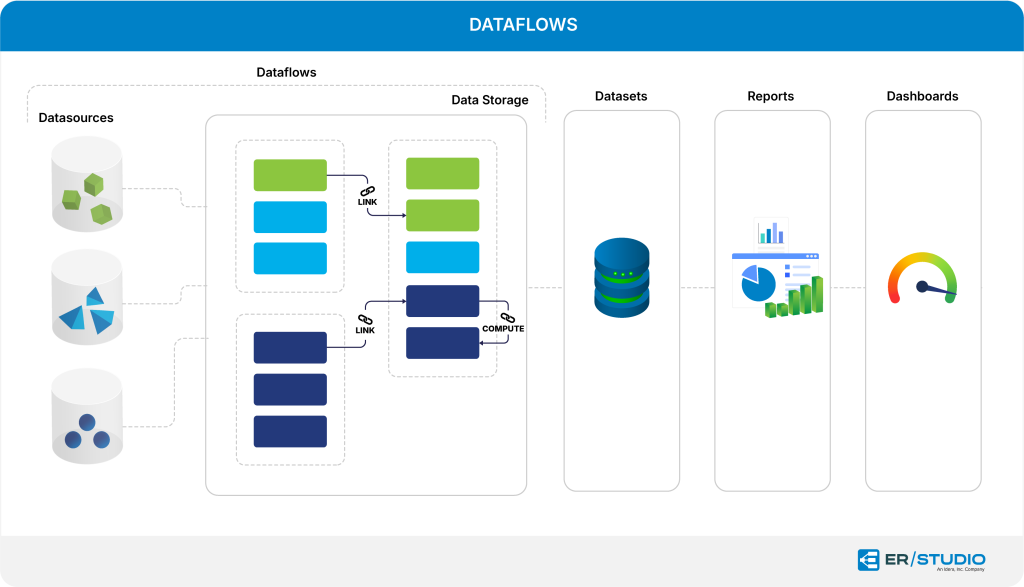
In a polyglot data environment, multiple modeling approaches, storage systems, and technologies coexist. One team might be using relational models in Oracle, while another stores JSON documents in MongoDB, and a third builds analytical datasets in スノーフレーク.
Polyglot modeling accepts this diversity and focuses on:
Rather than enforcing a single model, polyglot modeling embraces the reality of hybrid architectures—and provides a framework to keep everything coherent.

What makes ER/Studio so effective in complex data environments is its ability to bridge all three approaches seamlessly.
Whether you’re designing a single domain or managing hundreds of systems, ER/Studio gives you the flexibility to model how you need to—without forcing a particular methodology.
You can:
Most importantly, these modeling approaches aren’t mutually exclusive. You can build an enterprise model gradually—adding domains as needed—while applying common models to accelerate delivery and support governance in your current systems.
“Data scientists spend about 45% of their time on data preparation tasks, including loading and cleaning data.”
- Alex Woodie, Big Data Wire
It’s easy to assume that if you want a unified data model, you need to pause development, freeze all pipelines, and redesign your data from the ground up. But that belief has stopped countless teams from moving forward.
In reality, the best enterprise data models are built iteratively, just like the systems they represent. Many of the world’s most successful data organizations didn’t start with perfect blueprints—they created structure as they went.
You don’t need to start from scratch to introduce standardization. You don’t need to wait for the next platform migration or reorg to begin aligning models. What you need is the ability to integrate, compare, evolve, and govern your models in a way that supports both legacy and future architecture.
This is precisely where ER/Studio fits in.
Whether you’re building a centralized architecture from day one or aligning a decade’s worth of disconnected systems, ER/Studio supports your strategy without forcing you to rebuild.
For organizations designing new platforms or overhauling legacy systems, ER/Studio provides a powerful way to create a unified model from the ground up. You can define logical entities, conceptual relationships, glossary terms, and naming conventions before any physical implementation begins.
This foundation becomes a reference point for developers, DBAs, data stewards, and analysts—ensuring that as new data flows are built, they inherit consistent definitions.
You can model multiple domains (sales, logistics, HR, etc.), publish those models to a shared repository, and reuse patterns across teams—accelerating both delivery and documentation.
More commonly, organizations already have working systems—but they lack consistency. In these cases, ER/Studio excels at what we call progressive standardization.
You can:
Let’s say your analytics team is spinning up a reporting model for supply chain performance. Rather than starting from scratch, they can pull in an existing warehouse schema, identify common dimensions like product category または shipment status, and match them to enterprise terms.
Now, the next project doesn’t need to rediscover or redefine those concepts—they’re already aligned.
Finally, for organizations running polyglot architectures, ER/Studio enables shared meaning across systems without requiring shared structures. You don’t need to convert document databases into relational schemas or force CSV pipelines into a normalized model.
Instead, you can model the logic of the data—what it means, how it connects, where it originates, and how it flows. ER/Studio supports conceptual, logical, and physical models, and allows you to link disparate implementations to a common vocabulary.
You might have machine configurations stored in モンゴDB, product orders in SQL Server, and delivery tracking in Snowflake. ER/Studio gives you the tools to model all three—and connect them logically—without changing the source systems.
To break out of the usual examples, consider a multinational energy company managing sensor data across regions.
In South America, teams use an in-house PostgreSQL database to track sensor installations. In Europe, a third-party platform stores the same data in a custom API. Meanwhile, the global operations team reports on all installations through a centralized dashboard in Power BI, fed by Snowflake.
There’s no shared schema. No common field names. But they all refer to the same business entity: sensor deployment.
With ER/Studio, the company can:
As new divisions come online, they inherit a known structure—avoiding reinvention and enabling faster onboarding.
Enterprise modeling isn’t about doing everything at once. It’s about doing the right things consistently—building clarity, reducing duplication, and turning data into a business asset.
You don’t need a massive reset. You don’t need to rewrite your systems. What you need is a flexible modeling platform that supports:
ER/Studio gives you all of that—and more. Whether you’re building the foundation or extending it brick by brick, you can evolve your architecture without rebuilding it.
Book a demo today and start building the data clarity your organization needs—on your own terms.
Yes. With tools like ER/Studio, you can adopt enterprise and common data models incrementally—by reverse-engineering existing databases, mapping them to logical entities, and aligning with business terms over time. There’s no need to start from scratch.
An enterprise data model defines high-level, organization-wide concepts and relationships, while common data models focus on reusable, project-specific components like customer, order, or invoice structures. The two work together to promote consistency at different scales.
Absolutely. ER/Studio supports progressive modeling, so you can introduce new domains and data models alongside your current systems. These can be aligned with enterprise standards and connected to shared metadata without interrupting development or existing processes.
No. ER/Studio allows you to build incrementally. You can start with partial or conceptual models, promote reusable structures from existing assets, and evolve the model as requirements become clearer—without delaying delivery.
Start by reverse-engineering the current schema, then map it to your enterprise or common data model using ER/Studio. Define shared entities (like customer or product) using glossary terms to maintain consistency, then connect the new model to your governance framework and metadata repository.
Yes. When adding new models, ER/Studio ensures alignment through business glossary integration, naming standards enforcement, and version-controlled publishing to Team Server. This guarantees new models follow organizational rules for compliance, terminology, and architecture alignment.




