Every organization has its own language.
Terms such as Customer, Product, Revenue, Account, and Order may have well-defined meanings within one team but represent something different elsewhere in the business.
For Enterprise AI, those distinctions matter.
AI systems need more than access to data. They need context that explains what business concepts mean, how those concepts relate to one another, and how they connect to the data stored across enterprise systems.
This is why taxonomies, ontologies, knowledge graphs, and semantic models are becoming increasingly important.
But organizations do not necessarily need to begin from scratch.
Logical data models, business glossaries, metadata, and Enterprise Logical Data Models may already contain significant portions of the business meaning required for a semantic architecture.
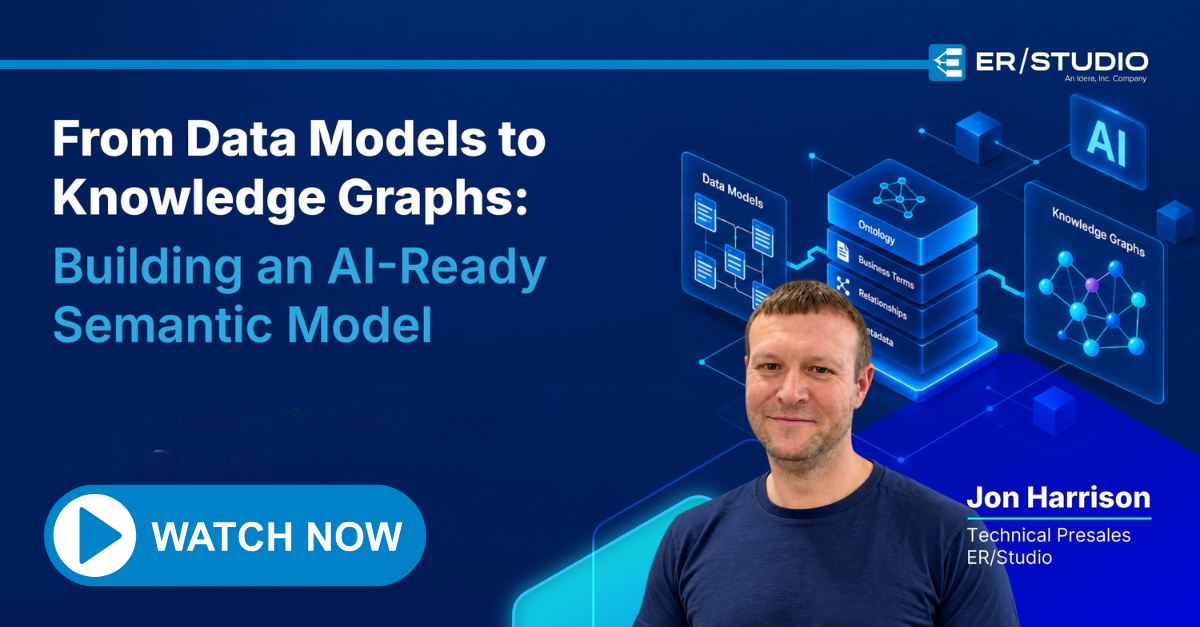
In this on-demand webinar, Jon Harrison explains the differences between these semantic concepts and shows where traditional data modeling fits.
You’ll see how an Enterprise Logical Data Model can act as a reusable model of the business and provide a foundation from which physical data structures, metadata, semantic relationships, and AI-ready context can be derived.
Jon also demonstrates how ER/Studio can help organizations build and manage this semantic model by connecting business concepts, definitions, relationships, and enterprise data.
This on-demand webinar is designed for data architects, enterprise architects, information architects, data modelers, governance leaders, metadata professionals, business glossary owners, knowledge graph practitioners, data engineers, AI leaders, analytics teams, and organizations exploring how existing data architecture can support Enterprise AI.
Jon Harrison
Technical Presales, ER/Studio
Watch this recorded session to learn how to evolve traditional data modeling assets into a richer semantic foundation that can support enterprise data architecture, governance, knowledge graphs, and AI.
A semantic model describes important business concepts, their meaning, and the relationships between them. It helps create a shared representation of how an organization understands its information.
A taxonomy primarily organizes concepts into classifications or hierarchies. An ontology typically goes further by describing richer relationships, meanings, properties, and rules between concepts.
A knowledge graph represents concepts or entities and the relationships between them in a connected structure. It can help applications and AI systems navigate relationships across information.
Logical data models already describe entities, attributes, definitions, and relationships. These elements can provide a strong starting point for ontology development, although additional semantic detail may be required depending on the use case.
An Enterprise Logical Data Model represents important business concepts and relationships across the organization independently of individual physical systems. It can provide a shared model of the business that supports multiple downstream data and semantic use cases.
AI systems need context to interpret enterprise data effectively. Semantic models can provide definitions, relationships, and business meaning that help AI understand how information relates within an organization.
Not necessarily. Existing logical models, metadata, and business glossaries may already contain valuable semantic information that can be extended for AI use cases.
ER/Studio can help organizations manage logical data models, business concepts, metadata, and relationships in a structured environment that supports both traditional data architecture and emerging semantic requirements.
Connect with our team to explore how ER/Studio can help your organization extend existing data models and metadata into an AI-ready semantic foundation.




