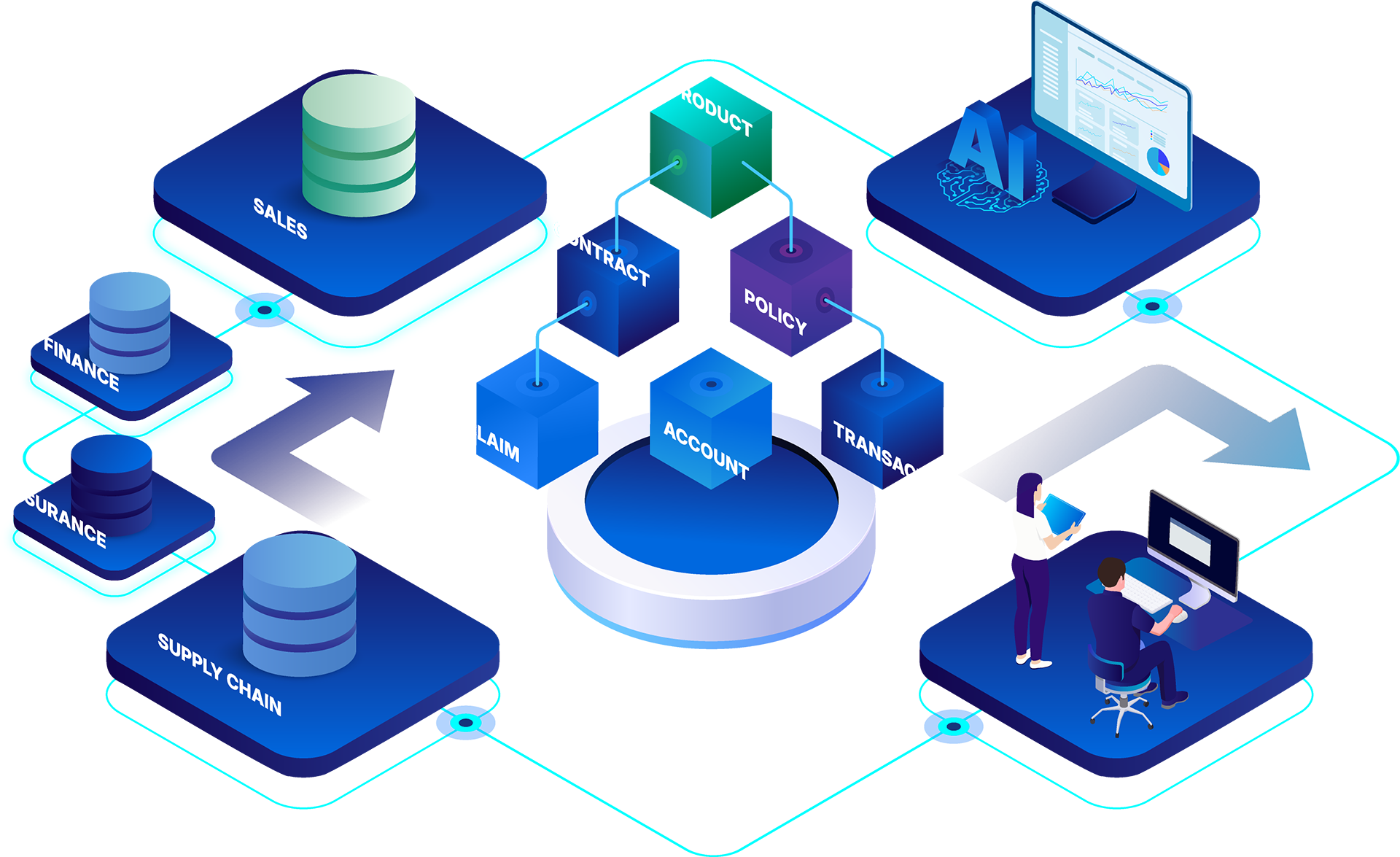
Artificial intelligence is changing how organizations access, analyze, and use data. Large language models (LLMs) can generate SQL queries, summarize reports, answer business questions, assist with documentation, and make data more accessible to both technical and non-technical users. As a result, many organizations are accelerating AI initiatives in an effort to improve productivity, uncover insights faster, and create competitive advantages.
Amid all this excitement, however, a dangerous assumption has started to emerge.
Some organizations believe AI reduces the need for traditional data architecture practices. If a language model can understand natural language, generate code, and work across multiple systems, why spend time creating logical data models? Why not let AI bridge the gaps between systems and definitions automatically?
The reality is quite different. AI does not eliminate the need for logical data modeling. In many ways, it makes logical data modeling more important than ever.
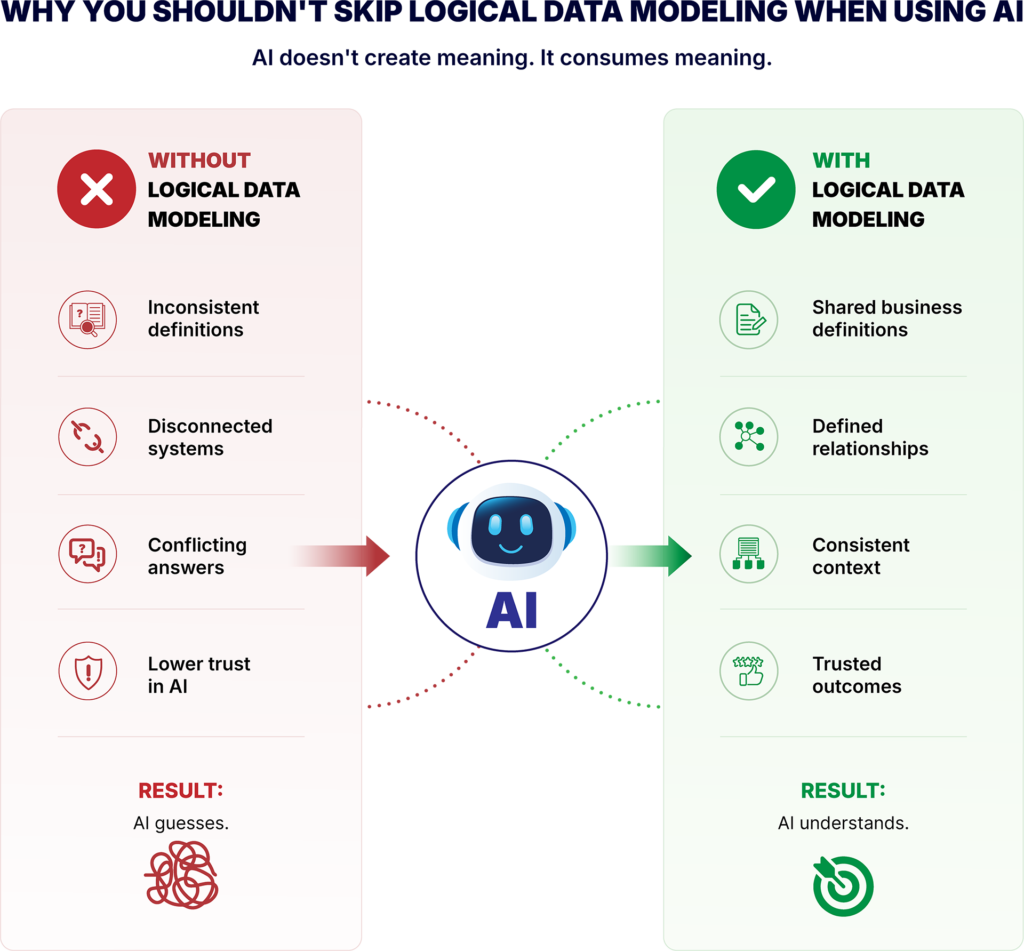
The reason is simple. AI does not create business meaning. It consumes business meaning. If an organization lacks clear definitions, consistent relationships, and a shared understanding of its data, AI will not solve those problems. Instead, it will expose them. In some cases, it may even amplify them.
Organizations that are achieving meaningful results with AI typically share a common characteristic: they have invested in creating a strong data foundation. Logical data modeling remains one of the most effective ways to establish that foundation because it creates the shared understanding that both people and AI systems rely on to make sense of information.
Much of the discussion around AI focuses on technology. Organizations compare models, evaluate vendors, experiment with copilots, and debate infrastructure decisions. While these conversations are important, they often distract from a more fundamental issue.
Most AI challenges are not technology challenges. They are data challenges.
A language model does not inherently understand what revenue means to your organization. It does not know how risk is calculated, how inventory is categorized, how claims are grouped, or how products relate to contracts unless those concepts have been clearly defined somewhere within the data environment. AI systems are exceptionally good at identifying patterns and generating responses, but they do not automatically resolve ambiguity.
This distinction becomes increasingly important as organizations attempt to deploy AI across multiple business functions. Finance may calculate revenue differently than sales operations. Supply chain teams may define inventory availability differently than ecommerce teams. Insurance teams may define loss, claim, exposure, and reserve differently depending on the reporting, regulatory, or actuarial context.
These inconsistencies often exist long before AI enters the picture. Traditional reporting processes may hide them because departments operate independently. AI changes that dynamic by creating a single interface through which users ask questions across systems and domains.
When employees begin asking questions such as “What is our current exposure?” or “Which product lines are most profitable?” inconsistencies that were previously hidden can quickly become visible.
The AI is not creating the problem. The AI is revealing it.
When people hear the term logical data modeling, they often think of diagrams, documentation, or database design exercises. While those elements may be involved, the real purpose of logical modeling is much broader.
論理データモデリング creates a business-focused representation of how information is organized across an enterprise. It defines key entities, relationships, business rules, and concepts independently of any specific technology platform.
For example, a logical data model may define concepts such as:
More importantly, it defines how those concepts relate to one another.
What makes a shipment complete? How does a product relate to a supplier? Can one policy have multiple claims? What determines whether a transaction is recognized as revenue? Which business rules govern these relationships?
These are not simply database questions. They are business questions.
論理データモデリング helps organizations answer them consistently before information is implemented across databases, applications, analytics platforms, governance tools, and AI systems.
This is why logical modeling remains relevant regardless of technology trends. While platforms change over time, the need to define business concepts clearly does not.
One of the most overlooked aspects of AI adoption is the importance of context.
Many organizations focus heavily on data volume. They assume that more data will automatically produce better AI outcomes. In practice, context is often more important than quantity.
Consider a database column named PRODUCT_ID. To a database administrator, that label may seem perfectly clear. To an AI system, however, it is simply a field name. The model does not inherently understand whether that product is a finished good, a raw material, a bundled offering, a subscription plan, or a service package.
Now imagine that same data exists within an environment supported by logical data models, business definitions, and documented relationships. The AI can now understand that products belong to categories, categories roll up into business lines, products are associated with suppliers, and certain products are governed by contractual terms, pricing rules, or regional restrictions.
Suddenly the information becomes much more meaningful.
The AI can operate within a framework that reflects how the organization actually works. Relationships become clearer. Business terminology becomes more consistent. Questions become easier to interpret correctly.
This is one reason semantic layers, business glossaries, metadata repositories, and logical data models are receiving renewed attention in AI initiatives. Organizations are discovering that successful AI depends not only on data availability but also on data meaning.
Without context, AI is forced to infer relationships. With context, AI can operate with far greater accuracy and consistency.
Imagine a retail or manufacturing company implementing an AI assistant to help operations leaders answer questions about inventory availability and fulfillment risk.
At first glance, the project seems straightforward. The organization already has inventory data in its ERP system, warehouse management platform, ecommerce application, supplier portal, and analytics environment. Reports have existed for years, and the AI assistant is expected to make those insights easier to access.
Then users begin asking questions.
A merchandising leader asks, “Which products are available to sell?”
A warehouse manager asks, “Which products are available to ship?”
A finance leader asks, “Which products are available for revenue recognition?”
A procurement manager asks, “Which products are available based on supplier commitments?”
Each question uses the word “available,” but each one means something different.
Available to sell may include products that are in stock, allocated, in transit, or expected from suppliers. Available to ship may only include units physically present in a warehouse and not reserved for another order. Available for revenue recognition may depend on delivery status, contract terms, billing rules, and acceptance criteria. Available based on supplier commitments may include purchase orders that have not yet arrived.
If those definitions are not clearly modeled, the AI assistant may return answers that look confident but are contextually wrong. The issue is not that the AI failed to retrieve data. The issue is that the organization never defined the relationships and business rules behind availability.
Logical data modeling helps prevent this problem. It can define inventory, product, warehouse, order, shipment, allocation, supplier commitment, and revenue recognition as related but distinct concepts. It can document how those concepts interact and which rules apply in different business contexts.
That structure gives AI a better foundation for answering questions. Instead of treating “available” as a generic term, the organization can ground AI responses in defined business meaning.
This is the difference between giving AI access to data and giving AI the context needed to use that data responsibly.
“The global data modeling tool market to grow from approximately $670 million in 2024 to $1.67 billion by 2033.”
- Businessresearchinsights.com
ガバナンス has become one of the most important topics in enterprise AI discussions. Organizations want to ensure AI outputs are accurate, explainable, secure, and compliant with regulatory requirements.
Much of the conversation focuses on access controls, model monitoring, risk management, and policy frameworks. These are all important considerations. However, governance also depends on something more fundamental: shared understanding.
Organizations cannot effectively govern concepts that have never been clearly defined.
Consider how often terms such as revenue, margin, exposure, claim, risk, shipment, inventory, account, or product appear within AI-generated outputs. If these concepts are interpreted differently across systems, governance efforts become significantly more difficult.
Logical data models provide a mechanism for documenting and standardizing these definitions. They establish a common language that can be shared across business units, technical teams, governance programs, and AI initiatives.
In this sense, logical modeling supports governance long before any AI system is deployed. It helps create the consistency required for trustworthy outcomes.
Organizations sometimes view logical data modeling as an activity that slows projects down. In reality, skipping logical modeling often creates technical debt that becomes more expensive to address later.
Without a logical foundation, inconsistencies accumulate across systems. Teams create their own definitions, naming conventions, structures, and interpretations. These decisions may seem harmless in isolation, but they compound over time.
AI initiatives frequently expose this accumulated complexity because they attempt to operate across multiple systems simultaneously.
The result is often a familiar pattern. An organization launches an AI project expecting rapid results. Early demonstrations appear promising. As adoption increases, users begin identifying conflicting answers, inconsistent metrics, and unclear business definitions. Teams then spend months reconciling issues that could have been addressed much earlier through proper data architecture practices.
The challenge is not unique to AI. Organizations encounter similar issues during cloud migrations, analytics modernization efforts, mergers and acquisitions, governance programs, and application transformations.
The difference is that AI tends to expose these issues faster and more visibly.
One reason logical data modeling continues to provide value is that it focuses on business concepts rather than technology implementations.
Applications evolve. Databases are migrated. Cloud platforms change. AI models are updated. New tools replace old ones. Business concepts tend to remain much more stable.
A policy remains a policy. A claim remains a claim. An order remains an order. A shipment remains a shipment. While the systems used to manage these concepts may change over time, the concepts themselves continue to drive business operations.
Logical models capture this knowledge in a technology-independent form that can survive multiple generations of applications and infrastructure.
This makes logical modeling valuable not only for AIへの取り組み but also for governance, modernization, analytics, and long-term architectural planning. Rather than supporting a single project, logical models create a durable foundation that helps organizations maintain consistency as technologies evolve.
For organizations investing heavily in AI, this long-term perspective is particularly important. AI technologies will continue changing rapidly over the coming years. The organizations best positioned to adapt will be those that have established clear definitions and relationships within their data environments.
Many organizations approach AI readiness as a technology problem. They focus on selecting platforms, evaluating models, and implementing tools.
The organizations achieving the most sustainable results often start somewhere else.
They begin by asking questions about their data. Do we have consistent business definitions? Do we understand how key entities relate to one another? Can different departments agree on core concepts? Are important business rules documented and understood? Can we explain where critical metrics originate?
These questions have less to do with artificial intelligence than they do with data architecture.
Logical data modeling helps answer them. It creates the foundation upon which successful AI initiatives can be built. Without that foundation, organizations often find themselves using AI to navigate complexity that should have been addressed much earlier.
ER/Studioは以下を支援します。 create the logical foundation that modern AI initiatives require. By defining business entities, documenting relationships, standardizing terminology, and connecting architecture to governance efforts, ER/Studio helps establish a shared understanding of data across the enterprise.
This foundation benefits far more than AI. It supports modernization initiatives, governance programs, analytics projects, and long-term architectural consistency. As organizations continue integrating AI into business processes, the value of clearly defined data only increases.
Before asking AI to understand your business, make sure your business understands its data.
Logical data modeling remains one of the most effective ways to create that understanding.
Discover how ER/Studio helps teams create the logical data models that support trustworthy AI, stronger governance, and better business decisions. Try it free.
Logical data modeling is the process of defining business entities, attributes, relationships, and rules independently of any specific database technology. It provides a business-focused view of how information is organized across an organization.
AI systems depend on consistent definitions and relationships to generate reliable outputs. Logical data modeling helps create the shared business understanding that improves AI accuracy, trustworthiness, and scalability.
No. AI can help analyze data and automate tasks, but it does not replace the need to define business concepts and relationships. Logical data modeling establishes the context that AI relies on to interpret information correctly.
Organizations often encounter inconsistent definitions, conflicting metrics, governance challenges, unreliable AI outputs, and difficulties scaling AI initiatives across departments and systems.
ER/Studio helps organizations create logical data models, standardize business definitions, document relationships, and align architecture with governance programs. These capabilities help build the trusted data foundation necessary for successful AI adoption.