
Manufacturing has become one of the most data-intensive industries in the world.
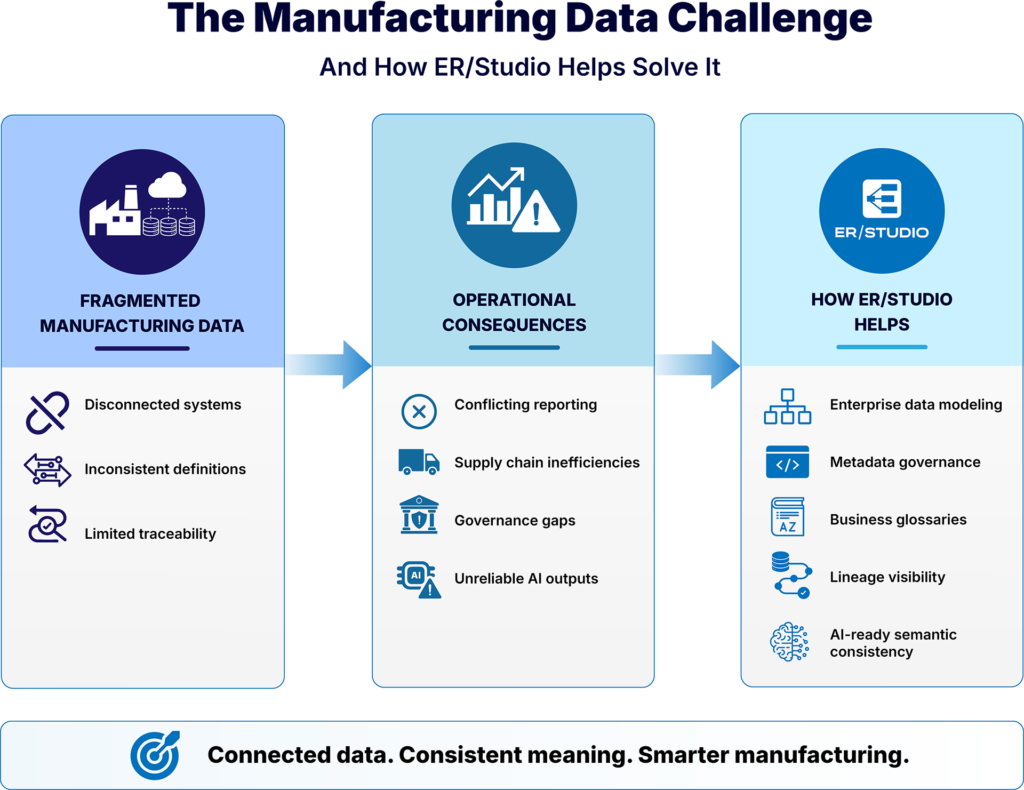
Modern manufacturers are simultaneously managing production systems, IoT devices, ERP platforms, MES environments, supply chain networks, warehouse systems, analytics platforms, compliance workflows, cloud applications, and increasingly, AI-driven operations. Every one of those systems generates valuable operational data. The problem is that most manufacturing environments evolved over decades, often through acquisitions, regional expansion, plant-level customization, and disconnected modernization efforts.
As a result, many manufacturers now operate inside highly fragmented data ecosystems.
Production teams define metrics differently across facilities. Supply chain systems use inconsistent vendor classifications. Operational reports conflict depending on which plant or department generated them. Legacy manufacturing systems remain poorly documented, while newer cloud initiatives introduce additional complexity on top of existing architecture.
For years, organizations managed these inconsistencies through manual workarounds and institutional knowledge. Engineers knew which dashboards were reliable. Operations managers understood which reports required adjustment. Analysts maintained spreadsheets that quietly corrected data inconsistencies behind the scenes.
That model is becoming increasingly difficult to sustain.
Manufacturers are now under pressure to support real-time analytics, predictive maintenance, automation initiatives, digital twins, regulatory reporting, and AI-driven decision-making at enterprise scale. Those initiatives depend on trusted, well-structured, semantically consistent data environments.
This is why enterprise data architecture is becoming a much more strategic priority across the manufacturing sector.
Platforms like ER/Studio are helping manufacturers create stronger operational alignment by connecting enterprise data modeling, metadata management, governance, lineage, collaboration, and semantic consistency into a unified architecture strategy.
Manufacturing data environments are fundamentally different from many traditional enterprise environments because they combine operational technology with enterprise business systems.
A modern manufacturer may need to integrate:
Each environment often evolves independently over time. Different plants may adopt different operational standards. Regional facilities may structure inventory or supplier data differently. Production teams may calculate downtime or utilization using inconsistent business logic.
Even relatively small inconsistencies create downstream problems.
If one facility categorizes defects differently than another, enterprise quality reporting becomes unreliable. If procurement systems structure supplier data differently across regions, forecasting and supply chain visibility become fragmented. If operational metadata lacks context, AI initiatives struggle to produce trustworthy outputs.
The challenge is no longer simply storing manufacturing data.
The challenge is creating shared understanding around what that data means across the organization.
Manufacturing data modeling is often misunderstood as simply designing databases.
In reality, enterprise manufacturing data modeling is about creating operational consistency across highly complex environments.
A strong manufacturing data model helps organizations define:
Most importantly, it helps manufacturers standardize how those concepts relate to one another across systems and facilities.
This becomes especially valuable as manufacturers expand analytics and AI initiatives.
AI systems do not inherently understand operational nuance. They depend on metadata, relationships, definitions, lineage, and semantic consistency. If business meaning becomes fragmented across systems, AI scales those inconsistencies rapidly.
ER/Studio helps manufacturers create stronger semantic alignment by connecting conceptual, logical, and physical data models directly to metadata, governance, lineage, and business terminology.
Instead of disconnected systems operating independently, organizations can create a more unified operational framework across manufacturing environments.
“ER/Studio has taken our data management to a new level. We can respond faster to business demands, reduce redundancy, and maintain data integrity across all our operations. It’s the perfect solution to support our evolving data architecture.”
- Angie Hastings, Data Architect, Newmont Mining
ガバナンス has become significantly more important across manufacturing operations over the last several years.
Manufacturers now face growing pressure around:
The problem is that governance initiatives often operate separately from the operational architecture they are attempting to govern.
Documentation exists in one system. Metadata lives somewhere else. Lineage visibility remains incomplete. Business definitions drift between departments and facilities over time.
Eventually, organizations lose confidence in their own operational reporting.
This is where enterprise architecture becomes critical.
ER/Studio allows manufacturers to embed governance directly into the data architecture itself rather than treating governance as disconnected administrative work.
For example, organizations can:
This creates much stronger long-term consistency across manufacturing operations.
Industry 4.0 initiatives continue accelerating across the manufacturing sector.
Organizations are investing heavily in:
But these initiatives depend heavily on well-structured enterprise data environments.
A predictive maintenance initiative, for example, may require:
If those systems lack consistent definitions or traceability, analytics reliability declines quickly.
The same challenge exists with digital twins. A digital twin only becomes operationally valuable when underlying systems remain semantically aligned and properly governed.
ER/Studio helps manufacturers create the structured architecture needed to support these initiatives by improving visibility into metadata, lineage, relationships, and business definitions across systems.
That alignment helps organizations scale modernization initiatives more effectively while reducing operational ambiguity.
Manufacturing supply chains have become significantly more distributed and interconnected.
Manufacturers now depend on:
This creates major challenges around consistency and visibility.
If supplier classifications differ across systems, reporting accuracy suffers. If inventory relationships become inconsistent between operational and analytical platforms, forecasting reliability declines. If procurement data lacks governance and lineage, operational planning becomes harder to trust.
Manufacturers increasingly recognize that supply chain optimization is not just a logistics challenge.
It is also a data architecture challenge.
ER/Studioは以下を支援します。 model and standardize supply chain relationships across operational and analytical systems so manufacturers can create stronger alignment between procurement, logistics, inventory, and production workflows.
This becomes especially valuable during disruptions, where operational visibility directly impacts production continuity.
Modern manufacturing data environments involve far more than database administrators and architects.
Today’s initiatives often involve:
Without structured collaboration, architecture becomes fragmented quickly.
Different facilities begin implementing conflicting standards. Analytics teams recreate operational logic independently. Governance visibility declines as environments scale. Eventually, operational trust erodes because nobody fully agrees on how enterprise data should be interpreted.
ER/Studio supports collaborative enterprise architecture through shared repositories, metadata management, business glossaries, and browser-based collaboration capabilities.
This allows organizations to create stronger operational alignment across facilities, departments, and modernization initiatives without losing governance visibility.
AI is already transforming manufacturing operations.
Organizations are using AI to support:
But AI systems amplify whatever structure already exists inside enterprise data environments.
If manufacturing definitions conflict across facilities, AI scales inconsistency.
If metadata lacks context, AI scales ambiguity.
If governance remains fragmented, AI produces unreliable outputs faster and at greater scale.
This is why AI readiness increasingly depends on semantic architecture.
Manufacturers need environments where:
ER/Studio helps manufacturers create that semantic foundation by connecting enterprise data modeling, metadata management, governance, lineage, and collaboration into a more unified operational architecture.
Manufacturing organizations are entering a period where operational competitiveness increasingly depends on data clarity.
The manufacturers that lead over the next decade will not simply be the organizations with the newest automation technologies or the largest AI investments.
They will be the organizations that understand their operational data most effectively.
They will know:
This is why enterprise data architecture is becoming a strategic manufacturing capability rather than just a technical discipline.
ER/Studio helps manufacturing organizations create the structure, governance, collaboration, and semantic consistency needed to support modern manufacturing operations at scale.
Because smarter manufacturing operations begin with better understanding of enterprise data.
Modern manufacturing depends on connected data. See how ER/Studio helps make that possible.
Manufacturing data modeling is the process of structuring and standardizing data across production systems, supply chains, ERP platforms, IoT environments, analytics systems, and operational workflows. It helps manufacturers create consistent relationships between systems, improve visibility, and support more reliable reporting and decision-making.
Modern manufacturing environments rely on interconnected systems that often evolve independently over time. Without strong enterprise data architecture, manufacturers can struggle with inconsistent reporting, fragmented governance, disconnected analytics, and unreliable AI outputs. A governed architecture helps create operational consistency across facilities, teams, and systems.
ER/Studio helps manufacturers align business definitions, metadata, lineage, and governance across operational and analytical systems. By connecting conceptual, logical, and physical data models into a shared framework, organizations can reduce inconsistencies, improve collaboration, and create more reliable enterprise reporting environments.
ER/Studio helps support initiatives like predictive maintenance, digital twins, IoT analytics, and operational AI by creating structured, governed data foundations. Manufacturers can improve traceability, standardize operational definitions, and maintain stronger alignment between production systems, analytics platforms, and governance workflows.
AI systems depend heavily on consistent business definitions, metadata, and relationships between systems. If manufacturing data lacks semantic alignment, AI can amplify inconsistencies across reporting, forecasting, and operational decisions. ER/Studio helps manufacturers create a more connected semantic foundation that supports trustworthy analytics and AI-driven operations