Enterprise data environments are built to change. Organizations modernize platforms, migrate workloads to the cloud, introduce new applications, respond to regulatory requirements, and expand analytics use cases continuously. Change is not a failure condition. It is the expected state of modern data operations. What organizations struggle with is not change itself, but the unpredictability that accompanies it.
When a schema update breaks reporting, when a downstream system fails after a seemingly minor modification, or when compliance teams discover gaps during an audit, the root cause is rarely a lack of effort or skill. The failure almost always traces back to a change that was made without fully understanding its impact. In most organizations, data change is executed faster than it is understood.
Data modeling is the only discipline that consistently makes change predictable rather than reactive.
When data incidents occur, teams tend to focus on immediate technical causes. A transformation failed. A dashboard returned incorrect numbers. A pipeline processed unexpected values. These are surface level symptoms. The underlying cause is almost always a change that introduced unintended consequences.
A column definition was modified to support a new requirement, but downstream consumers depended on the original meaning. A table was repurposed for efficiency, but other systems were still relying on its previous structure. A performance optimization altered data granularity in a way that analytics teams were not prepared for. These changes are rarely reckless. They are simply uninformed.
The problem is not that organizations lack process. Many teams have change management, approval workflows, and testing in place. The problem is that those processes operate without a complete picture of how data structures are connected 企業全体.
Without that picture, change becomes guesswork.
“Databases evolve just like code. Managing that evolution requires disciplined change.”
- Martin Fowler
As data platforms mature, dependencies multiply. What starts as a single application database grows into a web of integrations, reports, analytics pipelines, and operational processes. Over time, the number of consumers increases faster than documentation can keep up.
Teams often assume that a dataset belongs to a specific domain or application because that was true at some point in the past. In reality, that same dataset may now support dashboards in another department, feeds to a machine learning model, regulatory reporting, or external data sharing. These dependencies are rarely obvious unless they are explicitly modeled.
When dependencies remain hidden, the cost of change increases dramatically. Teams spend time diagnosing issues that could have been anticipated. Releases are delayed while impacts are assessed retroactively. Trust erodes as stakeholders experience repeated surprises.
について real cost is not the incident itself, but the operational drag caused by uncertainty.
Most organizations rely on downstream controls to manage data risk. Monitoring alerts detect failures after deployment. Data quality checks identify anomalies once data is already flowing. Dashboards highlight inconsistencies after users notice discrepancies. These controls are necessary, but they are inherently reactive.
Reactive controls answer the question of what went wrong. They do not answer whether a proposed change is safe before it is implemented.
Predictability requires upstream visibility. Teams need to understand structure and dependency before making decisions, not after damage has occurred. No amount of monitoring can replace architectural understanding.
This is where data modeling plays a unique role. It operates at the structural level, before data moves, before transformations execute, and before analytics consume results.
Data modeling provides a shared, explicit representation of how data is structured and how it connects across systems. It documents entities, attributes, relationships, constraints, and dependencies in a way that can be analyzed and discussed.
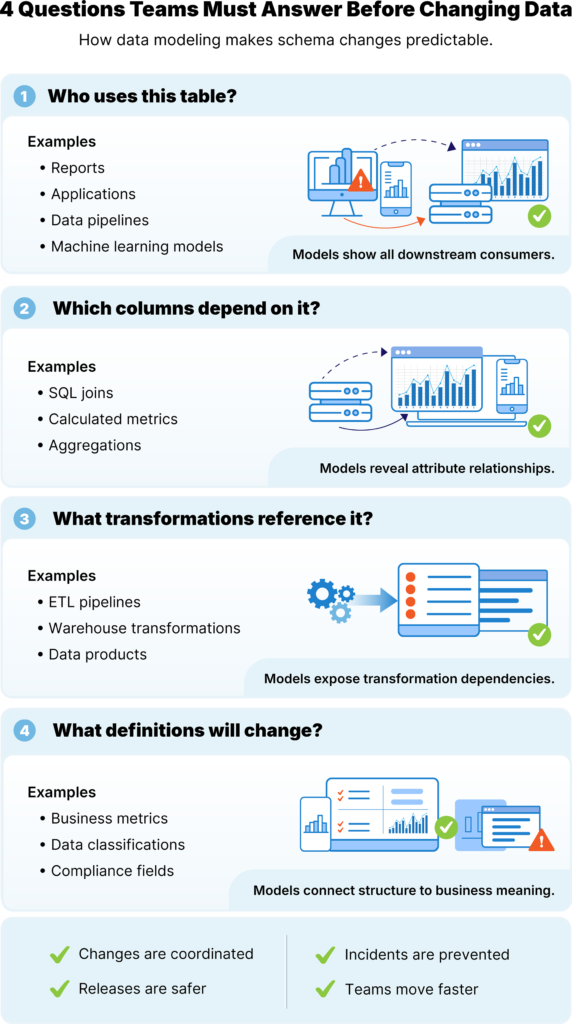
A living data model allows teams to answer questions that are otherwise difficult or impossible to answer with confidence. Which applications use this table today. Which reports depend on this column. What downstream transformations will be affected if a definition changes. How does this dataset flow through the platform.
These questions are not theoretical. They determine whether change introduces risk or delivers value safely.
Without models, teams rely on partial knowledge and assumptions. With models, they rely on evidence.
Impact analysis is often treated as a technical feature, but its value is fundamentally business oriented. When teams can see the downstream effects of change before it happens, they can plan more effectively, coordinate across departments, and communicate risk clearly to stakeholders.
Predictable change shortens delivery cycles because teams spend less time reacting to surprises. It improves collaboration because dependencies are visible rather than debated. It strengthens compliance because data usage paths are documented and auditable.
From a leadership perspective, impact analysis increases confidence. Executives trust timelines when risks are known. Compliance teams trust controls when lineage is clear. Business stakeholders trust analytics when definitions are consistent.
None of this is possible without a structural foundation.
In many data environments, architectural knowledge lives in people rather than systems. Senior engineers and architects understand how things work because they were there when decisions were made. Over time, that knowledge becomes tribal.
When those individuals are unavailable, teams hesitate. Changes are delayed. Approvals become conservative. Innovation slows because risk cannot be quantified.
Data modeling reduces reliance on tribal knowledge by capturing architectural understanding in a durable form. It turns implicit knowledge into explicit structure that teams can rely on regardless of who is present.
One reason data modeling has a mixed reputation is that many organizations treat it as a design activity rather than an operational practice. Models are created early in a project and then abandoned as systems evolve.
Static models do not support predictable change. Models must reflect reality to remain useful.
This requires tooling and processes that integrate modeling into daily workflows. Reverse engineering ensures models match deployed systems. Version control ensures changes are tracked over time. Collaboration ensures multiple teams can work from the same source of truth.
When models evolve alongside platforms, they become an asset rather than an artifact.
ER Studio is designed to support data modeling as a living discipline rather than a one time exercise. By enabling teams to reverse engineer existing databases, ER Studio captures the reality of deployed systems rather than relying on assumptions.
Logical and physical models coexist in a shared repository, allowing architects and engineers to work at the appropriate level of abstraction without losing alignment. Impact analysis capabilities reveal dependencies across systems, enabling teams to assess change before deployment.
Versioning and collaboration features ensure that models stay current as platforms evolve. Integration with governance and catalog tools extends architectural visibility beyond modeling teams and into the broader data ecosystem.
This approach makes modeling operational. It embeds predictability into change management rather than treating it as an afterthought.
“Information sources continually change their content and structure, requiring data warehouses to evolve accordingly.”
- International Journal of Database Management Systems
There is a common misconception that modeling slows teams down. In practice, the opposite is true. Teams that understand dependencies early move faster because they avoid rework, firefighting, and emergency coordination.
Predictable change reduces the need for excessive buffers and approvals because risks are known. It allows teams to make informed tradeoffs rather than conservative guesses. It enables organizations to innovate without sacrificing stability.
Speed without understanding creates chaos. Speed with understanding creates momentum.
In competitive markets, the ability to change safely is a differentiator. Organizations that can introduce new capabilities, respond to regulation, and scale analytics without constant disruption outperform those that cannot.
Predictable change builds trust across the organization. Business leaders trust the platform. Analysts trust the data. Engineers trust releases. Compliance teams trust controls.
Data modeling is not about perfection. It is about visibility. It provides the insight required to navigate complexity with confidence.
Cloud adoption, real time data, and advanced analytics ensure that change will continue to accelerate. Organizations that rely on guesswork and tribal knowledge will struggle to keep pace. Organizations that invest in modeling as an operational discipline will adapt with confidence.
Data modeling does not prevent change. It makes change understandable.
Predictability is not optional in modern data environments. It is the foundation that allows organizations to move fast without breaking trust.
See how ER/Studio helps teams understand the impact of change before it happens.