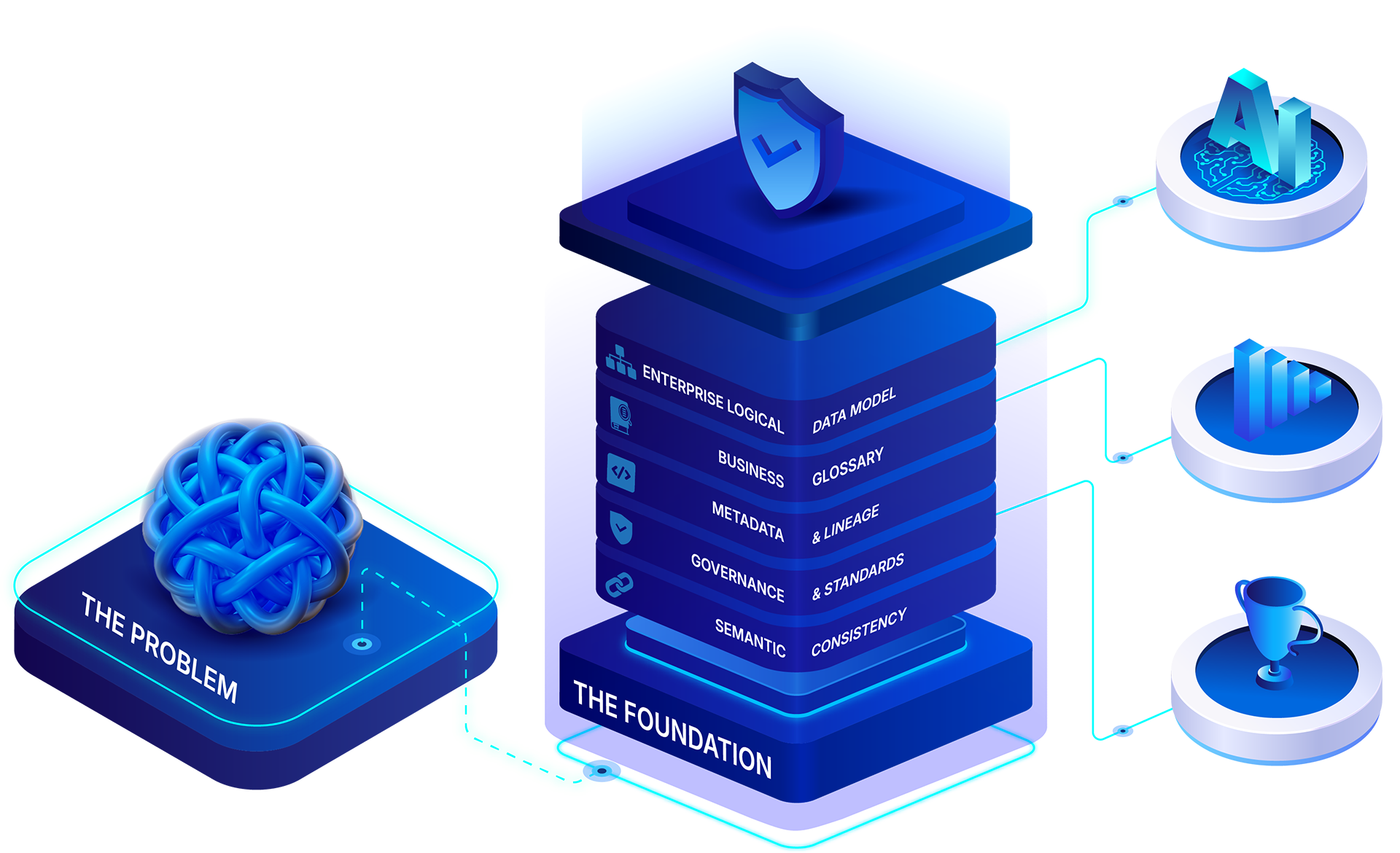
Bill Inmon and Jamie Knowles recently published a compelling article comparing modern enterprise data environments to the legendary Gordian knot: a tangled, deeply interconnected mess that organizations have spent decades trying to solve.
Their central argument is incredibly relevant right now.
The enterprise data problem was never simply about moving data between systems. It was about reconciling meaning across systems that were never designed to operate together at enterprise scale.
And now AI is forcing organizations to confront that reality much more directly.
For years, enterprises invested heavily in cloud platforms, data lakes, ELT pipelines, analytics ecosystems, and large-scale modernization initiatives. Technically, data became easier to move, store, and process than ever before.
Yet many organizations still struggle with something surprisingly fundamental:
The same business concept often means different things in different places.
A “customer” in one system may not match a “customer” somewhere else. Revenue may be calculated differently across departments. Product hierarchies evolve independently. Operational metrics drift over time as teams optimize locally rather than architecting globally.
Humans learned how to work around these inconsistencies.
“The goal is to create a single, unified source of truth for the entire organization.”
- Bill Inmon
One of the strongest ideas presented by Inmon そして Knowles is the concept of “semantic entropy.”
That phrase perfectly captures what happens inside large enterprises over time.
Applications are built independently. Departments create their own reporting logic. Acquisitions introduce entirely new systems. Governance standards evolve unevenly. Business terminology slowly diverges between operational groups.
Eventually, the organization loses a shared understanding of its own business concepts.
Historically, this created reporting problems, integration challenges, and governance frustrations. But the rise of generative AI raises the stakes significantly because AI systems reason across patterns in data without inherently understanding enterprise context or intent.
If the underlying semantics are inconsistent, AI systems amplify those inconsistencies rapidly and at scale.
This is why many organizations are discovering that AI readiness is not primarily a model problem.
It is a semantic coherence problem.
The challenge is no longer simply storing data or transporting data efficiently. The challenge is establishing trustworthy business meaning across operational systems, analytics platforms, governance frameworks, and AI ecosystems.
That distinction matters enormously.
Because organizations can have incredibly advanced infrastructure while still struggling to produce AI outputs the business actually trusts.
One of the most interesting implications of the Inmon and Knowles article is that the industry spent decades trying to solve integration primarily through infrastructure.
Organizations built:
But infrastructure alone never solved the underlying issue because the problem was never fundamentally technical.
It was semantic.
Data pipelines can transport values between systems with incredible speed and scale. But pipelines alone cannot reconcile business definitions, operational context, governance logic, or enterprise meaning.
That requires architecture.
More specifically, it requires semantic architecture.
This is one reason organizations are placing renewed focus on:
These disciplines are becoming increasingly important because AI systems depend heavily on structured business meaning to produce reliable outputs.
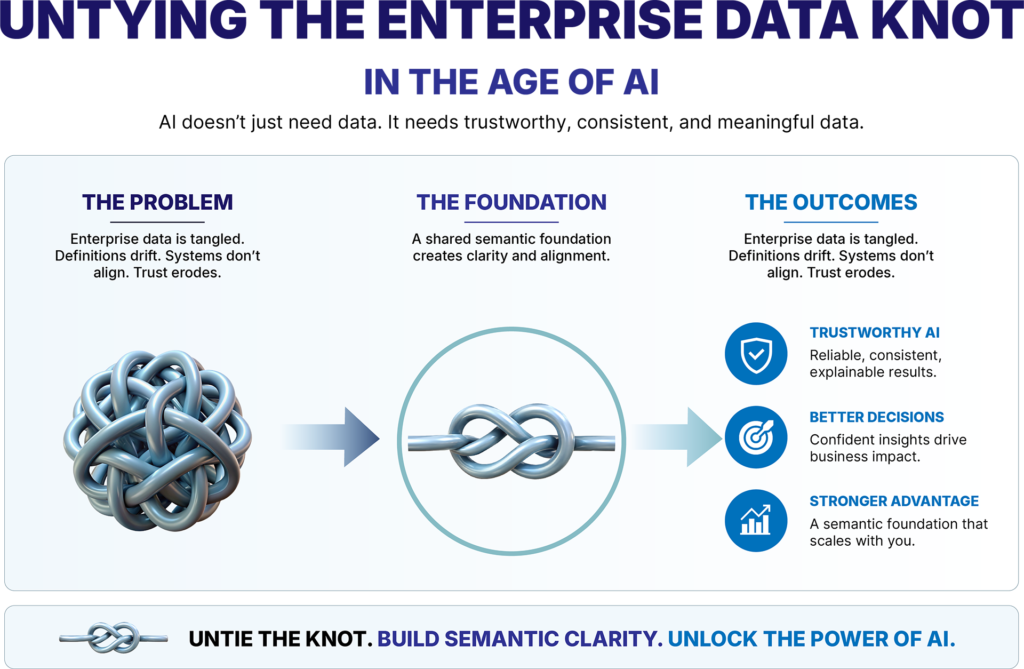
One of the strongest themes throughout the Inmon and Knowles article is the importance of the Enterprise Logical Data Model (ELDM) as a shared semantic backbone for the enterprise.
That idea feels especially important in today’s AI environment.
Modern enterprises operate across an enormous mix of technologies and platforms. Operational systems, cloud applications, governance tools, analytics environments, SaaS platforms, AI ecosystems, and legacy databases all introduce additional layers of complexity.
Without a stable semantic foundation connecting them, organizations gradually lose consistency around core business concepts.
This is where logical data modeling becomes incredibly valuable.
Unlike physical models, which focus primarily on implementation details, logical models focus on business meaning. They help establish shared understanding around:
That semantic layer becomes critically important for AI because modern AI systems increasingly operate across multiple domains simultaneously.
An AI assistant helping executives analyze supply chain performance may need to interpret finance systems, inventory platforms, supplier relationships, production schedules, and operational reporting all within the same workflow.
Without semantic consistency across those environments, the outputs become much harder to trust.
Logical data models help create continuity across constantly evolving technical systems. They provide the stable business context AI systems need to operate more reliably.
One of the biggest misconceptions surrounding enterprise AI is the idea that trust begins at the physical model layer.
In reality, trust begins much earlier.
It begins with clear definitions, consistent relationships, governed metadata, lineage visibility, and strong enterprise architecture.
Most organizations are not investing in AI simply because they want faster outputs. They want outputs that business users can actually trust.
That means:
This is where semantic consistency becomes incredibly valuable.
When enterprise data remains properly modeled and aligned, AI systems gain much better context around the information they are consuming. Relationships between systems become clearer. Definitions remain standardized. Metadata provides operational meaning and lineage visibility.
The result is not simply “better data.”
The result is more reliable reporting, more trustworthy analytics, and greater confidence from the people actually using these systems to make decisions.
That trust matters more than many organizations realize.
An AI-generated report is only useful if people believe it.
AI is also changing the role metadata and governance play inside the enterprise.
Historically, metadata management was often viewed as documentation work while governance initiatives were treated primarily as compliance exercises.
That perception is changing quickly.
Modern AI systems depend heavily on contextual information. They need visibility into where data originated, how it changed, who owns it, which systems are authoritative, and how business concepts relate across environments.
Without metadata and lineage, AI systems lose visibility into trust, quality, and business meaning.
This becomes especially important as organizations move toward more autonomous and agentic AI systems capable of triggering workflows, interacting across systems, and supporting operational decisions.
The more autonomous AI becomes, the more dangerous semantic inconsistency becomes.
This is why governance can no longer exist separately from architecture itself.
Governance increasingly needs to be embedded directly into how enterprise meaning is defined, modeled, documented, and managed across systems.
One of the most valuable aspects of the Inmon and Knowles article is that it focuses on restoring shared business meaning across fragmented enterprise systems.
That is exactly where platforms like ER/Studio can provide meaningful value for enterprise architecture and data modeling teams.
ER/Studio helps organizations establish and maintain the semantic backbone described throughout the article through enterprise logical data modeling, metadata management, business glossaries, lineage visibility, collaborative governance, and semantic alignment capabilities.
The goal is not simply documenting databases more effectively.
The goal is creating stronger consistency between business meaning and technical implementation across highly fragmented enterprise environments.
That consistency becomes ますます重要 as AI systems consume larger volumes of enterprise information across more systems, applications, and business domains.
When definitions remain aligned, metadata remains governed, and relationships remain traceable, organizations gain something incredibly important:
Confidence in the outputs AI systems produce.
That confidence ultimately benefits the end users relying on AI-generated reporting, analytics, recommendations, and operational insights every day. The stronger the semantic foundation becomes, the more accurate, explainable, and trustworthy those AI-driven results become as well.
The original Gordian knot metaphor works especially well because enterprise data complexity rarely exists as a single isolated issue. It exists as thousands of interconnected inconsistencies accumulated over decades of independent application development, local optimization, acquisitions, and fragmented modernization efforts.
The challenge is not simply technological.
It is semantic.
And AI is making that reality impossible to ignore.
The organizations that succeed with AI over the next decade will likely not be the organizations with the largest models or the most experimental tooling. They will be the organizations that establish the clearest semantic understanding of their own business environments.
In many ways, the future of enterprise AI may depend less on teaching machines how to think and more on teaching enterprises how to speak the same language again.
Build a stronger semantic foundation for AI with ER/Studio’s enterprise data modeling, metadata, and governance capabilities. Try ER/Studio free today.
Semantic consistency means that business concepts maintain the same meaning across systems, departments, and platforms. For example, terms like “customer,” “revenue,” or “supplier” should be defined consistently throughout the organization. Without semantic consistency, analytics, reporting, governance, and AI systems can produce conflicting or unreliable results.
AI systems rely heavily on patterns, relationships, metadata, and context. Unlike humans, AI cannot instinctively recognize when different systems use conflicting definitions or inconsistent business logic. If enterprise data lacks alignment, AI systems can amplify those inconsistencies and generate outputs that are inaccurate or difficult to trust.
An Enterprise Logical Data Model (ELDM) provides a shared semantic framework for the organization by defining business entities, relationships, rules, and hierarchies independently of specific technologies or applications. It helps create consistency across fragmented systems and supports governance, analytics, integration, and AI initiatives.
Metadata and lineage provide context around enterprise data, including where data originated, how it changed, who owns it, and which systems are authoritative. This visibility helps organizations validate AI-generated outputs, improve explainability, strengthen governance, and increase trust in AI-driven reporting and recommendations.
ER/Studio helps organizations establish stronger semantic consistency through enterprise data modeling, metadata management, business glossaries, lineage visibility, and governance capabilities. By helping align business meaning with technical implementation, ER/Studio supports more accurate, explainable, and trustworthy AI outcomes across enterprise environments.