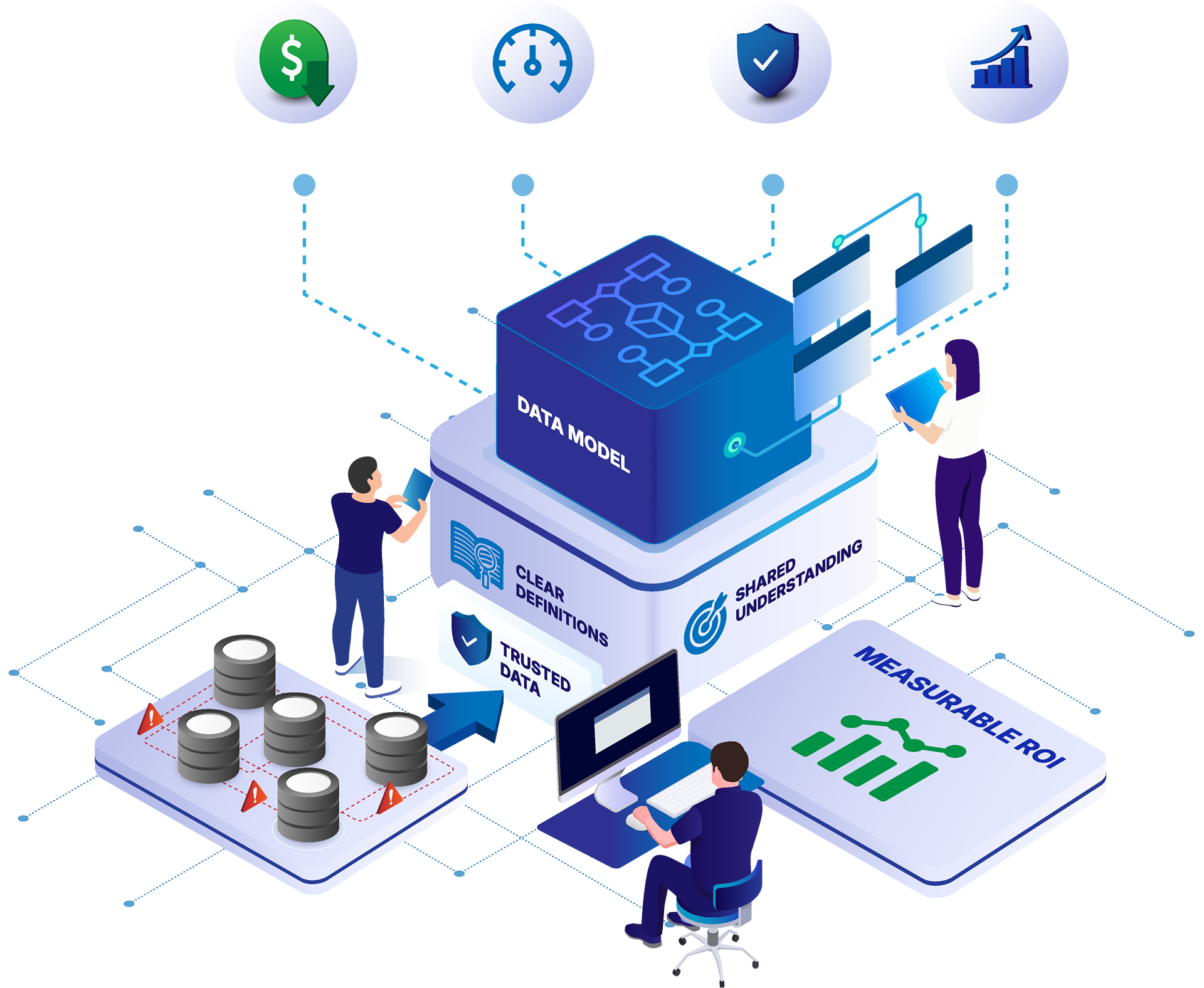
Data modeling has a perception problem, and it is costing organizations more than they realize.
For decades, it has been framed as a technical discipline. Something necessary, but not strategic. Something that lives inside IT or data teams and supports downstream systems without directly influencing business outcomes. When deadlines tighten or budgets shrink, it is often treated as optional. A nice-to-have rather than a requirement.
That framing is outdated.
In a modern, data-driven enterprise, data modeling is not just a technical activity. It is a business capability that directly impacts cost, speed, risk, and decision quality. The organizations that recognize this are not just improving their data environments. They are fundamentally changing how efficiently they operate.
The challenge is not whether data modeling delivers value.
The challenge is proving that value in terms executives actually use to make decisions.
Data teams often advocate for modeling using technical reasoning. They talk about normalization, schema design, lineage, or architectural consistency. These are all valid points, but they rarely resonate outside the data organization.
Executives are not evaluating modeling techniques.
They are evaluating trade-offs.
Every investment competes for finite budget and attention. When data modeling is positioned as an additional step, it is often interpreted as a delay to delivery rather than an enabler of long-term value. That perception creates friction between engineering priorities and business expectations, especially in organizations that are under pressure to move quickly.
This is where many data initiatives lose momentum before they even begin.
To change that dynamic, the conversation must shift from technical correctness to economic impact. Data modeling needs to be framed not as a cost center, but as a driver of measurable business outcomes.
To understand its return on investment, it is important to move beyond the narrow definition of data modeling as diagramming or database design. At its core, data modeling is a way of aligning three fundamental aspects of an organization:
This alignment is what turns raw data into a usable, trusted asset.
Consider how many organizations struggle with something as simple as defining a “customer.” Different systems may use different identifiers, definitions, or rules. Marketing, sales, finance, and support teams often operate with slightly different versions of the same concept. Without a shared model, those differences persist and multiply.
Data modeling resolves this by establishing a common structure and vocabulary. It creates a consistent foundation that every system and team can rely on. That consistency is not just a technical benefit. It is a business advantage.
The absence of data modeling does not create an immediate failure. Instead, it introduces inefficiencies that accumulate gradually and often go unrecognized until they become significant barriers.
Organizations begin to experience symptoms that feel disconnected but share a common root cause:
Individually, these issues may seem manageable. Collectively, they create a drag on productivity that affects nearly every part of the organization.
What makes this especially costly is how teams respond. Instead of addressing structural issues, they adapt their workflows. Data teams spend more time fixing inconsistencies. Business users build workarounds. New systems are layered on top of old ones.
The result is a growing gap between the organization’s data potential and its actual performance.
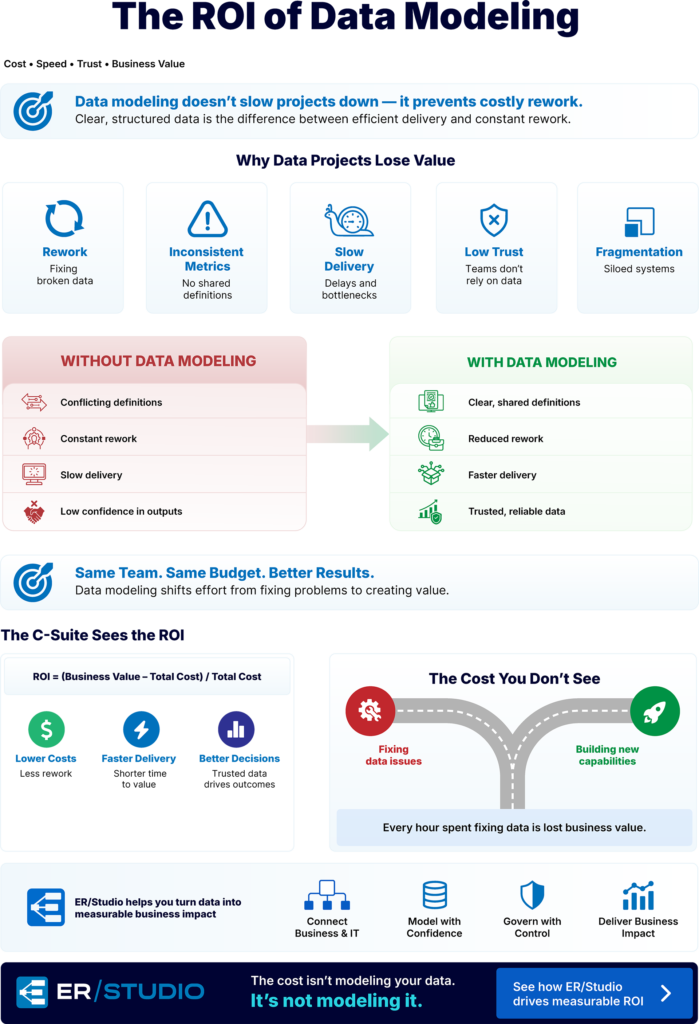
To make data modeling relevant to executive decision-makers, it must be evaluated using the same framework applied to any other investment. That means focusing on total cost, expected value, and long-term impact.
Several key metrics are essential in this discussion:
From these components, ROI can be calculated using a standard formula:
ROI = (Expected Benefit – TCO) / TCO
This framework changes the conversation. Instead of debating whether modeling adds time to a project, the discussion shifts to whether it reduces total cost and increases total value over time.
One of the most misunderstood aspects of data modeling ROI is how it affects cost allocation rather than total cost.
In many cases, the overall size and cost of a data team does not change significantly whether modeling is included or not. What changes is how that time is spent.
Without modeling, a larger portion of effort is dedicated to:
With modeling, that same effort can be redirected toward:
This is the “hidden lever” of data modeling.
It does not just reduce costs. It reallocates effort from reactive work to value-generating work.
Speed is often cited as a reason to skip data modeling, but this perspective focuses too narrowly on initial delivery. When viewed across the full lifecycle, the opposite is often true.
Projects that include structured modeling tend to move faster overall because they avoid the inefficiencies that slow down later stages. Requirements are clearer, reducing ambiguity during development. Testing cycles are shorter because data behaves more predictably. Maintenance is less intensive because systems are built on a stable foundation.
Even modest improvements, such as a 10 to 15 percent reduction in rework, can have a significant impact when applied across multiple phases of a project.
Speed is not just about how quickly something is delivered.
It is about how efficiently it continues to deliver value.
Opportunity cost is one of the most powerful but least discussed aspects of data modeling ROI.
Every hour spent fixing data issues is an hour not spent creating new value. In poorly structured environments, this trade-off is constant. Teams are forced to prioritize maintenance over innovation, which limits the organization’s ability to grow and adapt.
Data modeling changes that equation.
By reducing the need for reactive work, it frees up capacity that can be invested in strategic initiatives. Over time, this creates a compounding effect where each improvement builds on a stable foundation, enabling faster and more impactful progress.
This is where the true return emerges.
Not just in cost savings, but in increased potential.
“Poor data quality costs organizations at least $12.9 million a year on average.”
- ガートナー
While financial metrics are critical, they do not capture the full impact of data modeling. One of the most important outcomes is trust.
In low-trust environments, data is constantly questioned. Reports are validated repeatedly. Teams rely on their own versions of the truth. Decision-making slows because confidence is low.
In high-trust environments, the opposite happens. Data is consistent, definitions are clear, and teams can act quickly because they trust what they see.
That trust has measurable effects:
Trust is not abstract.
It directly influences how effectively an organization operates.
Another key shift is recognizing that data modeling is not a siloed activity. The most effective models are built through collaboration between business and technical teams, where domain knowledge is translated into structured data definitions.
This collaborative approach produces better outcomes because it ensures that models reflect real business processes rather than theoretical structures. It also creates shared ownership, which improves adoption and consistency across the organization.
When data modeling becomes a team sport, it stops being a bottleneck and starts becoming an accelerator.
ER/Studio enables organizations to move beyond ad hoc data practices and establish a consistent, scalable modeling approach that delivers measurable business value.
It provides:
These capabilities allow organizations to reduce inefficiencies, improve data quality, and accelerate delivery across data initiatives.
More importantly, they enable a shift from reactive problem-solving to proactive strategy.
At a surface level, data modeling appears to add cost.
At a strategic level, it removes it.
The real question organizations should be asking is not whether they can afford to invest in data modeling. It is whether they can afford the long-term consequences of operating without it.
Those consequences show up everywhere.
In slower delivery. In higher maintenance costs. In lower trust. In missed opportunities.
Data modeling addresses all of them.
Ready to see how ER/Studio can help you quantify and maximize the ROI of your data strategy? Book a demo today.
The most effective approach is to quantify current inefficiencies. Measure time spent on data reconciliation, report validation, and maintenance work. Then model how reducing those activities impacts total cost of ownership and productivity. Framing data modeling as a reallocation of effort rather than a net new cost is often key to gaining approval.
Data modeling increases upfront investment slightly but reduces downstream costs significantly. Maintenance, rework, and operational overhead decrease, which lowers the total cost of ownership over the lifecycle of a system or platform.
Both. Direct ROI can be measured through reduced development time, lower maintenance costs, and improved efficiency. Indirect ROI appears in areas such as faster decision-making, improved trust, and increased capacity for innovation, which are harder to quantify but often more impactful.
Well-structured data models create a reusable foundation that supports new use cases without requiring significant rework. This reduces the cost and complexity of scaling data platforms, analytics initiatives, and AI projects over time.
Data modeling creates a shared language and framework that both groups can use. This reduces miscommunication, improves requirements clarity, and ensures that technical implementations accurately reflect business needs, leading to better outcomes across projects.