In 2025, the Government Accountability Office (GAO) reviewed the eleven most critical federal legacy systems and found eight running outdated languages such as COBOL and Assembly. Only three of the eleven had modernization plans covering everything GAO requires, including a disposition plan for the legacy system. Even a plan that ticks every GAO box fails if nobody fully understands the system it’s supposed to retire.
This guide explains what makes public sector data modeling structurally different, where modernization and interagency sharing break down, and how a governance-integrated platform changes both.
Two things separate public sector data modeling from its commercial equivalent. The systems are older than their documentation, and statute reaches directly into the design.
The retention constraint alone changes physical design decisions around archival structures, versioning, and lineage that a commercial data warehouse team would settle on cost alone.
Generic best-practice guidance never reaches these constraints. A private sector warehouse redesign optimizes for query performance and time to insight. A federal system redesign has to preserve disposition schedules, defend access decisions to an auditor, and stay interpretable to a sister agency that models the same concept differently.
The scale of that work is well documented. GAO’s 2025 review identified eleven of the most critical federal legacy systems still awaiting modernization, spanning Treasury, HHS, DHS, EPA, and six other departments. Most of those systems have no accurate model behind them, and no agency can write a credible modernization plan for a system nobody has modeled. ER/Studio’s reverse engineering closes that gap by mapping the live schema into a model an architect can work from.
Four statutory frameworks shape how a government data model gets structured:
(FIPS 199) has no direct private-industry equivalent, and each affects a different design layer. ER/Studio’s public sector modeling resources cover how agencies apply them in practice.
| Framework | Scope | Effect on model design |
| FISMA | Federal information security baseline | Drives access control design and the security categorization applied to every system holding federal data |
| Privacy Act of 1974 | Collection, maintenance, and disclosure of records about individuals | Makes personally identifiable data a modeled category carrying its own handling rules from the start |
| Federal Records Act | Retention and disposition requirements | Ties schema lifecycle decisions to an approved records schedule |
| FIPS 199 | Low, Moderate, and High impact classification tiers | Supplies the shared sensitivity language that belongs inside the model itself |
A functional audit trail records who accessed a record, when, and what action was taken, and it treats read access as seriously as write access. Unauthorized viewing of a sensitive government record is an exposure event in its own right, so the model has to capture access as a first-class event in its own structure.
User-defined properties let an architect attach the FIPS 199 categorization, the governing records schedule, and the responsible steward to the entity or attribute they apply to. The classification then travels with the structure, which keeps it out of a parallel document that drifts.
Agencies publish their Freedom of Information Act (FOIA) processing figures each year through the annual FOIA reports, and the Department of Justice’s FY2025 report data is now available for review. Answering a request quickly and defensibly requires knowing where the requested data lives and how it moved through the system, which is the same lineage an audit trail depends on. Agencies that cannot document that structure answer slowly, or answer with less confidence than the response requires.
Modernization that does not break downstream systems starts with documenting the legacy schema before anything changes, then proceeds incrementally with dependency visibility at every step. GAO’s 2025 findings connect legacy risk directly to a documentation and planning gap. Across the 11 most critical federal legacy systems, the same pattern repeats. Old code, unpatched vulnerabilities, and no complete plan to replace any of it.
| Finding | Count | Source |
| Systems running outdated programming languages | 8 of 11 | GAO-25-107795 |
| Systems with known unremediated cybersecurity vulnerabilities | 7 of 11 | GAO-25-107795 |
| Systems whose modernization plan included all key elements | 3 of 11 | GAO-25-107795 |
| Systems with no documented modernization plan at all | 2 of 11 | GAO-25-107795 |
| Annual operating and maintenance cost, 10 systems in the earlier review | $337 million | GAO-23-106821 |
GAO looked for three key elements in each plan:
That last element carries the most weight, because a disposition plan requires knowing what the legacy system holds and what depends on it.
The $337 million that GAO reported for the ten systems in its earlier review is annual operating and maintenance spend, and it competes directly with the modernization budget. That is why wholesale replacement is rarely an option for an agency. Incremental modernization is the realistic option, and incremental change is the kind that breaks downstream systems when dependencies are undocumented.
Reverse engineering is where public sector data modeling starts on a legacy system, and it is what makes planning possible. The documentation work happens in two layers.
ER/Studio’s リバースエンジニアリング maps an existing legacy schema into a documented 物理モデル before any migration or modernization decision, capturing tables, relationships, constraints, and dependencies across relational, cloud warehouse, and NoSQL platforms. For a large legacy database, an accurate physical model typically takes one to three weeks.
Expanded, business-friendly names and definitions let a program office, an auditor, or a partner agency read the system. Column names like cust_acct_nbr document nothing to a reviewer. This layer adds another four to eight weeks depending on schema complexity and whether subject matter experts are still available.
Without both layers, the disposition plan GAO looks for is an assertion. Both timelines sit well inside the two to six months a lift-and-shift migration takes without that documentation, and they separate a modernization plan that survives oversight review from one that stalls.
Reverse engineering surfaces the actual relationships a legacy schema carries before anyone changes it. Undocumented foreign keys, orphaned integration points, and downstream reports that read directly from a production table stay invisible until a migration breaks them. Mapping the schema into a documented model makes those dependencies explicit while changes are still on paper.
Pairing that model with three ER/Studio capabilities closes the loop:
The break gets caught in review, which matters in an environment where a failed deployment becomes an incident report.
Entrust ran thousands of interrelated legacy tables with little documentation, and the team budgeted six months of manual work to map the estate. ER/Studio’s reverse engineering produced the documented physical model in a week. Entrust is a commercial company. The problem it solved is the one GAO keeps finding in government.
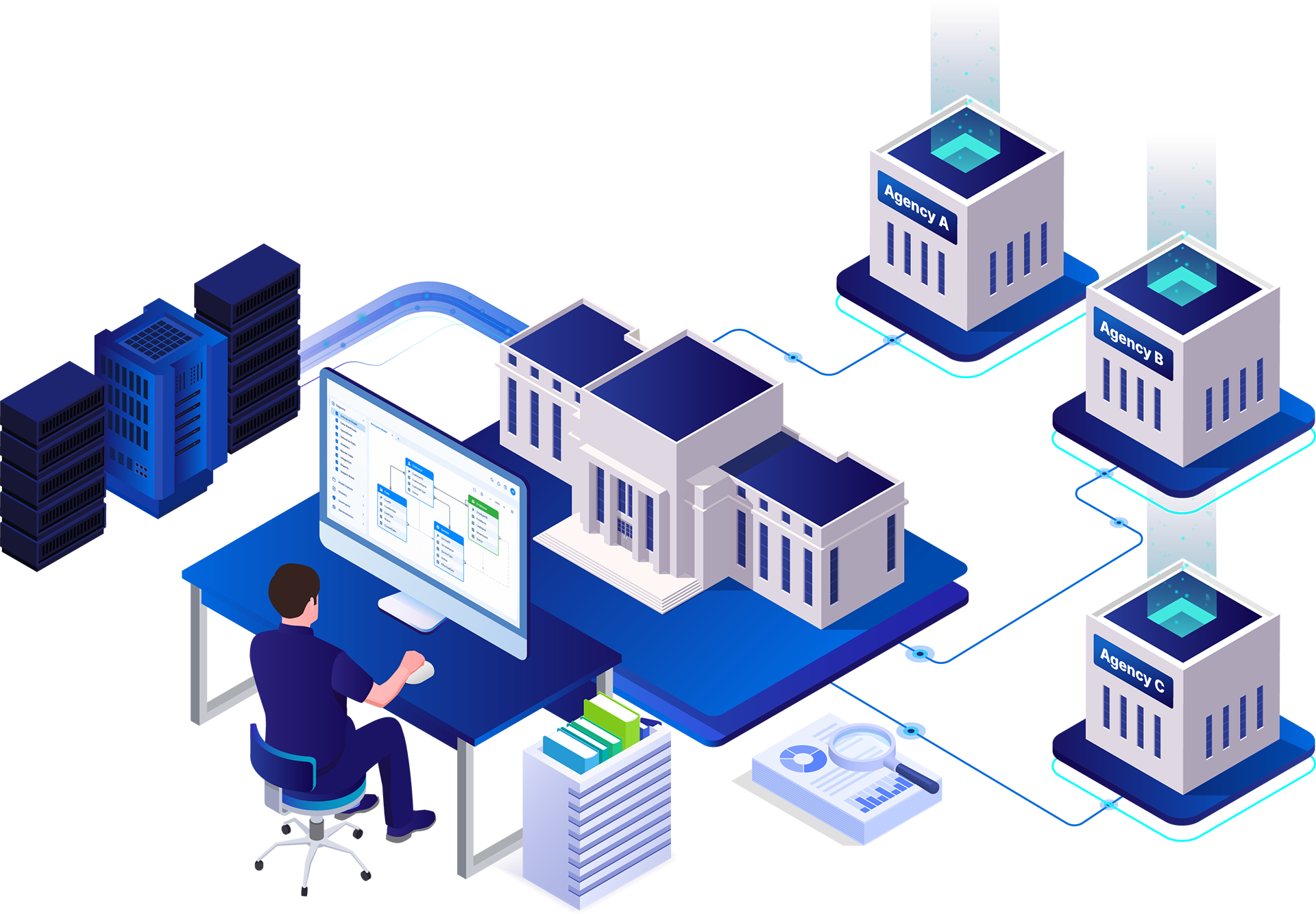
Agencies define shared concepts differently, and reconciling those definitions is a public sector data modeling task.
A “case” in a child welfare system, a “case” in a benefits eligibility system, and a “case” in a state court system describe genuinely different objects with different lifecycles and different identifying keys. When two agencies exchange data on that word alone, the semantic mismatch surfaces downstream as a data quality problem no pipeline can fix.
Interoperability is an explicit federal policy priority. The Federal Data Strategy sets a government-wide framework for treating data as a strategic asset, with interagency data standards among its stated aims. That priority lands on the modeling layer, because a standard expressed only in a document has nothing to enforce it against.
Shared logical models and governed business glossaries are the reconciliation mechanism, and ER/Studio supports both as connected artifacts in public sector data modeling work.
That association is what turns an interagency data-sharing agreement into something the receiving system can consume.
ER/Studio provides enterprise data modeling and governance for agencies documenting legacy systems across multiple database platforms. Four capabilities map onto the problems established above.
Reverse engineering coverage spans the heterogeneous estate a typical agency operates, from mainframe-era relational systems including DB2, Oracle, and SQL Server through cloud warehouses including Snowflake, Azure Synapse, and BigQuery. The full platform support list includes 30-plus database platforms, so an agency can document its entire estate in one modeling environment.
ER/Studio チームサーバー gives agency stakeholders a shared model repository and enterprise glossary accessible through a browser. Program staff, data stewards, and oversight reviewers see published models and authoritative definitions without a desktop modeling license, and those glossary-to-asset associations give the agency a governed データカタログ of what its systems contain.
ER/Studio integrates bi-directionally with マイクロソフト そして Collibra for agencies that have already committed to those governance platforms. Definitions and lineage stay aligned across both systems without manual exports, so the modeling investment extends the catalog investment. ER/Studio’s metadata bridges move metadata in and out of BI tools, data lakes, and ERP systems, including SAP and Oracle ERP through the Safyr integration.
Role-based permissioning in Team Server controls who can view, edit, or approve model content, mapping to the separation-of-duties and read-access requirements named earlier. Named releases and version history give each approved model state a citable version, so an architect can show an auditor which model governed the system at a given point in time.
Modernization plans, audit trails, and interagency data sharing all rest on the same foundation. An accurate model of what the underlying system contains. That work comes first, and the agencies GAO singled out are the ones where it has not happened yet. For public sector data architects, ER/Studio provides the reverse engineering, enterprise glossary, and governance integration to close that gap in a real legacy environment.
デモのリクエスト to see ER/Studio reverse engineer a legacy schema from your own environment and produce the documented model your next modernization plan depends on.
Public sector data modeling goes beyond the standard conceptual, logical, and physical layers. Three requirements distinguish it. Encode statutory retention and disposition schedules in the physical design, classify data against FIPS 199 impact tiers inside the model, and maintain logical models that stay interpretable to partner agencies. Generic best-practice guides cover none of these.
The first step is reverse engineering the legacy schema into a documented physical model before any migration or integration attempt. That model exposes the relationships, constraints, and downstream dependencies that would otherwise fail silently, and it becomes the reference for validating the target design.
FISMA sets the security baseline, the Privacy Act of 1974 governs records about individuals, the Federal Records Act establishes retention and disposition schedules, and FIPS 199 supplies the Low, Moderate, and High classification tiers. State and local agencies often align with the same NIST standards, even when they are not formally mandated.
Through a shared logical model that defines concepts independently of any single agency’s implementation, paired with a governed business glossary that ties each authoritative definition to the data assets carrying it. The Federal Data Strategy points agencies toward this kind of standards adoption.





