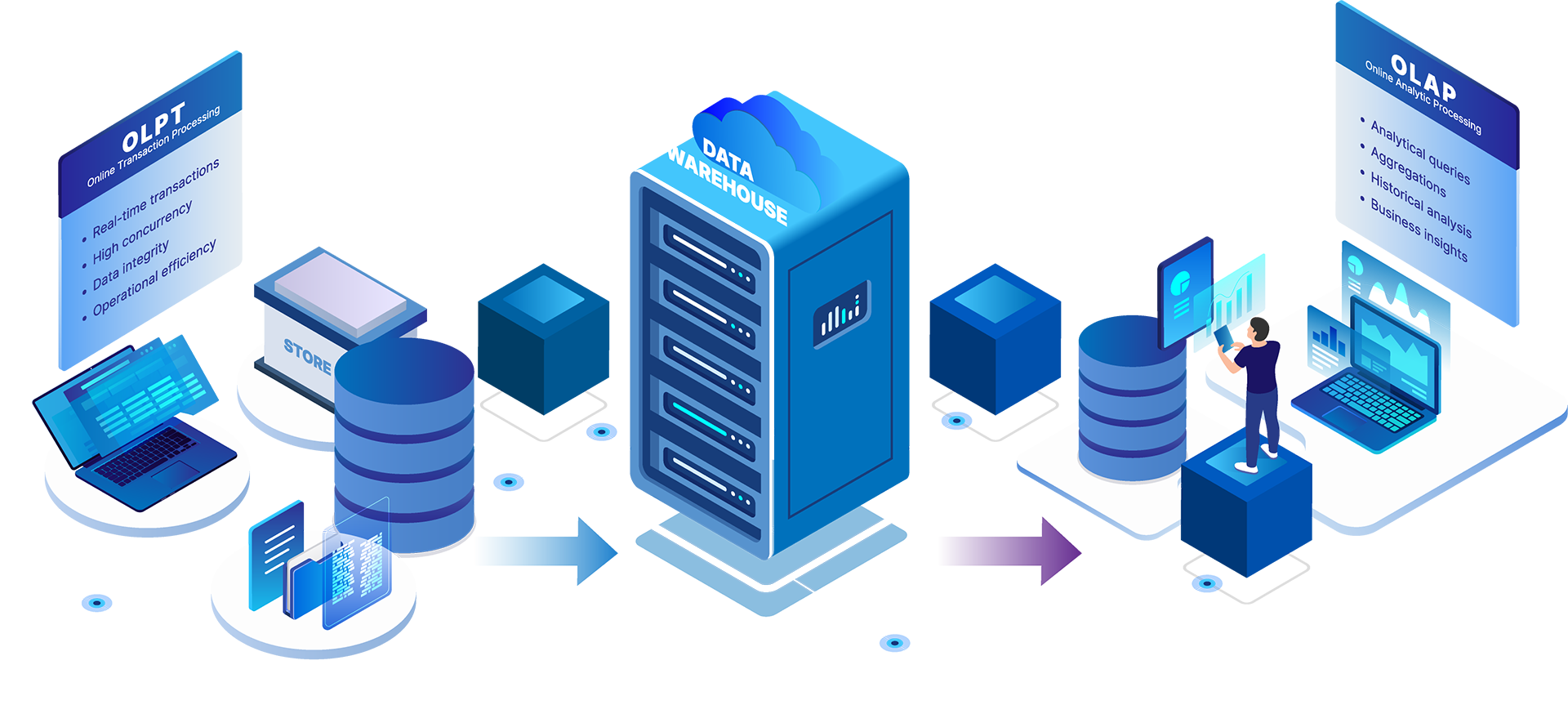
For organizations building modern data platforms, few concepts are more foundational than OLTP and OLAP. These two architectural approaches shape how businesses collect, process, store, and analyze data across nearly every system they use.
Yet despite how common the terms are, they are still frequently misunderstood. Some teams assume OLTP and OLAP are competing technologies. Others believe one is older while the other represents the future. In reality, both remain essential because they solve fundamentally different business problems.
Understanding the distinction matters because the way data is structured for operational processing is very different from the way data is structured for analytics, reporting, governance, and AI. The difference affects application performance, scalability, reporting accuracy, governance consistency, and increasingly, AI readiness.
Organizations that misunderstand these differences often struggle with overloaded systems, inconsistent reporting, duplicated logic, and growing architectural complexity. This is why modern enterprise data architecture depends on understanding not just what OLTP and OLAP are, but how they work together.
OLTP stands for Online Transaction Processing. An OLTP system is designed to support operational business processes in real time. These systems handle the day-to-day transactions that keep an organization running.
Every time a customer places an order online, transfers money between accounts, updates their profile, books a flight, or submits a healthcare claim, an OLTP system is likely involved behind the scenes.
Because these systems support live operational activity, they are optimized for:
OLTP environments are built to process thousands or even millions of small transactions quickly and accurately. Even minor delays can affect customer experience, operational efficiency, or financial processing.
Most OLTP systems use highly normalized database structures. Data is split into related tables to reduce redundancy and improve consistency. For example, customer information may exist in one table, orders in another, and payments in a third. Relationships connect the information together.
This structure supports transactional accuracy and operational efficiency. OLTP systems also prioritize ACID compliance, which helps ensure transactions are processed consistently and reliably even when large numbers of users interact with the system simultaneously.
The queries inside OLTP systems are usually small and highly targeted. A system may retrieve a single customer record, process a payment, update inventory, or check an account balance. The focus is operational execution, not large-scale analysis.
Common examples of OLTP systems include:
These systems power the operational side of the business in real time.
OLAP stands for Online Analytical Processing. Unlike OLTP systems, OLAP environments are designed for analysis rather than operational transactions.
Their purpose is to help organizations explore trends, analyze performance, identify patterns, and support strategic decision-making. OLAP systems power reporting environments, dashboards, forecasting initiatives, and business intelligence platforms.
Where OLTP systems focus on processing individual transactions, OLAP systems focus on analyzing large volumes of data over time.
For example, an OLAP environment might help answer questions like:
These are analytical workloads rather than transactional ones.
OLAP systems are optimized for:
Unlike OLTP systems, OLAP environments are often denormalized. Data is commonly organized into star schemas, dimensional models, or analytical warehouse structures that improve query performance for reporting and analytics.
For example, a sales analytics model may combine customer, product, geographic, and time data into structures optimized for aggregation and analysis. Rather than prioritizing rapid updates, OLAP systems prioritize efficient retrieval of large datasets.
Most OLAP queries scan large volumes of data, join multiple domains together, and aggregate information across time periods or business categories.
Examples of OLAP environments include:
Platforms like Snowflake, Databricks, BigQuery, Redshift, and Microsoft Fabric are commonly associated with modern OLAP workloads.
At the highest level, the distinction is relatively simple.
OLTP systems help run the business.
OLAP systems help understand the business.
One supports operational execution while the other supports analytical insight. One captures transactions as they happen, while the other analyzes those transactions over time.
This difference affects nearly every aspect of architecture design, including data modeling, storage optimization, performance tuning, governance, and scalability.
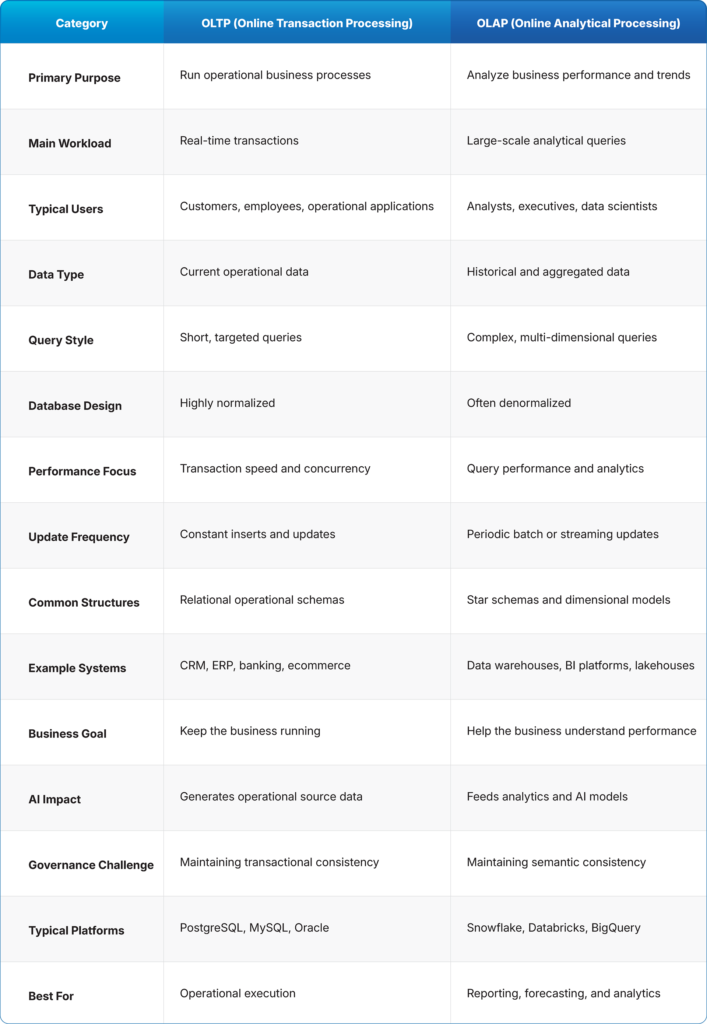
One of the biggest misconceptions is the idea that organizations should choose between OLTP and OLAP. In reality, most enterprises require both because they serve complementary business functions.
Operational systems generate the transactional data required to run the organization. Analytical systems transform that data into insight.
An ecommerce company, for example, may process customer purchases through an OLTP platform while simultaneously using an OLAP environment to analyze purchasing trends, customer behavior, and inventory performance.
A healthcare provider may use OLTP systems to manage patient interactions while relying on OLAP systems to evaluate treatment outcomes and operational efficiency.
A bank may process financial transactions through OLTP platforms while using OLAP systems to analyze fraud patterns, profitability, and customer risk.
The environments work together continuously. In modern architectures, operational data typically flows from OLTP systems into OLAP environments through ETL pipelines, ELT pipelines, streaming architectures, or integration platforms.
Operational data eventually becomes analytical data.
について differences between OLTP and OLAP become especially visible in data modeling practices.
OLTP environments typically use normalized relational models designed around operational processes and transactional consistency. The goal is to minimize redundancy while supporting efficient updates and operational reliability.
Operational schemas are usually highly detailed and process-oriented because they must support the mechanics of daily business activity.
OLAP environments, on the other hand, usually use dimensional modeling approaches such as star schemas and snowflake schemas. These structures prioritize analytical usability and query performance rather than transactional efficiency.
Dimensions and facts help organize information in ways that are easier to analyze across business categories, time periods, and operational domains.
For example, a retail analytics model may include:
This structure allows analysts to evaluate trends quickly without reconstructing operational relationships across highly normalized tables.
The distinction is important because organizations often encounter problems when they attempt to use operational systems for large-scale analytics or analytical systems for transactional processing.
Each architecture exists for a reason.
As organizations manage increasingly complex data ecosystems, one of the biggest challenges is maintaining consistency between operational systems and analytical platforms. OLTP and OLAP environments often evolve separately over time, with different teams, different priorities, and different implementation approaches.
That separation can create significant problems.
Operational systems may define business entities differently than analytical platforms. Reporting logic may drift from source system definitions. Governance documentation can become disconnected from actual implementations. Over time, organizations end up with fragmented models, duplicated business logic, and inconsistent reporting across the enterprise.
This is where enterprise data modeling becomes especially valuable.
ER/Studioは以下を支援します。 design, document, govern, and align both OLTP and OLAP environments through a shared modeling and metadata framework. Instead of treating operational and analytical systems as disconnected silos, ER/Studio allows teams to manage them as part of a broader enterprise data architecture strategy.
For OLTP systems, ER/Studio supports the design and management of highly structured operational models that prioritize transactional integrity, normalization, and operational consistency. Teams can model relational structures, define relationships, enforce naming standards, and maintain detailed documentation that supports operational application development.
For OLAP environments, ER/Studio supports dimensional modeling, warehouse design, analytical structures, and enterprise reporting initiatives. Architects and analytics teams can model star schemas, define dimensions and facts, document transformation logic, and align reporting environments to shared business definitions.
More importantly, ER/Studioは以下を支援します。 maintain consistency between the two.
As data moves from operational systems into analytical platforms, ER/Studio provides visibility into:
This becomes increasingly important as organizations modernize cloud environments, expand governance initiatives, and adopt AI-driven analytics.
Without strong modeling and metadata management practices, operational and analytical environments often drift apart over time. Definitions become inconsistent, duplicate logic spreads across pipelines, and trust in enterprise reporting begins to erode.
ER/Studio helps reduce that fragmentation by giving organizations a centralized framework for managing enterprise data meaning across systems and use cases.
The platform also supports collaboration across technical and business teams. Data architects, analysts, governance leaders, engineers, and operational stakeholders can work from shared models and metadata rather than maintaining disconnected interpretations of the business.
This creates several long-term benefits:
As organizations continue integrating operational systems, cloud platforms, analytics environments, and AI applications, maintaining alignment across OLTP and OLAP architectures becomes increasingly difficult without centralized modeling and governance practices.
ER/Studio helps organizations manage that complexity while supporting both the operational performance requirements of OLTP systems and the analytical scalability demands of OLAP environments.
Rather than viewing operational and analytical architectures as separate worlds, organizations can use ER/Studio to connect them through a more consistent, governed, and enterprise-aligned data strategy.
Although OLTP and OLAP remain distinct architectural concepts, modern cloud platforms have introduced more overlap than existed historically.
Lakehouses and cloud data platforms increasingly support mixed workloads, near real-time analytics, and operational intelligence use cases. Some organizations are experimenting with hybrid transactional and analytical processing approaches that attempt to combine operational and analytical capabilities within unified environments.
This has introduced terms like:
Even so, the underlying workload differences still matter. A platform optimized for millions of concurrent transactions behaves differently from one optimized for massive analytical scans and aggregations.
Organizations still need to think carefully about:
The architectural distinction between OLTP and OLAP has not disappeared. Modern platforms have simply become more flexible in how they support both workloads.
One of the biggest enterprise challenges is maintaining consistency between operational and analytical environments.
As data moves from OLTP systems into OLAP platforms, definitions can drift, metrics can diverge, and transformation logic can become fragmented across pipelines and reporting layers.
For example, finance may define revenue one way while sales defines it another way. Analytics teams may introduce additional calculations while AI systems consume yet another interpretation.
なし strong governance, organizations begin losing trust in their own data.
This is why modern data architecture increasingly emphasizes:
OLTP and OLAP systems may serve different purposes, but they still need to operate from a shared understanding of business meaning.
As organizations expand AI initiatives, this consistency becomes even more important. AI systems reason across operational and analytical environments simultaneously. If definitions and semantics are inconsistent, AI scales those inconsistencies rapidly.
Almost every organization running operational applications depends on OLTP systems in some form.
This includes:
If an organization processes live operational activity, it relies on transactional architecture.
Organizations with high transaction volumes, customer-facing systems, or real-time operational requirements are especially dependent on OLTP environments.
Organizations requiring strategic insight, analytics, forecasting, or reporting need OLAP environments.
This includes businesses pursuing:
In practice, most medium and large enterprises now depend heavily on analytical platforms because modern organizations increasingly rely on data-driven decision-making.
AI is increasing the importance of both OLTP and OLAP systems.
Operational environments continue generating the transactional data organizations rely on every day. Analytical environments increasingly feed machine learning models, forecasting systems, recommendation engines, and generative AI applications.
At the same time, AI exposes governance and consistency problems more quickly than traditional analytics ever did.
If operational systems define business concepts inconsistently, analytical environments inherit those inconsistencies. AI systems then amplify them across outputs, recommendations, and automated decisions.
This is one reason organizations are investing more heavily in:
The quality of AI outcomes increasingly depends on the consistency of the underlying data ecosystem.
It is easy to frame OLTP and OLAP as competing approaches, especially as modern platforms continue evolving. In reality, they remain complementary architectural patterns designed for different business needs.
OLTP systems keep the business operating efficiently in real time.
OLAP systems help the business understand performance, identify trends, improve operations, and plan strategically.
One powers execution while the other powers insight.
Modern enterprises need both. As organizations continue expanding analytics, governance, cloud modernization, and AI initiatives, understanding the relationship between operational and analytical systems becomes even more important.
The future of enterprise data architecture is not about choosing OLTP or OLAP. It is about designing environments where operational systems, analytical platforms, governance frameworks, and semantic consistency work together as part of a connected enterprise data strategy.
As organizations modernize their data ecosystems, the challenge is no longer simply storing transactions or generating reports. The real challenge is creating environments where operational execution and analytical insight remain aligned across the enterprise.
That requires more than technology alone. It requires thoughtful data architecture, governance, metadata management, and modeling practices that ensure consistency as data moves between systems and use cases.
OLTP and OLAP are not relics of older architecture conversations. They remain foundational concepts that shape how modern enterprises build applications, analytics environments, cloud ecosystems, and AI-ready data platforms.
Organizations that understand these differences can design systems that are faster, more scalable, more trustworthy, and better aligned to business goals.
Organizations that ignore them often struggle with fragmented architectures, inconsistent reporting, governance issues, and growing operational complexity.
Understanding OLTP and OLAP is ultimately about understanding the broader relationship between operations, analytics, and enterprise data strategy itself.
And that relationship has never mattered more.
Discover how ER/Studio can help your organization align OLTP and OLAP environments through enterprise data modeling, governance, and metadata management.
OLTP systems are designed for operational transaction processing, such as processing orders, updating accounts, or managing customer interactions in real time. OLAP systems are designed for analytics and reporting, helping organizations analyze trends, evaluate performance, and support decision-making using large volumes of historical data.
Yes. Most organizations rely on both. OLTP systems handle day-to-day operational activities, while OLAP environments analyze the data generated by those operations. Together, they support both business execution and strategic insight.
OLTP systems prioritize transactional speed, consistency, and efficient updates, which is why they typically use normalized structures that reduce redundancy. OLAP systems prioritize analytical performance and reporting efficiency, so they often use denormalized dimensional models that simplify large-scale queries and aggregations.
AI and advanced analytics depend heavily on consistent, well-governed data across both operational and analytical systems. If business definitions, metrics, or metadata become inconsistent between OLTP and OLAP environments, AI systems can produce unreliable insights and conflicting outputs.
ER/Studio helps organizations model, govern, and align both operational and analytical systems through shared metadata, enterprise data modeling, lineage visibility, and governance frameworks. This helps reduce inconsistency, improve reporting accuracy, and create stronger foundations for analytics and AI initiatives.