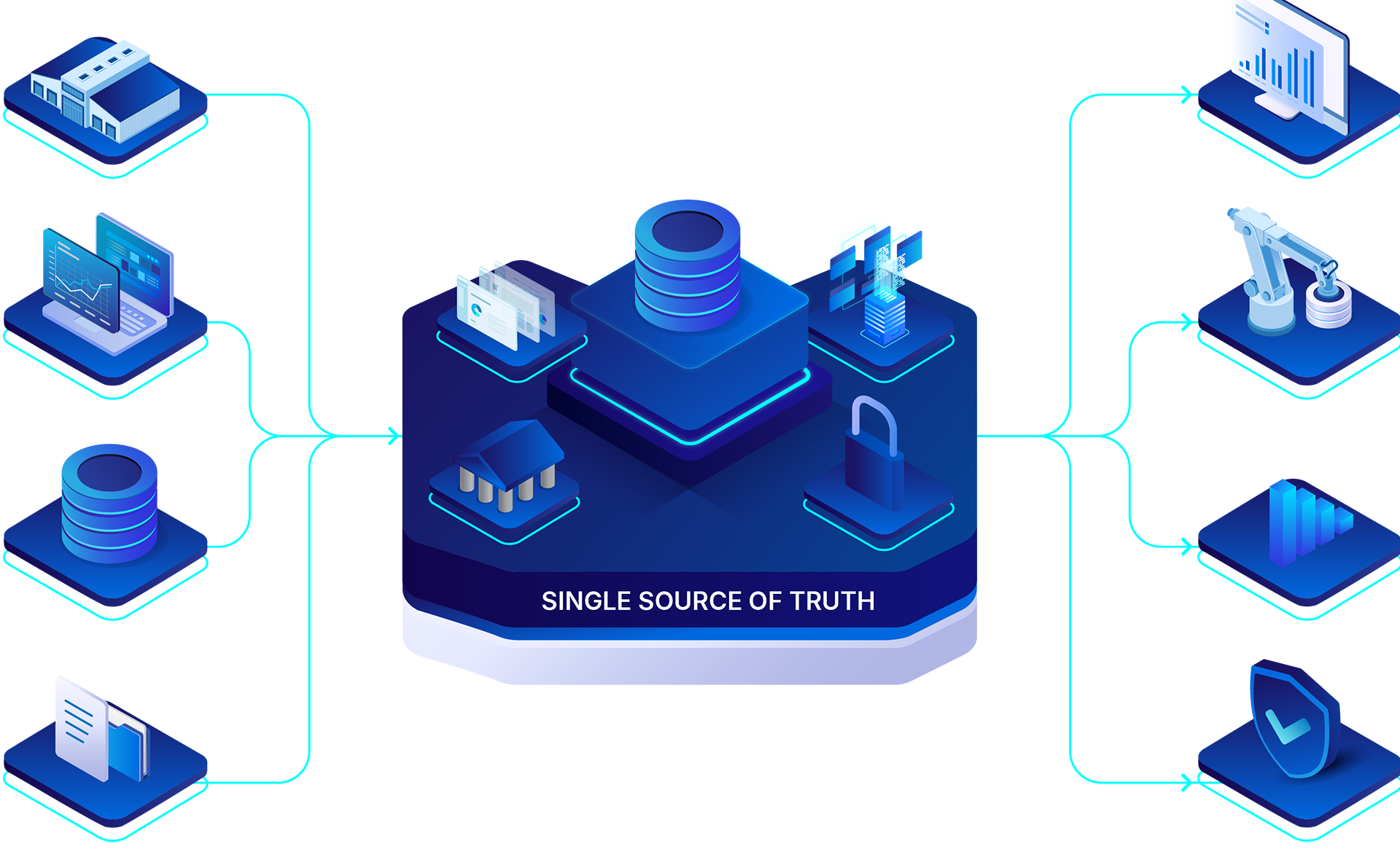
Industrial organizations are under constant pressure to improve efficiency, increase production, reduce downtime, and make faster decisions without compromising safety, quality, or regulatory compliance. Every one of those objectives depends on a single factor: the ability to trust and understand enterprise data.
That sounds straightforward.
In reality, it’s anything but.
Modern industrial operations rely on information flowing between engineering systems, production equipment, maintenance applications, enterprise resource planning (ERP) platforms, manufacturing execution systems (MES), warehouse management systems, environmental monitoring tools, quality management applications, and countless other technologies. Each system captures valuable information, yet each typically represents only one piece of a much larger operational picture.
The challenge is bringing those pieces together.
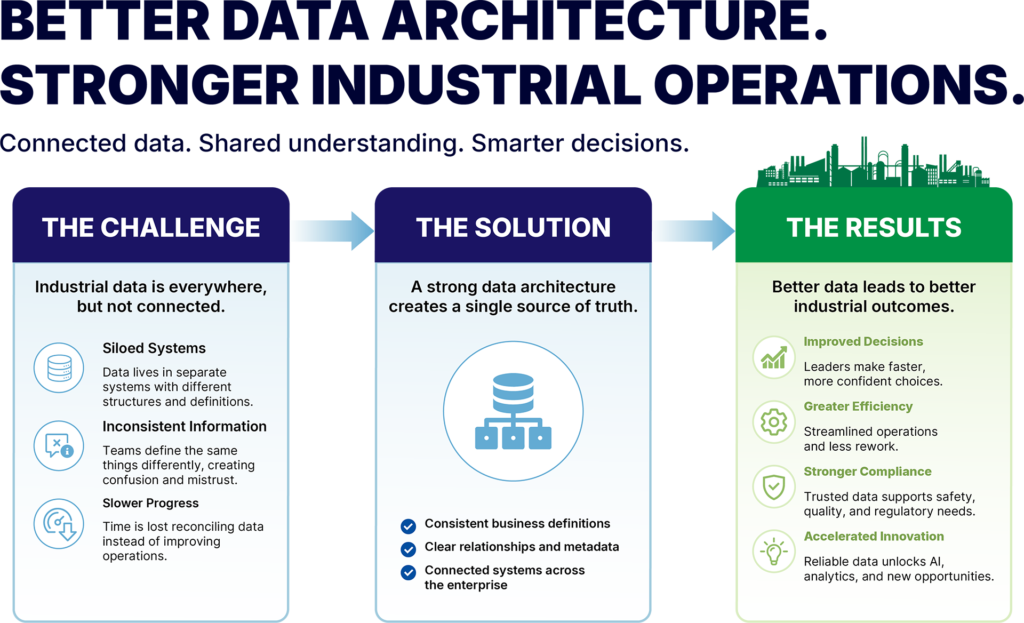
Without a consistent architectural foundation, the same asset, supplier, production metric, or maintenance record may be defined differently across multiple systems. Teams spend valuable time reconciling reports, validating information, and resolving inconsistencies instead of improving operations. As organizations continue investing in Industry 4.0, predictive maintenance, digital twins, advanced analytics, and AI, those disconnected data environments become increasingly difficult to manage.
Technology is advancing rapidly.
エンタープライズ・データ・アーキテクチャ must evolve just as quickly.
Today’s industrial enterprise extends far beyond the production floor. Equipment continuously generates telemetry through Industrial Internet of Things (IIoT) devices. Supply chains span continents. Regulatory reporting requirements continue to grow, while executives expect real-time visibility into operational performance across facilities, business units, and geographic regions.
Every department depends on enterprise data, but each interacts with it differently. Engineering teams focus on product and equipment information. Operations managers monitor production efficiency and throughput. Maintenance organizations analyze asset performance and preventive maintenance schedules. Supply chain teams optimize inventory movement and logistics, while environmental, health, and safety teams monitor compliance and sustainability initiatives. Finance teams rely on accurate operational data to understand costs, profitability, and overall business performance.
Although these groups share common business objectives, they often rely on different systems, different terminology, and different perspectives on the same information.
The result is not a shortage of data. It’s a shortage of shared understanding.
Disconnected data has consequences that extend far beyond IT.
When engineering, operations, maintenance, finance, and supply chain teams define critical business information differently, even simple questions can become difficult to answer. Which production numbers are correct? Which asset record reflects the latest maintenance activity? Which report should leadership trust when making investment decisions?
These challenges become even more pronounced as organizations modernize their operations. New facilities are added, legacy systems are replaced, acquisitions introduce unfamiliar technologies, and cloud platforms become part of the enterprise architecture. Every change increases the complexity of the data landscape unless it is supported by a consistent architectural framework.
The cost of disconnected data is measured in more than time.
It can delay production improvements, complicate regulatory reporting, slow modernization initiatives, and reduce confidence in business decisions. Perhaps most importantly, it limits an organization’s ability to fully capitalize on emerging technologies that depend on trusted enterprise information.
“93% of Industrial Companies Still Struggle With Data Silos.”
- DirectIndustry e-Magazine
Many industrial organizations view data architecture as a technical discipline focused on designing databases.
In reality, enterprise data architecture is about creating a shared understanding of how the business operates.
A well-designed data architecture establishes consistent business definitions, documents relationships between critical data assets, and provides the metadata needed to connect operational systems across the enterprise. Instead of treating data as isolated records within individual applications, it creates an enterprise-wide framework that helps every department understand how information relates to the broader business.
That consistency creates measurable value.
Engineering teams spend less time validating information and more time improving processes. Operations leaders gain confidence that production metrics are consistent across facilities. Maintenance teams can better understand how equipment performance affects production goals. Governance and compliance teams gain greater visibility into data lineage and business definitions, simplifying audits and regulatory reporting. Executive leadership benefits from trusted analytics that support faster, more informed decisions.
When everyone works from the same architectural foundation, data becomes a strategic asset instead of an operational challenge.
Nearly every industrial organization is pursuing initiatives designed to improve efficiency, resilience, and competitiveness. Some are implementing predictive maintenance programs to reduce unplanned downtime. Others are investing in digital twins, cloud modernization, advanced analytics, or AI-driven operational intelligence. Many are pursuing all of these initiatives simultaneously.
Although these projects differ in scope, they share a common dependency.
They all rely on trusted enterprise data.
Artificial intelligence cannot generate reliable recommendations if equipment, production, and maintenance data use inconsistent business definitions. Digital twins lose value when underlying operational systems describe assets differently. Advanced analytics produce conflicting insights when production metrics vary between business units.
Organizations cannot build intelligent operations on disconnected information.
They first need an enterprise architecture that establishes consistent business meaning across every system that creates, consumes, and analyzes data.
The challenges facing industrial organizations are not theoretical. They are playing out every day in companies managing complex, global operations.
Consider Newmont Corporation, one of the world’s largest gold mining companies. With more than 30,000 employees and operations spanning North America, South America, Australia, and Africa, Newmont manages an enormous ecosystem of operational, logistics, environmental, and financial data. As the business continued to expand, so did the complexity of managing that information across multiple regions, departments, and technology platforms.
Like many industrial organizations, Newmont wasn’t struggling because it lacked data. The company had plenty of it.
The challenge was making that data work together.
Operational information from mining sites existed separately from financial systems. Environmental metrics were maintained in dedicated platforms, while logistics and production data lived in their own environments. Without a unified architectural approach, teams spent significant time reconciling information, manually documenting changes, and ensuring data remained synchronized across systems.
As Newmont expanded its enterprise data warehouse, another challenge emerged. Existing modeling tools made reverse engineering database changes a slow, manual process. Even relatively small schema changes often required extensive rework, making it difficult for architects to keep enterprise models synchronized with production systems.
At the same time, collaboration became increasingly difficult.
Data architects, developers, and business teams were working across multiple geographic regions without a centralized repository for enterprise models. Different teams maintained different versions of the same information, creating version conflicts, duplicated effort, and inconsistent interpretations of business data. The larger the organization became, the more difficult it was to ensure everyone was working from the same architectural foundation.
Regulatory compliance added another layer of complexity. As a global mining organization, Newmont needed detailed metadata management, documented data lineage, and comprehensive audit trails to support environmental reporting, financial transparency, and regulatory requirements. Manual documentation processes made those objectives increasingly difficult to achieve while increasing both effort and risk.
None of these challenges are unique to mining.
Manufacturers face similar issues connecting production systems with quality management and supply chain platforms. Energy providers manage operational data across generation, transmission, maintenance, and compliance systems. Aerospace organizations must coordinate engineering, production, suppliers, and lifecycle maintenance across globally distributed teams.
The technologies may differ.
The underlying data challenges are remarkably similar.
To address these challenges, Newmont implemented ER/Studio as the foundation for its enterprise data architecture. Rather than focusing on a single pain point, the organization adopted a comprehensive approach that connected data modeling, metadata management, collaboration, and governance within a centralized platform.
One of the first improvements came through ER/Studio’s reverse engineering capabilities. Instead of rebuilding entire models whenever database structures changed, Newmont’s architects could selectively reverse engineer only the affected tables or portions of the schema. This significantly reduced the effort required to keep enterprise models synchronized with operational systems while allowing the team to respond more quickly to evolving business requirements.
Equally important was the organization’s ability to centralize metadata management. By documenting data lineage, business definitions, attributes, and transformation details within ER/Studio, Newmont created greater transparency across its enterprise data landscape. Teams could better understand where information originated, how it moved through the organization, and how it was used, strengthening both governance and regulatory compliance.
ER/Studio also helped Newmont align conceptual, logical, and physical data models within a single architectural framework. This ensured that high-level business objectives remained connected to detailed implementation while reducing redundancy and improving consistency throughout the data lifecycle. Rather than viewing enterprise architecture and operational databases as separate disciplines, the organization established a connected modeling strategy that supported both day-to-day operations and long-term modernization initiatives.
Collaboration improved as well.
を通して ER/Studio’s centralized repository and web-based access, architects, developers, and business teams could work from the same up-to-date enterprise models regardless of location. Instead of maintaining separate versions or relying on manual coordination, stakeholders gained a shared environment for reviewing, updating, and understanding enterprise data.
The results demonstrate what becomes possible when industrial organizations establish a strong architectural foundation. Newmont reduced manual workload through automation, improved team productivity through centralized collaboration, increased model accuracy, and strengthened compliance capabilities through comprehensive metadata management and governance.
The story is not simply about implementing a new data modeling tool.
It is about giving an organization the architectural foundation needed to manage growing complexity with greater confidence.
“ER/Studio’s reverse engineering has transformed our workflow, cutting down model update time by 40%.”
- Newmont
Every industrial organization is on its own modernization journey.
Some are replacing legacy systems. Others are expanding globally, implementing cloud platforms, adopting AI, or investing in predictive maintenance and digital twins. While the technologies and priorities may differ, the underlying requirement remains remarkably consistent.
Successful modernization begins with trusted enterprise data.
Organizations that establish consistent business definitions, governed metadata, and connected enterprise models are better positioned to integrate new technologies, improve reporting, strengthen compliance, and support innovation without creating additional complexity.
Industrial organizations cannot eliminate complexity, but they can manage it more effectively. The key is establishing a data architecture that provides consistency across systems, departments, and business initiatives.
ER/Studio was built to help organizations do exactly that. Rather than functioning solely as a data modeling tool, it provides an enterprise platform for designing, governing, documenting, and sharing data architecture. By connecting conceptual, logical, and physical data models with metadata management, collaboration, and governance capabilities, ER/Studio helps industrial organizations create a trusted foundation that supports both current operations and future innovation.
One of the greatest challenges facing industrial organizations is ensuring that every department speaks the same language.
Engineering may define an asset one way, while maintenance systems use different terminology. Operations teams may measure production performance differently than finance, while compliance teams maintain separate definitions for regulatory reporting. These inconsistencies often go unnoticed until reports conflict or projects require significant reconciliation.
ER/Studio helps eliminate this disconnect by establishing a common architectural framework that defines business concepts, relationships, and metadata once, then applies those definitions consistently across the enterprise. Conceptual, logical, and physical models remain connected, giving both technical and business teams a shared understanding of how enterprise information is structured and used.
Rather than creating isolated documentation for individual projects, organizations develop enterprise models that become long-term architectural assets.
Industrial organizations operate in environments where accountability matters. Whether demonstrating compliance with ISO standards, supporting OSHA reporting, documenting environmental metrics, or preparing for internal audits, organizations need confidence that their data is accurate, traceable, and well governed.
ER/Studio centralizes metadata management by documenting business definitions, attributes, mappings, and data lineage within a single environment. Teams gain visibility into how information moves throughout the enterprise, making it easier to understand the impact of changes, identify dependencies, and maintain consistency across operational systems.
Instead of treating governance as a separate initiative, organizations can embed governance directly into the architecture itself. Business glossaries, enterprise data dictionaries, and metadata remain connected to the models they describe, helping ensure that business meaning evolves alongside the systems that support it.
Industrial transformation depends on more than technology. It depends on people working together.
Data architects, engineers, operations managers, developers, governance teams, and business stakeholders all contribute valuable expertise, yet many organizations still rely on disconnected review processes involving spreadsheets, PDFs, email chains, and static documentation.
ER/Studio replaces those fragmented workflows with collaborative capabilities designed for enterprise architecture.
The Multi-User Repository allows multiple architects to work concurrently on shared enterprise models while maintaining version control, detailed change history, and role-based access. Teams can safely develop different portions of the architecture simultaneously without overwriting one another’s work, making it easier to support large modernization initiatives across multiple facilities or business units.
について チームサーバーポータル extends collaboration beyond technical teams. Through a secure, browser-based interface, business users, analysts, governance professionals, and project stakeholders can explore models, review metadata, browse business glossary terms, participate in discussions, and provide feedback without requiring desktop modeling software.
This broader participation helps improve communication between business and IT while ensuring architectural decisions are informed by the people who use enterprise data every day.
Industrial organizations are investing heavily in technologies that promise greater efficiency, improved resilience, and more intelligent operations. AI, predictive maintenance, digital twins, advanced analytics, and automation all have the potential to transform how organizations operate.
Those initiatives share one critical dependency.
They require trusted enterprise data.
ER/Studio helps organizations prepare for these initiatives by establishing consistent business definitions and governed metadata that can be reused across modern data platforms. Instead of repeatedly redefining assets, processes, suppliers, and operational metrics for every new project, organizations build upon an architectural foundation that evolves with the business.
As industrial operations continue to grow more connected, the ability to maintain consistent enterprise meaning becomes increasingly important. Organizations that invest in strong data architecture today are better positioned to integrate new technologies tomorrow without introducing additional complexity.
The industrial sector has entered a period of unprecedented transformation. Connected operations, cloud platforms, AI, automation, and advanced analytics are changing how organizations manufacture products, manage assets, optimize supply chains, and make business decisions.
Yet technology alone is not enough.
Organizations also need confidence that the data powering those technologies is accurate, consistent, and aligned across the enterprise.
That confidence begins with architecture.
A well-designed enterprise data architecture helps connect systems that were never intended to work together, establishes consistent business definitions across departments, and provides the governance needed to support modernization initiatives with confidence. It enables organizations to spend less time resolving inconsistencies and more time improving efficiency, reducing downtime, strengthening compliance, and driving innovation.
ER/Studio provides the modeling, metadata management, governance, and collaboration capabilities industrial organizations need to create that foundation. Whether supporting a single manufacturing facility or a global enterprise operating across multiple continents, ER/Studio helps transform disconnected data into trusted enterprise knowledge that supports better decisions at every level of the organization.
As industrial organizations continue their digital transformation journeys, one thing is becoming increasingly clear.
The future belongs to organizations that not only collect data, but also understand it, govern it, and use it to its fullest potential.
Start your free ER/Studio trial today and discover how a trusted enterprise data architecture can help your industrial organization improve efficiency, strengthen governance, and support the next generation of operational innovation.
Industrial organizations rely on data from engineering, production, maintenance, supply chain, finance, and compliance systems. A strong data architecture connects these systems through consistent business definitions and metadata, helping improve reporting, operational efficiency, governance, and decision making.
ER/Studio enables industrial organizations to design conceptual, logical, and physical data models while centralizing metadata management, business glossaries, data lineage, and governance. This helps create a unified view of enterprise data across multiple systems and departments.
Yes. ER/Studio provides the architectural foundation needed to support initiatives such as Industry 4.0, predictive maintenance, digital twins, cloud modernization, analytics, and AI by establishing trusted enterprise data models and consistent business definitions.
ER/Studio’s Multi-User Repository allows multiple architects to work concurrently on shared models, while the Team Server Portal enables engineers, business users, governance teams, and other stakeholders to securely review models, browse metadata, participate in discussions, and collaborate through a web browser.
ER/Studio helps organizations document metadata, business definitions, mappings, and data lineage while supporting enterprise data governance through business glossaries, enterprise data dictionaries, role-based collaboration, and integration with leading governance platforms such as Microsoft Purview and Collibra.