Organizations today have no shortage of tools promising to help them manage, govern, and understand their data. Data catalogs, governance platforms, metadata repositories, and data modeling solutions all play important roles in the modern data stack. As vendors continue expanding their capabilities, however, the line between these technologies has become increasingly blurred.
One of the most common questions data leaders ask is whether they need a dedicated data modeling platform or if they can rely on the modeling capabilities included in their データカタログ.
It is a fair question. After all, many data catalogs now include lineage diagrams, business glossaries, metadata visualization, and basic relationship mapping. On the surface, these capabilities can appear similar to data modeling.
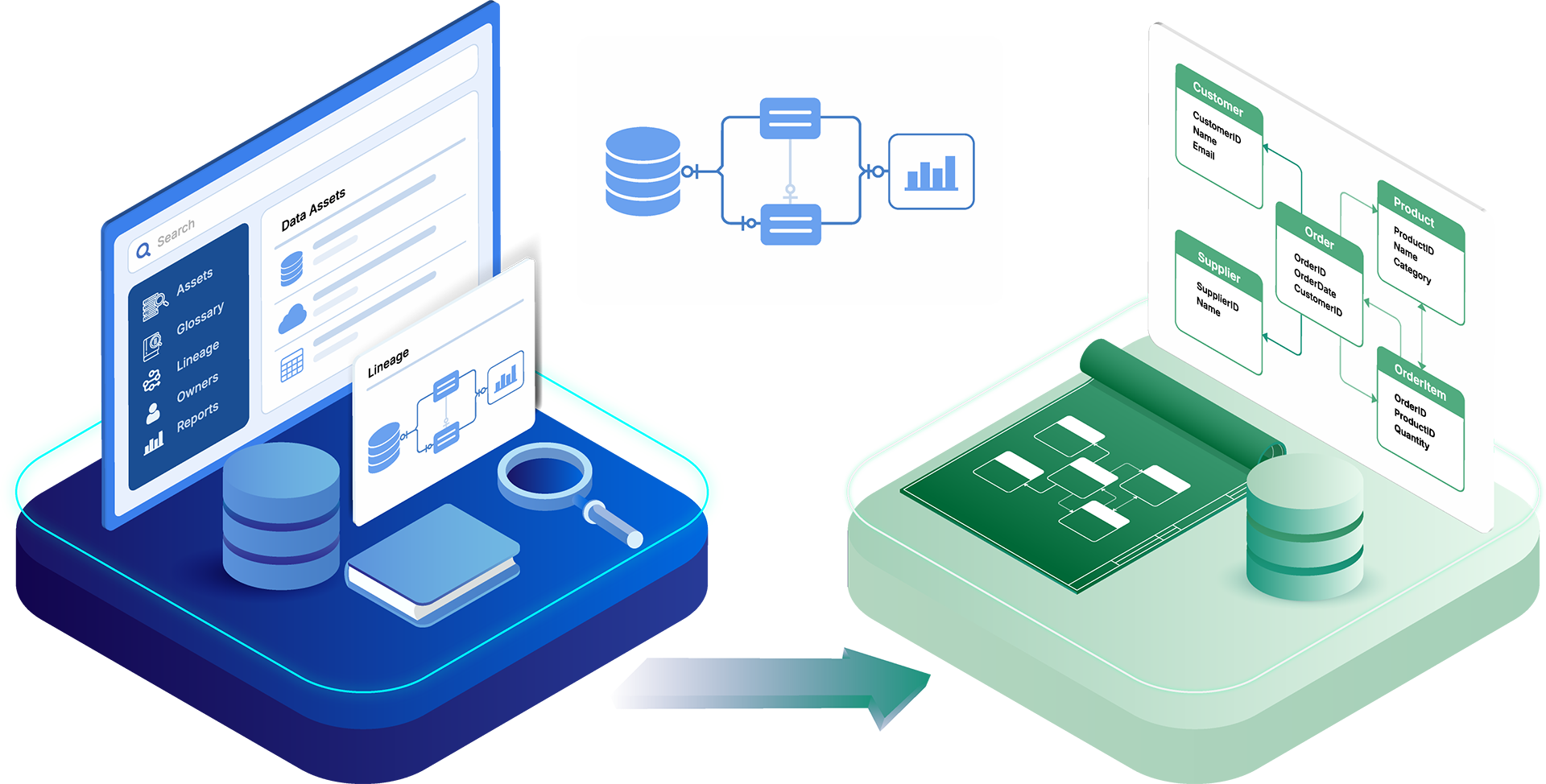
The reality is that data catalogs and data modeling platforms solve fundamentally different problems. A data catalog helps organizations understand what exists, while a data modeling platform helps them define what should exist.
Understanding that distinction can help organizations avoid costly mistakes as they modernize legacy systems, migrate to the cloud, strengthen governance programs, and prepare for AI initiatives.
Over the last decade, organizations have invested heavily in data governance and メタデータ管理. As those initiatives matured, data catalogs became an essential component of the enterprise data stack.
Catalogs made it easier to discover assets, identify data owners, trace lineage, and document business definitions. For many organizations, this represented a major step forward compared to spreadsheets, disconnected documentation, and tribal knowledge.
At the same time, catalog vendors began adding visualization and relationship mapping features. Some introduced basic modeling capabilities that allowed users to see how data assets related to one another. As these features expanded, many organizations naturally began asking whether they still needed a dedicated data modeling solution.
The answer depends on what the organization expects the tool to accomplish.
If the primary objective is discovering, documenting, and governing existing assets, a カタログ may provide much of the required functionality. If the objective is designing databases, standardizing structures, managing change, modernizing systems, or creating a long-term architectural foundation, a dedicated data modeling platform serves a very different purpose.
The biggest misconception in this discussion is the assumption that documentation and design are interchangeable.
They are not.
Imagine an architect documenting every room, hallway, and utility connection in an existing building. That documentation is valuable because it helps people understand what exists and how it functions. However, documentation alone does not provide a framework for designing a new building.
The same principle applies to data.
A catalog documents data assets that already exist, helping users understand systems, ownership, lineage, and metadata. A data modeling platform, by contrast, focuses on designing and managing the structures that support those systems.
One documents reality. The other shapes it.
This distinction becomes increasingly important as organizations grow more complex. As new applications, databases, warehouses, lakehouses, and analytics platforms are introduced, architectural consistency becomes harder to maintain. Without intentional design, complexity accumulates quickly.
データカタログ provide tremendous value when organizations need greater visibility into their data environments.
They help answer questions such as:
For governance teams, data stewards, analysts, and business users, these capabilities are essential. A well-implemented catalog reduces confusion, improves trust, and makes data easier to find and understand.
This visibility becomes especially important in large organizations where data is distributed across dozens or even hundreds of systems.
The challenge is that visibility alone does not create consistency. A catalog can tell you where data exists, who owns it, and how it moves throughout the organization, but it does not necessarily define how that data should be structured or standardized moving forward.
A data modeling platform focuses on structure, design, and implementation.
Instead of asking where data exists today, modeling helps define how data should be organized moving forward.
This includes activities such as:
データモデリング provides the blueprint that guides implementation.
For example, a logical data model may define what a customer, account, product, policy, or transaction represents from a business perspective. That logical model can then be transformed into a physical data model containing the database-specific structures, datatypes, keys, relationships, and implementation details required to build the actual database.
This is a critical distinction.
A drawing tool or catalog visualization may help describe a database. A data modeling platform helps create one.
“A database that is not modeled carefully will grow into a liability instead of an asset.”
- David C. Hay, Data Model Patterns: Conventions of Thought
Many organizations purchase a catalog expecting it to solve broader architectural challenges. Eventually, they discover that they are asking the tool to do something it was never designed to do.
The first sign is when metadata discovery begins to replace architecture.
A catalog can show where information exists and how it moves between systems. It cannot automatically establish a future-state design for those systems. Knowing what exists today does not determine what should exist tomorrow.
The second sign appears when governance initiatives struggle to create consistency.
Many organizations document business terms and definitions within a catalog. While documentation is important, documenting inconsistent definitions does not eliminate inconsistency. If five systems define a business concept differently, placing those definitions into a glossary does not magically standardize them.
That standardization often begins with data modeling.
The third sign appears during modernization efforts.
Organizations frequently discover that catalogs provide visibility into legacy environments but offer limited guidance when redesigning those environments for the future. As a result, complexity gets documented rather than reduced.
Consider a company attempting to standardize product information across engineering, ecommerce, supply chain, analytics, and finance systems.
The data catalog plays an important role. It can identify where product information exists, who owns the data, which reports depend on it, and how product information flows throughout the organization. These insights are valuable, but the catalog alone does not answer a more fundamental question:
What is a product?
Different departments often have different answers. Engineering may define a product as a collection of components and assemblies, while ecommerce teams view it as a marketable offering available for purchase. Supply chain teams may organize products through inventory and sourcing structures, while finance may define products according to revenue recognition and reporting requirements.
Each perspective serves a legitimate business purpose, but differences between them can create inconsistency across systems, reports, and analytics.
A data catalog can document those differences. A data modeling platform helps resolve them by establishing common entities, relationships, and business rules that guide implementation across the enterprise.
The result is not simply better documentation. It is greater consistency throughout the organization.
Many organizations begin modernization projects believing they have a solid understanding of their existing data environments. That confidence often changes once migration efforts begin.
Legacy databases may contain years of undocumented changes. Different applications may implement similar concepts in different ways. Naming conventions may vary dramatically across systems, and relationships that exist in practice may never have been formally documented.
A data catalog can help identify assets, dependencies, and lineage. Those insights are critical during modernization efforts, particularly when organizations need to understand the scope and impact of planned changes.
However, understanding the current state is only part of the challenge.
A modeling platform provides the blueprint needed to rationalize, standardize, and redesign those structures for the future. This is one reason data modeling remains a critical discipline during modernization initiatives. Organizations are rarely moving data from one platform to another without change. More often, they are redesigning the architecture that supports that data.
Without a model, modernization can become little more than relocating existing complexity.
Artificial intelligence has introduced a new level of urgency to this conversation.
Many organizations are investing heavily in copilots, generative AI, predictive analytics, and intelligent automation. While these technologies create exciting opportunities, they also expose weaknesses in underlying data foundations that may have existed for years.
AI systems do not eliminate inconsistency.
They inherit it.
If business concepts are defined differently across systems, AI models inherit those inconsistencies. If product hierarchies are poorly defined, AI inherits those weaknesses. If relationships between entities are unclear, AI-generated outputs become less reliable and more difficult to trust.
This is why many organizations are rediscovering the importance of data architecture, enterprise semantics, and governance.
Before AI can generate trusted outputs, organizations must establish trusted inputs. Data modeling helps create that foundation by providing the structure, meaning, and consistency needed to support governance, analytics, and AI initiatives alike.
As organizations become more dependent on AI-driven decision making, the importance of well-defined business concepts only increases.
The answer ultimately depends on the problem you are trying to solve.
| If your goal is… | You likely need… |
| Discover data assets | データカタログ |
| Improve metadata visibility | データカタログ |
| Manage governance workflows | データカタログ |
| Design new databases | Data Modeling Platform |
| Standardize business definitions | Data Modeling Platform |
| Modernize legacy systems | Data Modeling Platform |
| Compare designs to deployed databases | Data Modeling Platform |
| Strengthen architecture and governance together | Both |
For many organizations, the strongest approach is not choosing one or the other.
It is combining both.
A data modeling platform establishes structure, standards, and architectural intent. A data catalog makes that information discoverable throughout the organization and connects it to governance, stewardship, and operational processes.
Together, they provide a more complete view of enterprise data while helping organizations balance visibility, consistency, and control.
The question is not whether data catalogs are valuable. They absolutely are.
The real question is whether visibility alone is enough.
A data catalog helps organizations understand what they have.
A data modeling platform helps them define what they need.
As organizations pursue modernization, ガバナンス, cloud transformation, and AI initiatives, that distinction becomes increasingly important. Visibility without design often leads to complexity. Design without visibility can create governance challenges.
The most successful organizations recognize that both disciplines matter. Catalogs help document data, while data modeling helps define it. When data becomes a strategic asset, defining it well is often the difference between simply managing information and building a foundation that can support future growth, innovation, and AI adoption.
Ready to move beyond documenting data and start designing it? Try ER/Studio free today.
In most cases, no. Data catalogs are designed to help users discover, understand, and govern existing data assets. Data modeling platforms focus on designing, standardizing, and managing the structures that support those assets. While some catalogs include basic modeling features, they typically do not provide the depth required for enterprise data architecture.
A data model defines the structure, relationships, and business rules associated with data. Metadata describes information about data, such as ownership, lineage, classifications, and definitions. Data models often become an important source of metadata, but the two concepts serve different purposes.
Data governance relies on consistent definitions, structures, and standards. Data modeling helps establish those foundations before systems are implemented, making governance efforts more effective and sustainable over time.
No. If anything, AI increases the importance of data modeling. AI systems depend on consistent, well-understood data structures and business definitions. Poorly defined data often leads to unreliable AI outputs.
Organizations often use ER/Studio to create logical and physical data models, standardize business definitions, reverse engineer existing databases, compare designs to deployed systems, and manage architectural change. Data catalogs complement these capabilities by making metadata and governance information accessible across the organization.