Most organizations approach データガバナンス like they’re shopping for a single appliance that will solve everything. They’re not. They’re assembling a technology stack where each component needs to do one thing exceptionally well and integrate cleanly with the rest.
The question isn’t which governance tool wins. It’s which tools cover your specific gaps, how they connect, and what foundational pieces you’re missing. Governance catalogs can’t govern what they can’t see, and most of them see surprisingly little without proper upstream metadata, a blind spot vendors rarely discuss in demos.
This comparison walks through six tools that frequently appear in enterprise governance infrastructure, what they excel at, and where they depend on other systems to function. If you’re migrating off PowerDesigner or building governance capabilities from scratch, this breakdown clarifies which tools belong in your platform mix and which problems remain unsolved.
Governance infrastructure breaks into four functional layers:
Most governance failures happen because organizations buy catalog tools without addressing the upstream modeling gap. Catalogs primarily ingest and enrich metadata rather than author foundational structural models. If your models are outdated, incomplete, or trapped in legacy tools, your governance platform governs fiction.

Strengths: Enterprise data modeling focused on accuracy, multi-user collaboration, and integration with governance platforms.
Supports metadata export and synchronization to Purview and Collibra via APIs and metadata exchange, helping governance tools work with richer structural metadata. Supports PowerDesigner model import, preserving logical and physical models. Strong in EMEA and regions requiring detailed compliance documentation at the schema level.
Limitations: Purpose-built for modeling, not designed to replace catalog or discovery tools but to supply the foundational metadata they require.
Requires data architects or DBAs who understand relational modeling and normalization. Value shows up in what other governance tools can do with better metadata, not as a standalone governance interface.
最高だ: Organizations building governance on accurate foundational metadata. Teams migrating from PowerDesigner who need continuity in modeling practices while feeding modern governance tools. Teams where model sharing across distributed architecture groups matters for consistency.
Strengths: Sophisticated policy workflows with multi-level approval chains.
Strong stewardship capabilities across business and technical domains. Extensive integrations with Tableau, Power BI, and major cloud data warehouses. Supports governance processes required for regulatory compliance including GDPR, CCPA, HIPAA, and SOX through configurable rule engines. The most mature policy enforcement platform for regulated enterprises.
Limitations: Heavy implementation lift.
Pilot deployments typically take 3 to 6 months, while full enterprise rollouts can stretch 6 to 18 months or longer depending on complexity. Dedicated admin resources and external consulting typically needed. Licensing costs scale sharply with user counts and data volumes. You need enterprise-grade governance requirements to justify the investment.
最高だ: Global enterprises in financial services, healthcare, and pharma that need robust policy enforcement across EMEA, APAC, and North America. Organizations where regulatory fines for governance failures exceed the cost of proper implementation.

Strengths: Native integration across Azure, Microsoft 365, Power BI, and SQL Server with automated scanning that delivers clean metadata.
Low barrier to entry for Microsoft shops. Included capabilities in E5 licensing, though additional scanning and classification features are metered. Deploys quickly in Microsoft environments, often in weeks rather than quarters.
Limitations: Struggles outside the Microsoft ecosystem.
Third-party connectors exist for Snowflake, AWS, and Oracle but lack the depth and reliability of native Microsoft scanning. Limited stewardship workflows compared to dedicated governance platforms. You get what Microsoft prioritizes, which may not align with your governance roadmap or regional compliance needs.
最高だ: Azure-first organizations that need basic metadata governance quickly and don’t require deep policy management outside Microsoft’s environment. Teams consolidating around Microsoft’s data stack.
One common phased approach for regulated enterprises is deploying Purview first to get Microsoft assets governed quickly, then adding Collibra for non-Microsoft systems later. The dual-platform strategy costs more but can deliver value faster than waiting for a full Collibra rollout, though it’s not the only valid path.
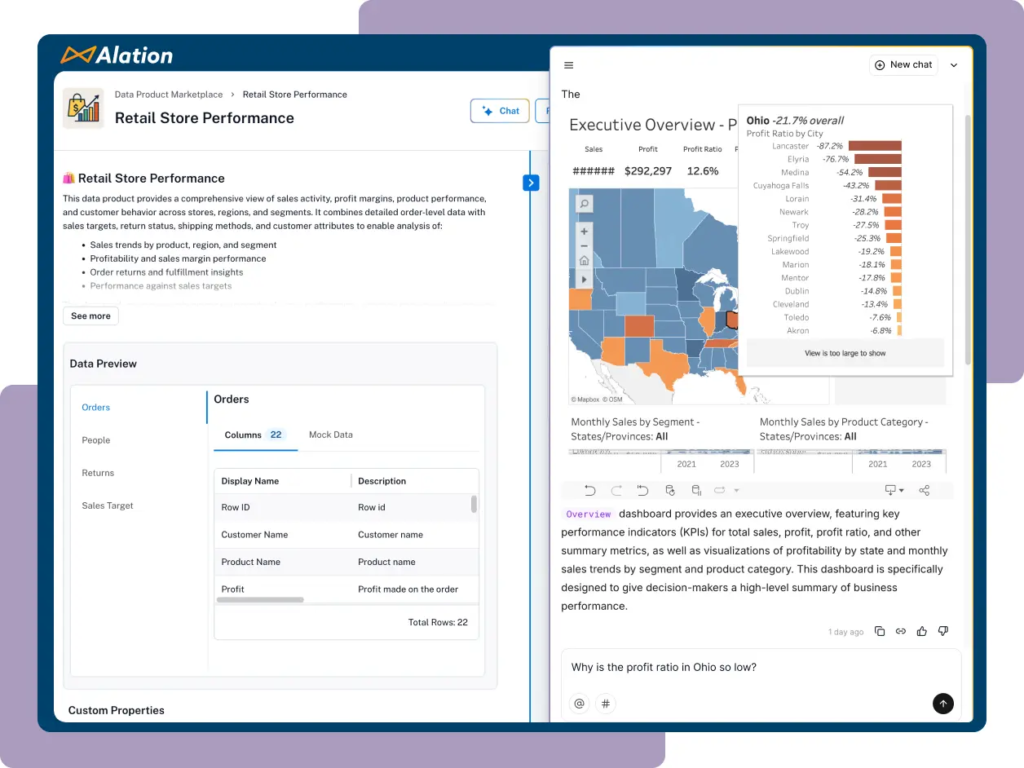
Strengths: Leads search and discovery in the market.
Analysts find data in minutes instead of days through collaborative features like shared queries, conversations, and crowd-sourced documentation. High adoption among data teams who use it daily. Analysts can find and understand data without waiting for catalog administrators to document every table manually.
Limitations: While Alation supports policy tagging and governance workflows, it’s not a full policy enforcement engine like Collibra.
You’ll find data easily and can integrate with access control systems, but Alation’s core strength is discovery rather than deep compliance workflow automation.
最高だ: Organizations focused on data democratization and analyst productivity where policy enforcement happens elsewhere in the infrastructure. Teams where the primary governance pain point is “nobody can find our data.”
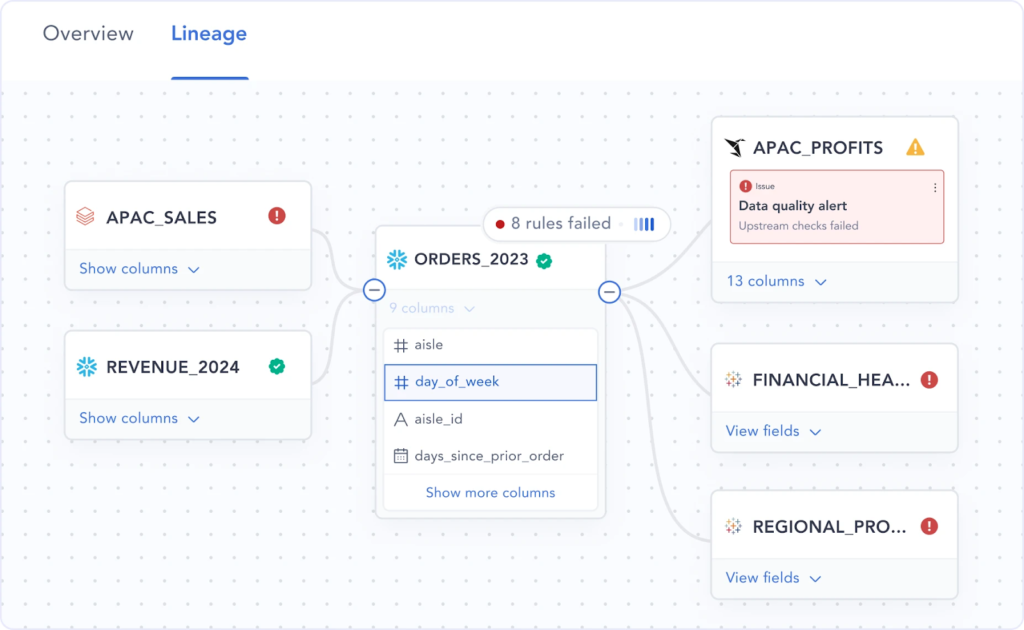
Strengths: Modern UI that data teams prefer over legacy governance interfaces.
Strong automation for metadata collection from cloud-native platforms like Snowflake, Databricks, and dbt. Appeals to teams building modern data platforms who need governance that matches cloud velocity. Faster time to value than traditional governance tools. Governance capabilities have expanded significantly in recent releases.
Limitations: Integration ecosystem still growing beyond the core cloud data platforms.
Still lighter than Collibra or Informatica in deep stewardship and compliance workflow automation, though the gap is narrowing. Works best for teams prioritizing speed and usability over extensive compliance process management. If you’re still running quarterly release cycles for governance policies, Atlan will frustrate your process.
最高だ: Cloud-native data teams running Snowflake or Databricks who need governance without the overhead of traditional platforms. Organizations where governance needs to keep pace with weekly deployment cycles.
Strengths: Comprehensive MDM and data quality capabilities that span mainframe to cloud.
The integration platform handles scenarios where you’re moving GDPR-regulated data across AWS, Azure, and on-premises Oracle simultaneously. If you need to govern SAP BW alongside Snowflake with transformation pipelines in between, Informatica has connectors that actually work. Handles complex master data management scenarios that other tools can’t touch.
Limitations: Complexity matches capability.
Implementation timelines stretch 12 to 18 months for full deployment. Expensive and resource-intensive across licensing, infrastructure, and staffing. Overkill for organizations that don’t need enterprise-scale MDM or complex transformation pipelines spanning hybrid environments.
最高だ: Large multinational enterprises with diverse technology estates acquired through M&A. Organizations with complex integration requirements spanning on-premises legacy systems and cloud platforms where futureproof architecture means supporting everything simultaneously.
Governance systems depend on metadata they don’t create.
Collibra can’t enforce policies on tables it doesn’t know about. Purview performs pattern-based classification and content scanning but benefits significantly from richer structural metadata. Discovery tools surface whatever metadata exists, accurate or not. Modern catalogs can infer foreign key relationships and semantic connections through query parsing, but they typically don’t capture the intentional design rationale that architects encoded deliberately.
At enterprise scale, data modeling is infrastructure. You can’t govern schemas you haven’t documented. ER/Studio generates structural documentation that governance catalogs consume. Models can be exported and synchronized to Purview and Collibra, though metadata lag between modeling updates and catalog sync remains something to manage.
PowerDesigner migrations benefit from this integration. Legacy models contain years of business rules, naming standards, and design decisions that represent institutional knowledge. ER/Studio imports those models and integrates clean metadata into modern governance solutions. The import can preserve logical and physical models, including domains, naming standards, and validation rules that took years to standardize across teams.
The difference shows up in policy enforcement accuracy and compliance audit results when governance tools receive more complete structural metadata.
Your actual governance requirements should drive component selection, not your aspirational ones. Organizations dealing with heavy regulatory compliance need Collibra or Informatica’s approval workflows and audit trails. Teams focused on analyst productivity get more from Alation or Atlan’s discovery capabilities. Don’t let vendors convince you that one platform handles both equally well.
Integration matters more than feature lists. Check the actual integration points and ask about metadata drift, not connector counts.
Organizations can approach governance from two valid entry points.
If your structural metadata is outdated or incomplete and you’re pursuing a modeling-first approach, addressing that foundation before implementing catalog tools can improve policy enforcement accuracy. ER/Studio helps ensure governance systems receive richer structural information.
Choose tools based on where your data lives today and will live in three years, not where you wish it lived. Purview makes sense for Azure shops actually committed to Microsoft’s ecosystem. Atlan fits cloud-native teams running Snowflake or Databricks as their strategic platform. Collibra works across hybrid environments but costs more to implement everywhere.
Plan for component selection, not the hero product. No single tool handles discovery, policy enforcement, and metadata governance equally well. Accept that you’re assembling tools with distinct purposes, then choose the best option for each function instead of compromising across all of them.
Map your current weaknesses against these capabilities. Identify where metadata quality is blocking governance effectiveness. Evaluate whether your modeling infrastructure supports or undermines the governance platforms you’re considering.
Your governance platform is only as accurate as the metadata feeding it.
If your structural models are outdated, incomplete, or stuck in legacy tools, every policy you enforce and every audit you run inherits that gap. The organizations getting governance right aren’t buying better catalogs. They’re fixing the foundation first.
Try ER/Studio and see what your governance tools have been missing.