Most teams that step away from data modeling tools do not do it intentionally.
They do it gradually.
At some point, modeling becomes something that happens at the beginning of a project. After that, attention shifts toward pipelines, transformations, and delivery. New data sources are added, schemas evolve, and logic is implemented in SQL, orchestration tools, and applications. The system continues to function, and for a while, everything appears to be working.
Then the friction starts.
It shows up as inconsistencies between environments, confusion around definitions, and increasing effort required to understand how data actually flows. Teams begin to rely on tribal knowledge and ad hoc documentation. At that point, the issue is no longer about modeling. It is about metadata that is no longer centralized, governed, or visible.
This is where most organizations misdiagnose the problem.
They assume the modeling tool is no longer relevant. In reality, the problem is that the tool is no longer being used to manage what it was designed to manage: the structure, meaning, and traceability of data across the environment.
Modern data environments are not just larger than they used to be. They are fundamentally more fragmented.
A single business entity may exist across multiple databases, cloud platforms, and applications. It may be represented in relational tables, JSON payloads, and derived datasets. Each representation is valid in its own context, but they are not automatically aligned.
At the same time, transformation logic has become distributed. Instead of a centralized integration layer, logic is embedded in dbt models, ETL pipelines, BI tools, and machine learning workflows. Each layer introduces its own interpretation of the data.
The result is a system where structure exists, but meaning is scattered.
This is not something that can be solved by moving data faster or adding more pipelines. It requires a way to bring structure, meaning, and metadata back into alignment.
ER/Studio is often described as a data modeling tool, but that description understates what it actually does in a modern environment.
At its core, ER/Studio functions as a data architecture and metadata management platform that connects technical structures with business meaning across systems .
That distinction matters.
In a simple environment, modeling might be about designing schemas. In a distributed environment, modeling becomes about managing relationships between systems, definitions, and transformations.
This is where ER/Studio’s capabilities become critical.
One of the most underutilized features in ER/Studio is reverse engineering. Many teams use it once, at the beginning of a project, to generate a model from an existing database. After that, it is often ignored.
In practice, reverse engineering should be a continuous process.
ER/Studio can connect to live databases and generate fully editable, metadata-rich models that reflect the current state of the environment . When used regularly, this allows teams to keep their models aligned with reality instead of relying on outdated documentation.
This becomes especially important in environments with multiple stages such as development, QA, and production. Differences between these environments are inevitable, but without a structured way to detect and reconcile them, those differences accumulate.
ER/Studio’s advanced compare and merge capabilities allow teams to identify differences between models, resolve conflicts, and synchronize changes across environments . This is not just about keeping schemas in sync. It is about ensuring that changes are understood and intentional.
In many organizations, metadata exists in multiple places. Technical metadata is stored in databases and pipelines. Business definitions live in spreadsheets or BI tools. Lineage is partially documented, if at all.
This fragmentation makes it difficult to answer basic questions.
What does this field mean?
Where is it used?
What happens if it changes?
ER/Studio addresses this through its enterprise data catalog, which creates a centralized, searchable view of data assets across models and systems . Metadata from models can be linked directly to business terms, glossary definitions, and lineage information.
This is where modeling moves beyond structure and into usability.
Instead of forcing analysts and engineers to piece together context from multiple sources, the catalog provides a single place to understand both the technical and business aspects of data.
As data flows across systems, understanding those flows becomes increasingly difficult. Lineage is often partial or inferred, and impact analysis is reactive rather than proactive.
ER/Studio’s universal mapping and traceability capabilities address this directly by connecting models and enabling end-to-end visibility of data flows .
This allows teams to answer questions that are otherwise difficult to resolve:
If a column changes, which reports are affected?
If a table is modified, which downstream systems depend on it?
If a definition is updated, where does that definition need to be reflected?
Without this level of visibility, changes are made with incomplete information. With it, changes can be planned and validated before they are implemented.
One of the persistent challenges in enterprise environments is enforcing consistency without slowing down development.
Naming conventions, data types, and structural patterns often vary between teams. Over time, these differences create confusion and increase the effort required to integrate data.
ER/Studio addresses this through sophisticated naming standards and reusable templates that can be applied automatically across models . This allows organizations to enforce consistency without requiring manual oversight for every change.
Macros and automation further reduce the effort required to maintain standards. Repetitive tasks can be automated, allowing architects to focus on higher-value work while ensuring that models remain consistent.
“Analysts spend 30% to 40% of their time searching for and validating data.”
– Gartner
Data modeling is often perceived as a specialized activity performed by a small group of architects. In reality, it requires input from multiple stakeholders, including engineers, analysts, and business users.
ER/Studio’s multi-user repository and web-based collaboration portal are designed to support this level of interaction . Multiple users can work on models simultaneously with version control and role-based access, while business users can explore models, provide feedback, and participate in discussions.
This shifts modeling from an isolated activity to a collaborative process.
When business and technical teams work from the same models, alignment improves. Decisions are made with a shared understanding of the data, reducing the need for rework.
One of the reasons modeling tools lose traction is that they are not integrated into modern development workflows.
ER/Studio addresses this by supporting version control, change tracking, and integration with tools like Jira and GitHub. Model changes can be linked to tasks, reviewed, and managed alongside application code.
Forward engineering capabilities allow teams to generate DDL scripts directly from models, ensuring that database changes reflect the intended design. This creates a tighter feedback loop between design and implementation.
Instead of modeling being something that happens before development, it becomes part of development.
Modern applications increasingly rely on semi-structured data formats such as JSON. These formats provide flexibility, but they also introduce challenges when integrating with relational systems.
ER/Studio’s JSON data modeling capabilities allow teams to import, visualize, and map JSON structures to relational models . This creates a bridge between modern application data and traditional data architectures.
By incorporating these structures into a unified model, organizations can maintain consistency even as data formats evolve.
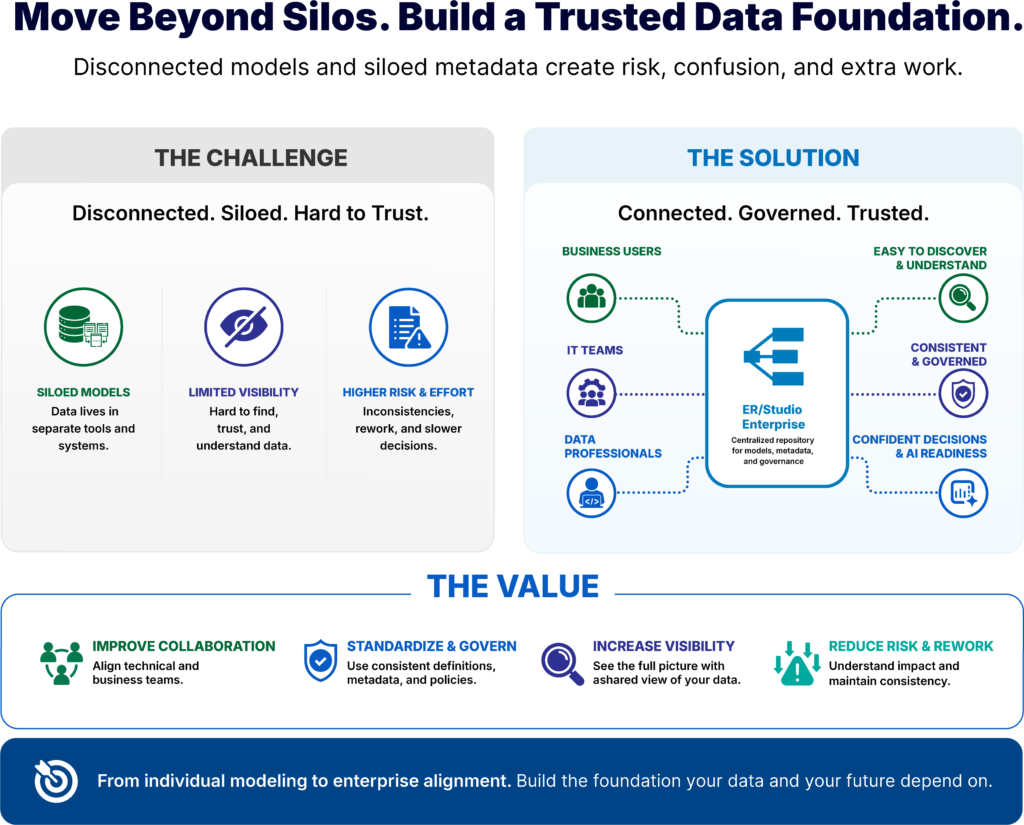
The value of ER/Studio is not in any single feature. It is in how those features work together to address a specific problem.
That problem is not creating models. It is maintaining a consistent, governed understanding of data in an environment where structure, meaning, and logic are constantly changing.
When ER/Studio is used as intended, it becomes the place where that understanding is defined, maintained, and shared.
Without it, the same understanding has to be reconstructed repeatedly from pipelines, code, and documentation.
When organizations consider discontinuing a tool like ER/Studio, the decision is rarely framed as “we no longer need data modeling.” It is usually framed as consolidation, cost optimization, or a shift toward newer tools and architectures. On paper, it can look like a reasonable move.
In practice, the consequences show up in ways that are harder to predict and even harder to reverse.
The first impact is not technical. It is structural. The model stops being maintained as a central reference point, and over time, there is no longer a single place where data definitions, relationships, and standards are clearly defined. What replaces it is not another system of record. It is a combination of pipeline logic, documentation, and individual interpretation.
At that point, consistency becomes dependent on coordination rather than design.
The second impact is duplication. Without a shared model, the same business logic begins to reappear in multiple places. Transformation rules are rebuilt in dbt, redefined in BI tools, and reinterpreted in downstream systems. Each version is slightly different, and over time, those differences become significant. The organization does not lose the ability to work with data, but it loses the ability to do so efficiently.
The third impact is loss of traceability. When models are no longer actively managed, it becomes much more difficult to understand how data flows across systems. Lineage becomes incomplete, and impact analysis becomes reactive. Changes are made based on partial knowledge, and issues are discovered after they affect downstream processes.
This is where risk begins to increase.
Without clear traceability, even small changes can have unintended consequences. A schema update in one system may break a report, affect a machine learning feature, or introduce inconsistencies that are not immediately visible. The cost of identifying and resolving these issues grows as the environment becomes more complex.
The fourth impact is on governance. Policies, classifications, and standards need a stable foundation to attach to. When there is no central model, governance becomes fragmented. Different teams apply rules in different ways, and compliance efforts require more manual effort to validate.
Finally, there is a longer-term impact that is often underestimated. Rebuilding a coherent model after it has been abandoned is significantly more difficult than maintaining one over time. Once definitions diverge and logic is distributed across systems, bringing everything back into alignment requires substantial effort.
None of this happens immediately. That is what makes the decision to step away from a modeling platform seem low-risk. The environment continues to function, and short-term priorities are met. The cost is paid gradually, in the form of increased complexity, reduced clarity, and growing dependence on workarounds.
For organizations operating at scale, those costs compound quickly.
This is not an argument against adopting new tools or evolving architectures. It is a reminder that the role ER/Studio plays is not easily replaced. It is not just about creating models. It is about maintaining a consistent, governed understanding of data as systems change.
Before deciding to move away, it is worth considering whether that capability will still exist, and if so, where it will live.
Most organizations that already use ER/Studio do not need to replace it. They need to reconnect it to how their data environment actually operates.
The complexity they are dealing with is not new. It is the natural result of scale, distribution, and continuous change. What ER/Studio provides is a way to manage that complexity without losing control of structure and meaning.
The question is not whether those capabilities are valuable.
It is whether they are being fully used.
If it has been a while since ER/Studio has been part of how your team thinks about data architecture, it may be worth revisiting how it fits into your current workflows and where it can provide the most impact.
Speak with an ER/Studio expert to see how you can better align your data models, metadata, and architecture to support your current and future initiatives.
ER/Studio is more than a diagramming tool. It serves as a data architecture and metadata management platform that connects conceptual, logical, and physical models with business definitions, lineage, and governance. It enables teams to manage structure, meaning, and relationships across complex data environments rather than just documenting schemas
Value is often lost when modeling is treated as a one-time activity instead of an ongoing process. As schemas evolve and transformation logic grows, the model can fall out of sync with reality. When that happens, definitions become fragmented across pipelines, BI tools, and applications, reducing consistency and increasing rework.
ER/Studio provides advanced compare and merge capabilities that allow teams to identify differences between models and databases, resolve conflicts, and synchronize changes across development, QA, and production environments. This ensures that schema changes are intentional, consistent, and aligned with the overall data architecture.
ER/Studio supports governance by linking technical metadata to business glossaries, classifications, and lineage. This creates a centralized view of data definitions and relationships, making it easier to enforce standards, track sensitive data, and demonstrate compliance across systems.
With its multi-user repository and web-based collaboration portal, ER/Studio allows architects, engineers, analysts, and business users to work from the same models. Teams can explore data structures, review changes, and align on definitions in real time, reducing miscommunication and improving decision-making.