ER/Studio Data Architect is trusted by organizations around the world to define, document, and manage enterprise data models. But while the Standard Edition provides a solid foundation for individual data modelers, teams working at scale need more—more collaboration, more governance, and more structure to drive real business outcomes.
That’s exactly what the Professional and Enterprise editions deliver.
These editions do far more than extend feature sets. They enable teams to centralize metadata, collaborate in real time, embed governance, and support modern architecture practices like Data as a Product. Whether you’re unifying global models, launching analytics platforms, or preparing for regulatory audits, these editions offer the infrastructure to support enterprise data delivery.
The Standard Edition includes core features like logical and physical modeling, forward and reverse engineering, and domain-level asset organization. It’s ideal for solo data modelers and foundational projects.
But when collaboration expands and governance becomes essential, additional capabilities are needed. With Standard:
For businesses that need scalable, governed, and discoverable data, Professional and Enterprise editions unlock what Standard can’t deliver.
The Professional Edition is designed for organizations that are evolving from isolated modeling efforts to a more connected and collaborative architecture practice. As teams grow—and as data initiatives span departments, domains, or platforms—modeling can no longer live on individual desktops or siloed files. The Professional Edition introduces the foundational infrastructure required to manage complexity, maintain consistency, and scale with confidence.
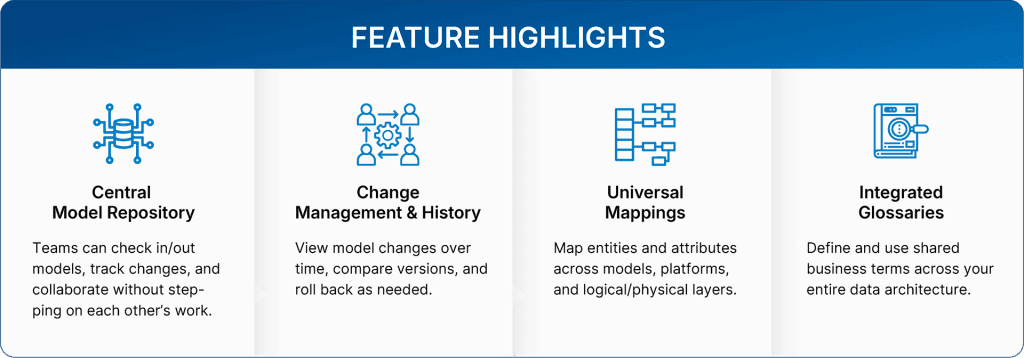
At its core is the ER/Studio Repository, a centralized version control system purpose-built for collaborative data modeling. Teams can check in and out models and submodels, view historical changes, compare versions, and manage merge conflicts. Every change is tracked. Every model version is preserved.
With the repository in place, teams can adopt shared modeling standards, using glossaries, universal mappings, and reusable templates. Terms like “Customer” or “Order” can be defined once and reused across systems—reducing rework and ensuring consistent understanding across platforms and teams.
Universal mappings further boost reusability by connecting logical and physical models, enabling traceability from high-level concepts to technical implementation—ideal for organizations managing hybrid or multi-platform data environments.
“The shared repository has been a game-changer for us, improving productivity by at least 30% across teams and ensuring that everyone is aligned on data definitions.”
– Protective Life
For larger organizations, highly regulated industries, or teams with complex data environments, collaboration isn’t enough. You need enterprise-grade governance, metadata control, and compliance support. The Enterprise Edition delivers all of that—and more.
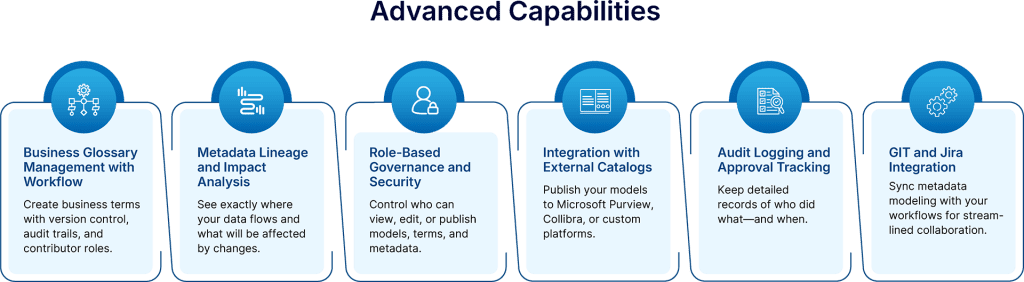
Enterprise Edition builds on everything in Professional and adds critical governance capabilities like workflow-driven glossary management, end-to-end lineage, granular access control, and enterprise-wide visibility. It’s designed to help teams operate with discipline and accountability, no matter how large or distributed the architecture becomes.
The Enterprise Edition is a bundle that includes both the Enterprise Team Edition and Team Server Core—a web-based publishing portal that makes models and metadata available to business analysts, architects, stewards, and executives. No desktop installation required—just open a browser, search, and explore. This transparency improves communication and turns your architecture into a discoverable asset.
The Enterprise Team Edition adds access to features built for scaled collaboration and integration, including connectivity with GIT and Jira, plus support for governance tools like Microsoft Purview and Collibra. These integrations allow your metadata and modeling workflows to connect with broader enterprise processes, enabling true governance at scale.
The advanced glossary management system allows you to manage definitions at scale, assign owners, enforce approval processes, and track versions. Metadata lineage tools provide traceability through every transformation, across every platform—critical for audits, migrations, and regulatory reporting.
Enterprise Edition also enables governed models to populate enterprise metadata platforms automatically via REST APIs and catalog connectors, ensuring consistency across your entire data estate.
Audit trails, role-based security, and automated change impact analysis help teams reduce risk, enforce standards, and support high-stakes use cases like financial reporting, healthcare data management, and compliance with frameworks like GDPR, HIPAA, and SOX.
“ER/Studio provides the ideal combination of a feature-rich, browser-based Portal that allows us to collaborate efficiently and keep up with our vast, complex databases and our customers’ needs.”
– Catalina Marketing
The Data as a Product (DaaP) approach represents a fundamental shift in how organizations design, manage, and deliver data. Instead of treating data as a byproduct of systems or pipelines, DaaP treats data as a governed, reusable asset with defined ownership and purpose—just like a traditional product.
Traditional data architecture focuses on pipelines and central control. Data is extracted, transformed, loaded—and then requested, often repeatedly, in different contexts. This model is reactive, opaque, and difficult to scale.
The DaaP approach applies product thinking to data:
Both upgraded editions of ER/Studio provide the infrastructure needed to make DaaP real—not just aspirational.

ER/Studio Professional and Enterprise editions don’t just add features. They unlock the ability to scale architecture, embed governance, and deliver data as a reusable, trusted product.
Professional gives your teams the tools to collaborate, reuse, and align. Enterprise empowers you to govern, secure, and integrate data architecture at scale. Both editions make it possible to adopt the Data as a Product approach—without disrupting your existing environment. If your data models are critical to decisions, strategy, or compliance, it’s time to upgrade.
Schedule a personal consultation to learn how Professional and Enterprise can take your organization to the next level.
Standard is best for individual modelers or small teams. It supports logical and physical modeling but lacks collaboration, reuse, and governance capabilities.
Professional adds team collaboration, model repository, glossary integration, and Team Server Core for centralized access and reuse.
Enterprise includes all Professional features and adds workflow-based governance, impact analysis, lineage tracking, audit logging, and integration with enterprise metadata tools like Microsoft Purview and Collibra.
You can view the full edition comparison here.
If your team has outgrown individual modeling workflows, the Professional Edition is the next logical step. It enables multi-user collaboration through a centralized repository, with built-in version control and change tracking. You can standardize glossary terms across projects, reuse model components, and ensure consistency across your models. Professional is ideal for teams that need to coordinate efforts, maintain shared modeling standards, and work efficiently without stepping on each other’s toes.
The Enterprise Edition includes everything in Professional, plus a bundled set of components: Enterprise Team Edition and Team Server Core. Together, they deliver comprehensive governance, integration, and enterprise-wide visibility. Enterprise Team Edition adds support for GIT, Jira, and integration with governance platforms like Microsoft Purview and Collibra. It also introduces workflow-based glossary term management, end-to-end lineage, and role-based access controls. With Team Server Core, you can publish models and metadata to a web-based portal, making them accessible to architects, analysts, and business stakeholders—no desktop install required. It’s the ideal solution for organizations that need full auditability, regulatory compliance, and consistent metadata across their entire data ecosystem.
No. Your existing models in Standard can be opened, reused, and extended in both Professional and Enterprise editions. You can also reverse engineer existing databases and layer governance and reuse on top—without starting from scratch.
The Data as a Product (DaaP) approach treats data as a curated, reusable, and well-governed business asset. Each data product is designed with a clear owner, a defined use case, embedded quality controls, and complete documentation—including metadata, lineage, and version control. Unlike traditional pipeline-centric data delivery, which is reactive and often fragmented, DaaP offers a structured, self-service approach where data products can be discovered, trusted, and reused across teams.
Upgrading from Standard is seamless and doesn’t require any rework or migration. You can continue using your existing models as-is while enabling advanced features such as the model repository, shared glossaries, and Team Server Core. This allows your team to adopt collaborative modeling and governance capabilities at your own pace, while still maintaining continuity. As your needs mature, you can scale governance practices incrementally without disrupting current workflows. To upgrade, contact our support team.