Artificial intelligence needs more than access to enterprise data. It needs to understand what that data means.
An AI system might be able to retrieve a table called CUST_ACCT, a field called REV_AMT, or millions of rows of transaction data. But those structures alone don’t explain what a Customer means to the business, how Revenue is defined, how a Customer relates to an Account, or which definitions the organization considers authoritative.
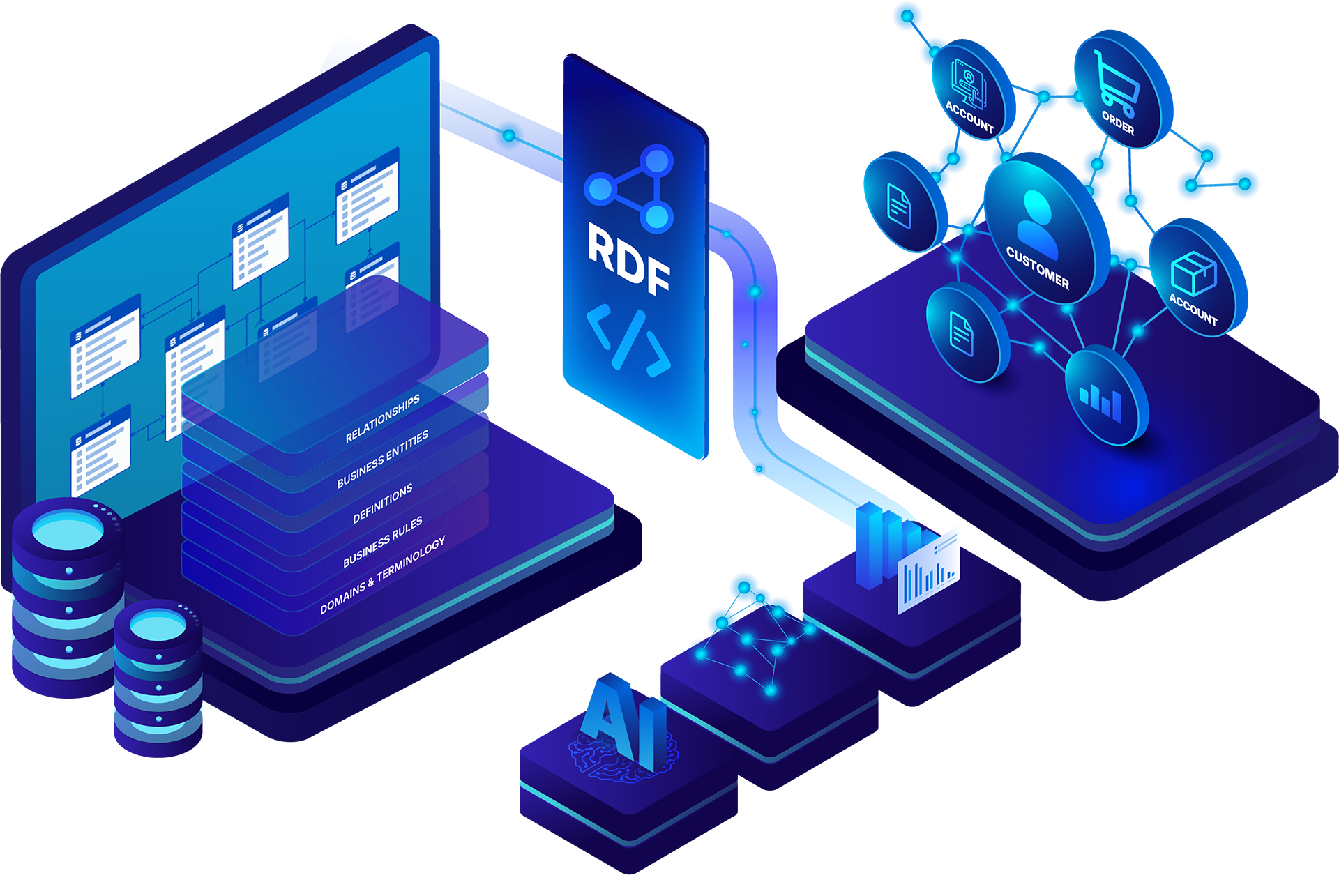
Much of that context may already exist in an organization’s data models. Enterprise Logical Data Models capture business entities, relationships, definitions, rules, domains, and terminology independently of the technologies that eventually consume them. They describe not only how data is structured, but also how the business understands it.
The challenge is making that meaning available in a form that AI systems, knowledge graphs, semantic technologies, and other applications can consume. That’s where RDF comes in, and where the new ER/Studio Semantic Generator can transform existing data models into reusable, machine-readable semantic assets.
RDF stands for Resource Description Framework. It is a W3C standard for representing information and relationships in a structured, machine-readable way.
In simple terms, RDF provides a way to translate the business meaning captured in a data model into a format that AI and other machines can understand and consume. Instead of an AI system seeing only database structures, RDF can communicate concepts such as Customer, Order, and Product, along with their definitions and how they relate to one another. You can think of an RDF file as a machine-readable version of the data model’s business meaning, giving AI and LLM-based applications valuable context about what the data represents.
Despite the word “framework,” RDF isn’t an application or database. It provides a standardized way to describe things and how they relate to one another. At its core, RDF represents information through statements containing three parts: a subject, a predicate, and an object. These statements are commonly called RDF triples.
Consider a simple business example:
Customer → places → Order
The subject is Customer, the predicate is places, and the object is Order. Another statement might establish that an Order → contains → Product, while another could define that a Customer → has → Customer ID.
On their own, these statements are simple. Combined, they can form a rich network of interconnected business concepts that machines can traverse and interpret.
This is particularly useful for AI because enterprise data rarely exists as isolated facts. Meaning comes from context and relationships. A Customer isn’t simply a table or record. Customers place Orders, have Accounts, sign Contracts, make Payments, and interact with Products. RDF provides a standards-based way to represent those connections so the meaning captured in a data model can be consumed by other technologies.
This is where RDF and data modeling become particularly powerful together.
A well-developed Enterprise Logical Data Model already contains much of the semantic context organizations want their AI and analytics systems to understand. It captures business concepts, their relationships, business rules, definitions, terminology, hierarchies, and other metadata.
Without a way to reuse that information, however, organizations can find themselves recreating the same business meaning in every downstream technology. A knowledge graph team interprets the business one way. An analytics team creates another semantic representation. An AI project creates another. Each may begin with the same underlying data, but differences can emerge as every team independently interprets what the data means.
ER/Studio provides another approach. The ER/Studio Semantic Generator transforms Enterprise Logical Data Models into standards-based semantic assets that can be consumed by semantic technologies, knowledge graphs, governance platforms, analytics environments, and AI systems.
Instead of manually rebuilding semantic meaning for every downstream system, organizations can reuse the business concepts, definitions, and relationships they have already established in their models. The data model becomes more than documentation or a database design artifact. It becomes a source of machine-readable business meaning.
An important part of understanding RDF is understanding the role of an IRI, or Internationalized Resource Identifier.
In an RDF context, an IRI provides a unique identifier for a resource. This becomes important because names alone are often not enough to tell a machine exactly what something means.
Imagine two systems that both contain something called Customer. One organization or system may define Customer as anyone who has purchased a product, while another might use the term only for people or organizations with an active account. To a human familiar with the business, the context might make the distinction obvious. To a machine exchanging information across different systems, the word “Customer” alone can be ambiguous.
An IRI gives the concept an unambiguous identity. For example, an organization might identify its Customer concept with an IRI resembling:
https://example.com/business/Customer
An Order could have its own identifier:
https://example.com/business/Order
The goal isn’t for employees to memorize these identifiers. Their value is that machines now have a persistent and precise way to reference each concept. When RDF describes a relationship between Customer and Order, the underlying semantic information can reference the exact concepts intended by the organization rather than relying solely on human-readable labels.
IRIs therefore play an important role in making semantic information portable and reusable. They help different technologies identify which specific business concept is being described as information moves between systems.
Large language models are remarkably capable of interpreting natural language, but enterprise AI introduces a more difficult challenge: the system needs to understand your organization and your data.
What does “active customer” mean? How is Net Revenue different from Gross Revenue? Can one Supplier have multiple Contracts? What relationship exists between an Invoice and a Purchase Order? Which definition of Product should an AI assistant use when several systems use that term differently?
Simply giving AI access to more database tables doesn’t answer those questions.
Business entities, definitions, relationships, hierarchies, and rules provide the context that raw database structures often cannot. RDF makes it possible to represent that context as connected, machine-readable information that can support semantic technologies, knowledge graphs, and AI architectures.
This also addresses a growing problem as organizations deploy more AI and analytics applications. If every application independently interprets business meaning, definitions can gradually diverge. Finance may define Revenue one way, Sales another, and an AI assistant may inherit whichever definition happens to exist in the system it accesses.
The better approach is to establish business meaning in an authoritative model and make that meaning reusable. Instead of asking every downstream technology to determine what Customer, Product, Revenue, or Purchase Order means, those concepts and their relationships can be defined once and made available in standardized semantic formats.
| Component | What It Does | Why It Matters for AI |
| Enterprise Logical Data Model | Defines business concepts, relationships, rules, and terminology | Establishes the trusted business meaning AI should work from |
| ER/Studio Semantic Generator | Transforms modeled business meaning into standards-based semantic assets | Makes existing modeling knowledge reusable by downstream technologies |
| RDF | Represents concepts and relationships in a machine-readable format | Gives AI and semantic technologies structured context about what data means and how it connects |
| IRI | Provides a unique identifier for each concept or resource | Helps machines distinguish exactly which Customer, Product, Order, or other concept is being referenced |
| Knowledge Graph / Semantic Technology | Organizes and connects semantic information for consumption and querying | Makes relationships and business context available for downstream applications |
| AI / LLM Applications | Consume enterprise information and context to support AI experiences | Can operate with richer, more consistent business context rather than relying only on raw data structures |
Consider an organization that has already defined Purchase Order in its Enterprise Logical Data Model. The model doesn’t merely contain the term. It can establish how a Purchase Order relates to Suppliers, Products, Contracts, Receipts, Invoices, Payments, and approval workflows while also capturing approved definitions and business rules.
Those relationships represent valuable business knowledge.
Now imagine a new AI initiative. Without reusable semantic assets, the team may need to reconstruct much of that context. Subject-matter experts are interviewed, definitions are copied from documentation, relationships are inferred from schemas, and terminology is rebuilt for the new application. When another AI or analytics project begins, much of that work may happen again.
This creates both inefficiency and risk. Every recreation of business meaning creates another opportunity for definitions and relationships to diverge.
The ER/Studio Semantic Generator changes that workflow by allowing organizations to generate reusable semantic assets from the Enterprise Logical Data Model itself. Instead of treating the data model and the AI-ready semantic representation as completely separate efforts, the trusted meaning established during modeling can become the starting point for downstream consumption.
The process becomes much more direct:
Model the business → Establish trusted meaning → Generate semantic assets → Consume that meaning across AI and other platforms
The result is less manual semantic rework and greater consistency across technologies. AI, analytics, governance, and semantic applications can begin with the same modeled concepts rather than independently reconstructing them.
The value of the ER/Studio Semantic Generator goes beyond simply creating another file format. Its larger benefit is making the knowledge already captured in enterprise data models reusable in modern semantic and AI architectures.
For organizations that have invested substantial effort establishing entities, relationships, definitions, rules, domains, hierarchies, and terminology, that modeling work represents institutional knowledge. The Semantic Generator provides a way to extend that investment into technologies that may not have been the original audience for the model.
This can deliver several practical benefits:
This last benefit is especially important. Technologies change rapidly. Organizations replace reporting platforms, modernize databases, introduce new AI assistants, and adopt new semantic technologies. Core business concepts such as Customer, Product, Supplier, Contract, and Invoice are comparatively stable.
Business meaning shouldn’t have to be reinvented every time the technology changes.
RDF, knowledge graphs, and AI are closely related in modern semantic architectures, but they aren’t interchangeable.
RDF provides a standardized way to represent concepts and relationships as machine-readable statements. A knowledge graph organizes connected information so relationships between concepts can be explored and queried. RDF is one standards-based approach that can be used to represent information within semantic and knowledge graph environments.
AI systems can then benefit from this richer semantic context as part of architectures designed to ground AI applications in organizational knowledge.
ER/Studio operates further upstream in this process. The Enterprise Logical Data Model establishes what the organization’s business concepts, definitions, rules, and relationships actually mean. The Semantic Generator then provides a way to transform that modeled meaning into reusable semantic assets.
That distinction matters because simply converting inconsistent or poorly defined information into RDF doesn’t make the underlying meaning trustworthy. The quality of the semantic asset ultimately depends on the quality and consistency of the business meaning behind it.
For organizations with established Enterprise Logical Data Models, that creates an important opportunity: instead of starting their semantic and AI initiatives from raw technical structures, they can start with business knowledge that has already been modeled and defined.
For decades, organizations have used data models to answer fundamental questions about their data. What are our core business entities? How are they related? What do they mean? Which rules govern them? What terminology should everyone use?
AI makes those questions even more important because the answers now need to be understandable not only to architects, developers, and analysts, but also to machines.
RDF provides a standards-based way to express connected meaning. IRIs give the concepts within that representation unique, unambiguous identities. And the ER/Studio Semantic Generator provides a way to transform trusted business meaning already captured in Enterprise Logical Data Models into reusable semantic assets for AI and other downstream technologies.
This extends the value of data modeling well beyond database design. Instead of remaining a static representation of the business, the model can become a reusable source of semantic context that helps governance, analytics, knowledge graphs, and AI operate from a more consistent understanding of enterprise data.
As organizations look for ways to make their data more useful to AI, the answer isn’t always to create more definitions, mappings, and semantic structures. In many cases, the most valuable business context has already been defined.
ER/Studio helps make that meaning reusable by the technologies that need it next. Try it free today.
RDF, or Resource Description Framework, is a standard for representing information and relationships in a machine-readable format. In simple terms, an RDF file can turn the business meaning captured in a data model into information that AI and other technologies can consume, including concepts, definitions, and the relationships between them.
AI and LLM-based applications need context to understand what enterprise data actually represents. RDF provides a structured way to express business concepts and how they relate to one another, helping AI work with more than raw tables, columns, and values. This semantic context can help AI operate from a more consistent understanding of the organization’s data.
The ER/Studio Semantic Generator transforms Enterprise Logical Data Models into standards-based semantic assets. This allows organizations to reuse business concepts, definitions, relationships, and other meaning already established in their models across semantic technologies, knowledge graphs, governance platforms, analytics environments, and AI systems.
An IRI, or Internationalized Resource Identifier, provides a unique identity for a concept or resource represented in RDF. Instead of relying solely on potentially ambiguous names such as “Customer” or “Product,” IRIs help machines identify exactly which business concept is being referenced as semantic information is shared across systems.
Generating semantic assets from an established Enterprise Logical Data Model allows organizations to reuse business meaning they have already defined rather than recreating it for every AI, analytics, or semantic initiative. This can reduce manual work, improve consistency, and help downstream technologies operate from the same trusted concepts and relationships.




