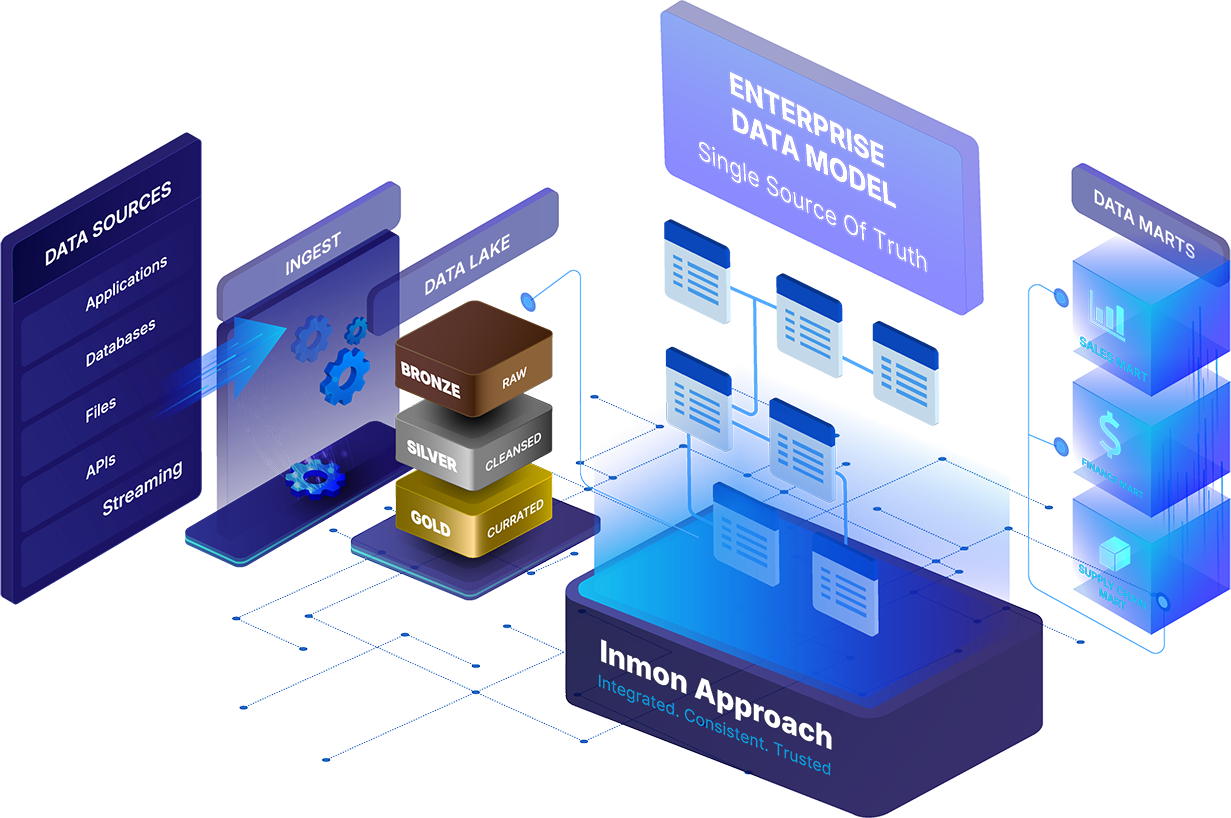
Organizations today are operating in a fundamentally different data landscape than they were even a decade ago. Modern platforms have made it possible to ingest, store, and process massive volumes of data with unprecedented speed. Distributed systems, cloud-native architectures, and scalable transformation frameworks have dramatically reduced the friction of working with data at scale.
At the same time, this progress has introduced a subtle but important shift in how data systems are designed. Many organizations have moved from deliberately modeling their data to rapidly engineering data flows. Pipelines, transformations, and orchestration have become the center of gravity. Structure and meaning, while not entirely ignored, are often deferred or distributed across downstream systems.
This tradeoff becomes particularly visible when organizations begin to operationalize AI. At that point, the limitations of pipeline-first thinking begin to surface. The issue is not that data cannot be accessed or moved efficiently. The issue is that the data does not mean the same thing everywhere, and AI systems are not capable of resolving that ambiguity.
Simply aggregating data and exposing it to AI does not create intelligence. It creates amplification. If inconsistencies exist in the underlying data, AI will scale them, not fix them .
Modern data architectures are heavily influenced by engineering concerns. Tools like Spark, dbt, and streaming frameworks have made it easier to build pipelines that move and transform data across multiple layers. Patterns such as medallion architectures encourage a progression from raw ingestion to refined datasets, typically described as bronze, silver, and gold layers.
In these architectures, data is often loaded first and modeled later, if at all. ELT has largely replaced traditional ETL approaches, enabling organizations to defer transformation logic until data is already stored in scalable environments. This shift reduces upfront design effort and allows for greater flexibility in how data is used.
However, this flexibility comes at a cost. When modeling is deferred, the responsibility for defining meaning is pushed downstream. Instead of being centralized and governed, semantic logic becomes fragmented across SQL transformations, BI tools, feature engineering pipelines, and application code. Each layer introduces its own interpretation of the data, often without a shared reference point.
This is not inherently wrong. In fact, it reflects a necessary evolution toward scalable and flexible systems. The problem is that the architectural balance has shifted too far toward movement and away from meaning.
To understand what has been lost, it is useful to revisit the foundational approaches to data warehousing. The two most influential methodologies, developed by Bill Inmon and Ralph Kimball, offer contrasting perspectives on how data systems should be designed.
Kimball’s approach is often described as bottom-up. It focuses on delivering business value quickly by modeling data around specific business processes. Dimensional models, typically implemented as star schemas, are designed to be intuitive and performant for analytical queries. Each data mart represents a subject area such as sales, finance, or inventory, with fact tables capturing measurable events and dimension tables providing descriptive context.
A key concept in the Kimball methodology is the use of conformed dimensions. These are shared dimensions that allow different data marts to be integrated logically. In theory, this enables consistency across the enterprise while still supporting incremental delivery.
In practice, however, maintaining conformance across independently developed data marts is challenging. As organizations scale, differences in definitions, grain, and transformation logic can emerge. Integration becomes dependent on discipline rather than architecture, and over time, inconsistencies can accumulate.
Inmon’s approach takes a different path. It is typically described as top-down, although that label can be misleading. The core idea is to establish an enterprise data warehouse as a centralized, integrated repository of data modeled in third normal form. This model is designed to reflect the enterprise’s core business entities and relationships in a consistent and non-redundant way.
Normalization plays a critical role in the Inmon model. By decomposing data into discrete entities and eliminating redundancy, the model enforces consistency and reduces the risk of conflicting definitions. Each entity represents a single concept, and relationships between entities are explicitly defined. This creates a stable foundation for integration.
From this enterprise data warehouse, downstream data marts can be created. These marts may use dimensional models for performance and usability, but they are derived from a single, consistent source of truth. This ensures that differences between marts are intentional rather than accidental.
The distinction between the two approaches can be summarized in terms of where integration occurs. In the Kimball approach, integration happens across data marts through conformed dimensions. In the Inmon approach, integration happens centrally within the enterprise data warehouse.
| Category | Inmon Approach | Kimball Approach |
| Architecture Style | Top-down | Bottom-up |
| Core Focus | Enterprise-wide integration | Business process optimization |
| Data Structure | Normalized enterprise data warehouse (3NF) | Dimensional models and star schemas |
| Integration Point | Centralized within the EDW | Distributed across data marts |
| Flexibility | Strong consistency across the enterprise | Faster departmental delivery |
| Modeling Philosophy | Build a unified enterprise model first | Build analytical models incrementally |
| Typical Strength | Governance and semantic consistency | Reporting performance and usability |
| Main Challenge | Longer upfront design effort | Maintaining consistency at scale |
| AI Readiness Impact | Strong centralized business meaning | Can introduce fragmented definitions over time |
| Best Fit | Large enterprises needing governed consistency | Organizations prioritizing rapid analytics delivery |
Many modern data architectures borrow elements from both Kimball and Inmon, but they introduce a fundamental shift in how systems are built.
Instead of starting with a structured model or clearly defined business entities, they often begin with raw data. Data is ingested into scalable storage layers and refined over time through a series of transformations. Patterns such as bronze, silver, and gold layers reflect this progression, where data moves from raw to curated to business-ready.
This approach is highly effective for handling scale and supporting rapid development. It allows teams to onboard new data sources quickly and iterate on transformations as requirements evolve. It also reduces the need for upfront design, which can be perceived as a bottleneck in fast-moving environments.
However, this shift changes where and how integration occurs.
In traditional Inmon-style architectures, integration happens early and centrally. Data from multiple systems is aligned to a consistent set of business definitions within the enterprise data warehouse. Differences in structure, naming, and meaning are resolved as part of that integration process. The result is a stable and unified representation of core business entities.
In many modern architectures, integration is deferred. Each transformation layer introduces its own interpretation of the data, and alignment happens incrementally, often in multiple places. Instead of a single integration point, there are many. Instead of one definition of a business entity, there may be several, each tied to a specific pipeline or use case.
This creates a fundamental difference in behavior.
When integration is centralized, consistency is enforced by design. When integration is distributed, consistency depends on coordination across teams and systems. As environments grow, this coordination becomes increasingly difficult to maintain.
The issue is not that modern architectures are flawed. They solve important problems related to scale, flexibility, and speed. The issue is that they shift the burden of meaning from a controlled, modeled layer to a distributed set of transformations.
Over time, this leads to divergence.
Different pipelines encode different assumptions. Business logic is duplicated and modified across environments. Definitions evolve independently. The system continues to function, but the underlying meaning becomes less consistent.
This is where the principles behind the Inmon approach become relevant again. Starting with a well-defined model does not limit flexibility. It provides a reference point that ensures flexibility does not come at the cost of consistency.
“A data warehouse is a subject-oriented, integrated, time-variant, and nonvolatile collection of data.”
– Bill Inmon
The limitations of pipeline-first architectures are not always obvious in traditional analytics. Reports and dashboards can often accommodate inconsistencies through localized logic. Analysts can interpret results in context and adjust their queries accordingly.
AI systems do not operate this way. They rely on patterns in the data and assume that those patterns reflect reality. When multiple definitions of the same concept exist, AI has no reliable way to determine which one is correct. It treats all inputs as equally valid and produces outputs that may be internally consistent but externally incorrect.
This is where the concept of semantic entropy becomes relevant. As data flows through multiple transformations and systems, its meaning becomes less consistent and more fragmented. Each layer introduces variations, and over time, the system accumulates multiple versions of truth.
AI amplifies this entropy. It does not resolve it.
To address this challenge, organizations need a way to reintroduce consistent meaning into their data architecture. This is where the idea of a semantic backbone becomes important.
A semantic backbone is essentially an evolution of the enterprise data model. It provides a unified representation of business entities, relationships, and definitions that can be applied across structured, semi-structured, and unstructured data.
In this model, data is not simply moved and transformed. It is aligned to a shared ontology that defines what the data represents. This alignment ensures that different data sources contribute to a consistent understanding of key concepts.
For structured data, this alignment can be achieved through traditional modeling techniques. For unstructured data, additional processing is required. Textual data must be parsed, filtered, and mapped to the same semantic framework. This process, sometimes referred to as textual ETL, enables unstructured data to be integrated into the broader model. Learn more about textual ETL directly through Bill Inmon’s company, LLM Management.
The benefits are significant. By attaching unstructured data to a semantic backbone, organizations can reduce noise, improve relevance, and create a unified foundation for analysis and AI.
Data modeling is often seen as a legacy practice, but this perception is misleading. The need for modeling has not disappeared. It has simply been obscured by layers of abstraction.
In many modern systems, modeling still occurs, but it is embedded in code rather than expressed explicitly. SQL transformations, data pipelines, and application logic all contain implicit models. The difference is that these models are fragmented, difficult to manage, and often inconsistent.
Reintroducing explicit data modeling does not mean abandoning modern tools or architectures. It means providing a clear and governed layer of meaning that guides how data is integrated and used.
Tools like ER/Studio play a critical role in this process. They enable organizations to design and maintain enterprise data models, define relationships and constraints, and ensure consistency across systems. By making models visible and manageable, they help bridge the gap between technical implementation and business meaning.
The evolution of modern data architectures has delivered real gains in scalability, flexibility, and speed. However, it has also exposed a growing gap between how data is moved and how it is understood. As organizations push toward AI-driven use cases, that gap becomes harder to ignore.
The Inmon approach provides a clear path forward. By establishing an enterprise data model as the foundation, organizations can ensure that data is integrated, consistent, and aligned to shared business definitions before it is distributed across systems. This does not limit modern architectures. It strengthens them by providing a stable layer of meaning that everything else can rely on.
In practical terms, this means reintroducing enterprise data modeling as a core part of the data lifecycle. Pipelines, transformations, and data products still play an important role, but they should be guided by a centralized model that defines what the data represents. When that model exists, integration becomes controlled instead of fragmented, and downstream systems operate from a consistent understanding of key business entities.
This is where ER/Studio fits directly into the Inmon approach. ER/Studio enables organizations to design and maintain enterprise data models that reflect real business concepts, not just physical data structures. It provides the ability to define entities, relationships, and standards in a way that can be shared across teams and systems. By reverse engineering existing environments and aligning them to a governed model, ER/Studio helps bring consistency to even the most complex, distributed architectures.
Rather than embedding meaning in scattered transformation logic, organizations can establish a clear semantic foundation and use it to guide how data is integrated, transformed, and consumed. This aligns directly with the principles behind the Inmon methodology while supporting the realities of modern platforms and AI.
The goal is not to replace what modern data architectures have achieved. It is to complement them with a layer of structure and meaning that ensures data remains consistent, trustworthy, and usable at scale.
Schedule a demo to see how ER/Studio can help you build an enterprise data model that supports modern architectures and AI with clarity and confidence.
The Inmon approach is a top-down data architecture methodology that begins with an enterprise data model and a centralized enterprise data warehouse (EDW). Data is integrated and structured in a normalized format, typically third normal form (3NF), to ensure consistency and alignment across the organization. From this foundation, data marts are created for specific business use cases.
The Inmon approach focuses on building a centralized, integrated data model first, ensuring consistent definitions across the enterprise before creating downstream data marts. The Kimball approach, by contrast, builds dimensional models such as star schemas for specific business processes and integrates them through conformed dimensions. Inmon emphasizes centralized integration, while Kimball relies on distributed integration across data marts.
Enterprise data modeling provides a consistent definition of business entities and relationships across systems, which is critical for AI. AI systems rely on patterns in data and cannot resolve conflicting definitions on their own. Without a unified model, AI can produce inaccurate or misleading results. A well-defined enterprise model ensures that AI operates on consistent, trusted data.
A semantic backbone is a unified layer of business meaning that connects data across systems, formats, and use cases. It extends the concept of an enterprise data model by aligning structured, semi-structured, and unstructured data to a single, governed set of definitions. This enables consistent analytics, governance, and AI reasoning across the organization.
ER/Studio enables organizations to design, manage, and govern enterprise data models across complex environments. It allows teams to define relationships, standardize business definitions, and align data structures across systems. By providing visibility into data models and dependencies, ER/Studio helps ensure consistency, supports governance, and creates a reliable foundation for analytics and AI initiatives.