Modern organizations operate in a world driven by data. Operational systems process millions of transactions every second, analytics platforms generate real-time business insights, and AI systems increasingly depend on structured enterprise knowledge to deliver reliable outcomes.
Yet many of the concepts powering modern data platforms are not new.
In fact, some of the most foundational ideas behind today’s cloud ecosystems, analytics architectures, and AI-ready data environments were established more than fifty years ago. Long before cloud warehouses, lakehouses, or generative AI existed, researchers and architects were already grappling with a challenge that remains surprisingly familiar today:
How do organizations structure, manage, and understand increasingly large amounts of information?
The history of data modeling is ultimately the story of how enterprise systems evolved to answer that question. It is a story shaped by relational theory, Entity Relationship modeling, data warehousing, distributed computing, cloud platforms, and now AI-driven architectures.
More importantly, it is the story of how organizations learned that technology alone is never enough. As data environments became larger and more complex, businesses consistently discovered that structure, consistency, relationships, and meaning mattered just as much as storage and processing power.
That lesson is becoming especially important again in the age of AI.
“Data modeling is the foundation of all successful database applications.”
– The Data Model Resource Book
Before relational databases transformed enterprise computing, most organizations relied on hierarchical and network database systems. These early approaches stored data in rigid structures tightly connected to application logic.
While functional for their time, these systems created major limitations. Accessing information often required navigating predefined pathways through highly technical data structures. Modifying systems was difficult because application logic and data design were deeply intertwined. As organizations expanded operational systems across finance, manufacturing, logistics, and customer management, these architectures became increasingly difficult to maintain.
The problem was not simply storage capacity. Organizations needed more flexible ways to organize and access data without constantly rebuilding applications underneath it.
By the late 1960s, the need for a more scalable and logical approach to enterprise data management had become impossible to ignore.
In 1970, IBM researcher Edgar F. Codd published what would become one of the most influential papers in the history of enterprise computing:
A Relational Model of Data for Large Shared Data Banks.
Codd’s relational model fundamentally changed how organizations thought about data.
Rather than tying information directly to rigid application structures, the relational model organized data into tables consisting of rows and columns while mathematically defining relationships between datasets. This approach introduced concepts like normalization, keys, tuples, and relational integrity, many of which still define modern database systems today.
Perhaps most importantly, Codd separated logical structure from physical implementation.
That distinction was revolutionary.
Organizations could now model business entities and relationships independently from the underlying storage mechanics. This dramatically improved flexibility, scalability, and long-term maintainability.
The relational model did more than improve databases. It changed the relationship between business systems and enterprise information itself.
While the relational model established the theoretical foundation for modern databases, organizations still needed practical ways to visualize and communicate increasingly complex data structures.
That challenge led to another major breakthrough.
In 1976, Peter Chen introduced the Entity Relationship model through his paper:
The Entity-Relationship Model: Toward a Unified View of Data.
Chen’s work introduced Entity Relationship diagrams, or ER diagrams, which allowed architects to visually represent:
This made data architecture significantly easier to understand across technical and business teams.
For the first time, organizations had a standardized visual language for modeling business structure and enterprise relationships.
Entity Relationship modeling quickly became foundational to enterprise data design because it connected technical implementation directly to business meaning. Rather than thinking only about storage mechanics, architects could model customers, products, transactions, employees, and operational relationships in ways that reflected real business processes.
Even today, ER modeling remains central to enterprise architecture and governance initiatives.
As relational theory matured throughout the 1970s, organizations began operationalizing these ideas through commercial database systems.
IBM’s System R project and the INGRES project at UC Berkeley helped transform relational theory into practical enterprise technology. During this period, SQL emerged as the dominant relational query language.
SQL fundamentally simplified how users interacted with data.
Instead of navigating rigid data paths manually, users could describe what they wanted through declarative queries. This dramatically improved accessibility and accelerated enterprise adoption of relational systems.
Throughout the late 1970s and early 1980s, commercial platforms like Oracle, DB2, Sybase, and later SQL Server helped relational databases become the enterprise standard.
Organizations rapidly expanded database usage across:
Databases were no longer isolated technical tools. They became core operational infrastructure supporting daily enterprise activity.
As relational databases expanded across enterprises, normalization became one of the defining principles of operational data modeling.
Normalization organizes data into related tables to minimize redundancy and maintain consistency. This approach proved especially valuable in Online Transaction Processing environments where organizations needed reliable operational performance and transactional integrity.
Well-designed normalized systems helped organizations:
Operational data modeling became increasingly sophisticated throughout the 1980s as enterprises built larger and more interconnected systems.
At the same time, data modeling itself began evolving into a recognized enterprise discipline rather than simply a database administration task.
As organizations expanded relational systems, the need for formalized modeling methodologies became increasingly clear.
During the 1980s, several influential modeling notations and frameworks emerged, including Barker notation and IDEF1X. These methodologies helped standardize how architects documented systems, relationships, constraints, and business rules.
The growing complexity of enterprise systems also contributed to the rise of Computer-Aided Software Engineering tools, commonly known as CASE tools. These platforms helped organizations manage larger data environments and maintain consistency across increasingly complicated architectures.
This period marked an important shift in how organizations viewed data modeling.
Data models were no longer seen only as implementation artifacts for developers. They increasingly became enterprise documentation assets that helped organizations:
That evolution laid the groundwork for the next major transformation in enterprise architecture.
By the late 1980s and early 1990s, organizations encountered a growing problem.
Operational databases were highly effective for transactional processing, but they were poorly suited for historical analysis and enterprise reporting. Businesses needed environments specifically designed for analytics and decision support.
This challenge led to the rise of the data warehouse.
Bill Inmon played a foundational role in formalizing the enterprise data warehouse concept, particularly through his influential book Building the Data Warehouse.
Inmon defined the data warehouse as:
“A subject-oriented, integrated, time-variant, and non-volatile collection of data in support of management’s decision-making process.”
That definition became foundational to enterprise analytics architecture for decades.
The data warehouse expanded the scope of data modeling significantly. Models now needed to support not just operational transactions, but historical integration, enterprise reporting, and cross-functional analysis.
This was a major shift.
Data modeling was no longer focused only on operational systems. It became central to enterprise decision-making itself.
While Inmon emphasized centralized enterprise integration, Ralph Kimball introduced another influential methodology during the 1990s: dimensional modeling.
Kimball’s approach focused on designing analytical environments optimized for reporting and business intelligence. Star schemas, fact tables, and dimensions became core structures for analytical querying.
Dimensional modeling proved especially effective for:
Kimball’s business-process-oriented approach helped organizations design analytics systems that were easier for users to understand and faster for large-scale reporting workloads.
The discussions between Inmon-style enterprise warehousing and Kimball-style dimensional modeling helped shape enterprise analytics architecture for decades.
The expansion of the internet during the 1990s dramatically accelerated the growth of enterprise data systems.
Organizations suddenly needed to support:
At the same time, platforms like MySQL and PostgreSQL expanded access to relational database technology beyond traditional enterprise environments.
Data volumes grew rapidly. So did architectural complexity.
As businesses became increasingly digital, databases stopped being isolated backend systems and became central components of customer experience, operations, and enterprise scalability.
By the mid-2000s, many organizations were generating data at scales traditional systems struggled to manage efficiently.
Technologies like Hadoop and MapReduce introduced distributed processing approaches capable of handling massive datasets across clusters of commodity hardware.
Around the same time, the NoSQL movement introduced flexible schema approaches optimized for scalability and distributed environments. Platforms like MongoDB, Cassandra, and Redis gained popularity for web-scale applications.
For a period, some organizations believed traditional data modeling would become less important in schema-flexible systems.
The opposite eventually happened.
As distributed architectures expanded, governance and semantic consistency became harder to maintain. Organizations discovered that flexibility without structure often created fragmentation, duplicated logic, and inconsistent business meaning.
The need for modeling never disappeared. The environments simply became more complex.
The rise of cloud infrastructure and cloud-native analytics platforms introduced another major shift in enterprise architecture.
Platforms like Snowflake, BigQuery, Redshift, and Databricks transformed how organizations stored, processed, and analyzed data.
These environments introduced:
At the same time, data lakes and lakehouses expanded support for structured, semi-structured, and unstructured data.
Data modeling evolved alongside these environments.
Architects increasingly needed to support hybrid ecosystems spanning:
The challenge was no longer just database design.
It became enterprise-wide semantic alignment.
The rise of generative AI and AI-assisted analytics is reshaping enterprise architecture yet again.
AI systems depend heavily on:
Without well-modeled enterprise environments, AI systems inherit fragmented definitions and inconsistent logic from the underlying data ecosystem.
In many ways, AI is exposing problems organizations were previously able to work around manually.
Two dashboards might calculate revenue differently. Operational systems may define customers differently than analytical systems. Governance documentation may not align with actual implementation logic.
Humans often compensate for these inconsistencies through institutional knowledge.
AI systems cannot.
This is one reason enterprise data modeling is becoming strategically important again. Organizations are rediscovering that structure, semantics, and governance matter just as much as infrastructure scalability.
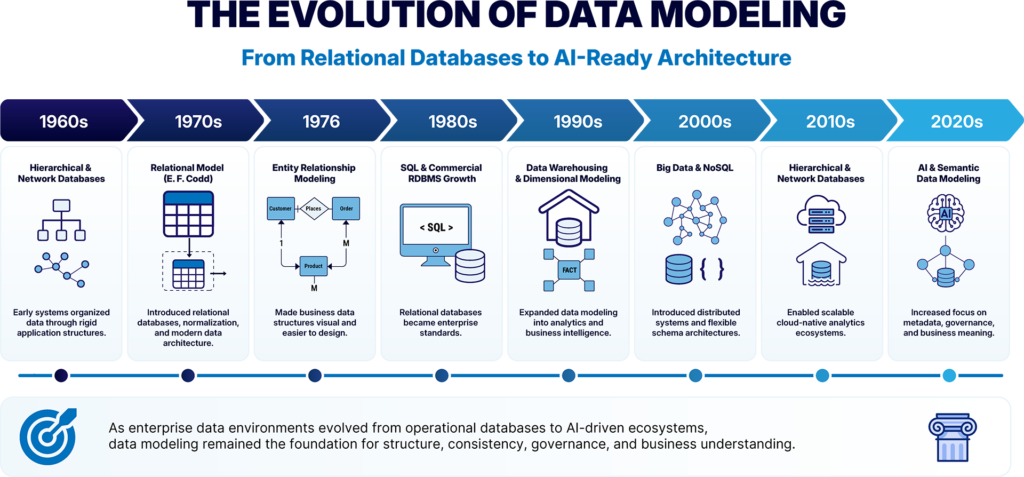
One of the biggest misconceptions about data modeling is the idea that it exists only to design relational tables.
Modern data modeling now supports:
Data models increasingly serve as enterprise knowledge frameworks connecting systems, business meaning, governance, and analytics together.
The discipline has evolved from physical database design into a broader enterprise architecture capability.
As enterprise environments continue growing more distributed and complex, organizations need modeling platforms capable of supporting operational systems, analytics platforms, governance initiatives, and AI-ready architectures simultaneously.
ER/Studio helps organizations manage this complexity through enterprise-grade data modeling and metadata management capabilities designed for modern data ecosystems.
With ER/Studio, organizations can model operational and analytical environments while maintaining consistency across enterprise systems, metadata, governance initiatives, and evolving cloud architectures.
ER/Studio supports:
Rather than treating modeling as isolated documentation, ER/Studio helps organizations operationalize enterprise data architecture as part of broader governance, analytics, and AI strategies.
That alignment becomes increasingly important as organizations modernize cloud environments and expand AI initiatives that depend on governed, trustworthy, and well-structured data ecosystems.
The future of data modeling will likely focus less on static storage structures and more on semantic alignment across increasingly distributed enterprise ecosystems.
As AI systems interact more directly with enterprise data, organizations will need stronger approaches for:
In many ways, the industry is returning to one of the original goals of data modeling: helping organizations create shared understanding around enterprise information.
The platforms will continue changing.
The infrastructure will continue evolving.
But the need for reliable structure, governed meaning, and enterprise alignment remains remarkably consistent.
That is why data modeling has remained foundational for more than fifty years.
And why it may become even more important in the era of AI.
Discover how ER/Studio helps organizations build modern data architectures through enterprise data modeling. Try ER/Studio for free today.
Data modeling is the process of defining how data is structured, related, organized, and managed within a system or across an enterprise. Data models help organizations create consistency between operational systems, analytics platforms, governance initiatives, and business processes.
The relational database model was introduced by Edgar F. Codd in 1970 through his influential paper, A Relational Model of Data for Large Shared Data Banks. His work established the foundation for modern relational databases and SQL-based systems.
Relational modeling is typically used for operational systems and focuses on normalization, transactional integrity, and reducing redundancy. Dimensional modeling is designed for analytics and reporting environments, using structures like fact tables and dimensions to improve query performance and business intelligence workflows.
Even with modern cloud platforms and AI technologies, organizations still need consistent business definitions, metadata, lineage, and semantic structure. Data modeling helps ensure data remains understandable, governed, and reliable across operational systems, analytics platforms, and AI initiatives.
ER/Studio helps organizations design, govern, and manage enterprise data architectures through data modeling, metadata management, lineage visibility, and semantic alignment capabilities. This helps improve consistency across operational systems, analytics environments, cloud platforms, and AI-ready data ecosystems.