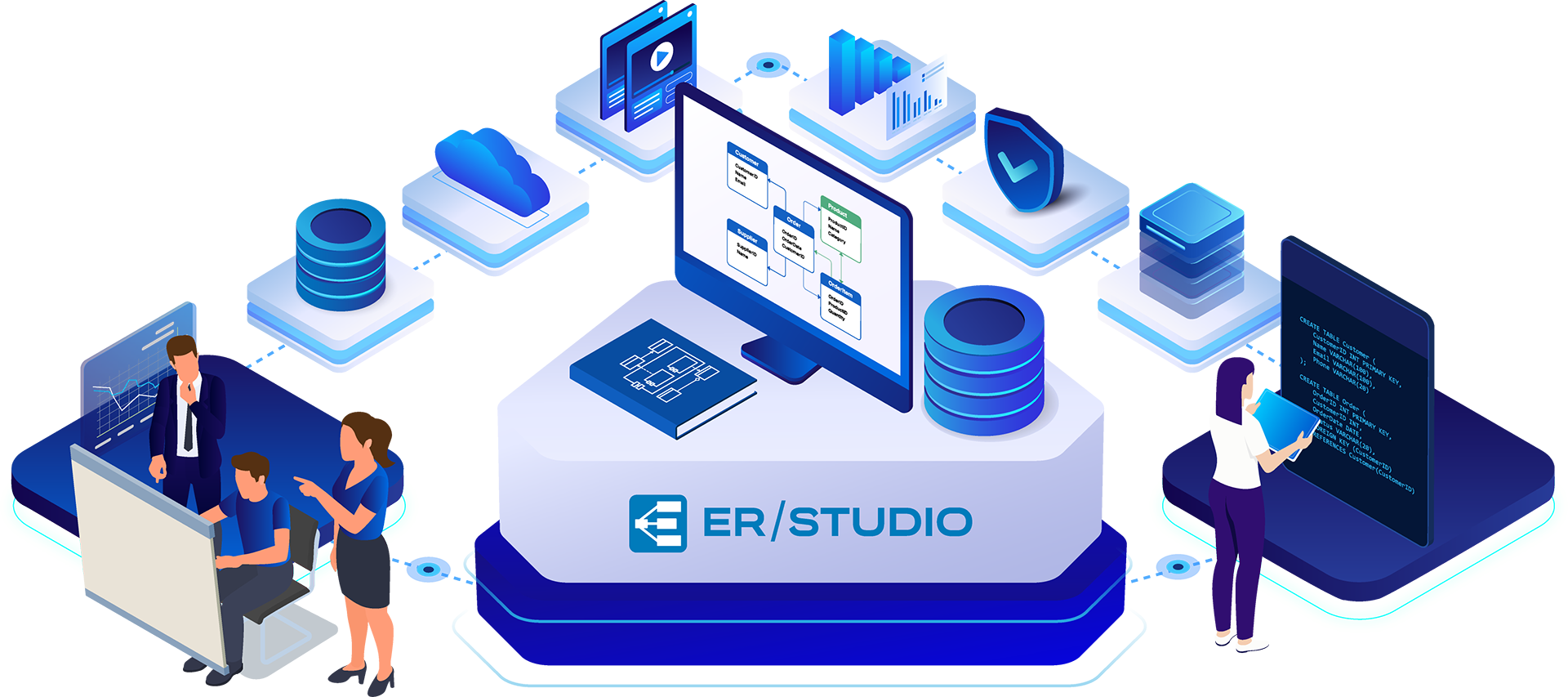
For decades, enterprise data modeling has provided the foundation for designing reliable information systems. Data architects have used conceptual, logical, and physical models to define business entities, establish relationships, reduce redundancy, and guide database implementation across increasingly complex technology environments. These practices remain as important today as they were when enterprise modeling first became a cornerstone of database design.
What has changed is the environment in which those models operate.
A generation ago, a data model often served a relatively straightforward purpose. It described the structure of a database that supported one or more business applications. Once implemented, the model largely remained within the domain of architects and developers responsible for maintaining that system.
Today’s enterprise data ecosystem looks very different.
Business information now flows continuously across operational databases, cloud data warehouses, lakehouses, streaming platforms, analytics environments, governance solutions, data catalogs, semantic layers, APIs, and AI-powered applications. A single business concept may appear in dozens of technologies, each serving a different audience and each interpreting information in its own way. Business analysts need trusted definitions to produce accurate reports. Data engineers require consistent structures for integration pipelines. Governance teams must ensure regulatory compliance. Analytics platforms depend on standardized semantic models, while AI applications increasingly rely on business context to generate meaningful responses.
Although the technologies have evolved dramatically, one requirement has remained constant: every system must represent the same underlying business meaning.
Unfortunately, that consistency is becoming increasingly difficult to maintain. As organizations introduce new platforms and teams adopt specialized tools, business definitions often become fragmented. Metrics are recreated independently within reporting platforms. Business glossaries evolve separately from technical implementations. Governance initiatives struggle to reconcile conflicting terminology after systems have already been deployed. AI assistants inherit whichever definitions happen to be available, often producing different answers to the same business question depending on the source they reference.
These challenges are rarely caused by poor database design. Instead, they reflect a broader architectural problem. While organizations have invested heavily in technologies that consume enterprise data, they have often invested far less in preserving the shared business meaning that connects those technologies together.
This shift has fundamentally changed the role of enterprise architecture.
Success is no longer measured solely by how accurately a database reflects business requirements. Enterprise architects must also ensure that business knowledge remains consistent as information moves between operational systems, governance platforms, analytics environments, semantic layers, and AI applications. In other words, the objective is no longer just to model data. It is to create a trusted foundation of enterprise knowledge that every downstream technology can understand and reuse.
None of this diminishes the importance of data modeling. In fact, the opposite is true. Logical and physical models remain the foundation of well-designed enterprise systems because they provide the structure upon which reliable applications are built. Without disciplined modeling practices, organizations quickly encounter redundant data, inconsistent relationships, poor documentation, and systems that become increasingly difficult to maintain.
The challenge is that modern enterprises require much more than well-designed databases.
Consider a business concept as familiar as Customer. At first glance, the definition appears straightforward, yet different parts of the organization often interpret it differently. Sales may define a customer as anyone who has purchased a product. Marketing may include prospects who have not yet completed a transaction. Finance may distinguish between active and inactive accounts based on billing history. Customer support may rely on entirely different criteria tied to service agreements.
Each definition may be valid within its own business context, but problems arise when those interpretations are translated into technology without a common architectural foundation.
Developers implement database schemas based on project-specific requirements. Analytics teams recreate customer logic inside reporting tools and semantic layers. Governance teams document approved business definitions within a catalog. Integration teams map data between operational systems. AI applications attempt to answer questions using whatever metadata or documentation is available to them.
Over time, multiple technical representations of the same business concept begin to emerge. Reports that appear to measure the same KPI produce different results. Business logic is duplicated across projects. Governance teams spend valuable time reconciling conflicting definitions instead of advancing strategic initiatives. As organizations adopt AI, these inconsistencies become even more visible because language models simply reflect the information they receive. If the enterprise cannot consistently define a business concept, AI cannot consistently explain or reason about it.
This is why many organizations discover that their greatest challenge is no longer designing databases. It is preserving business meaning as that information flows across an increasingly diverse technology landscape.
Traditional modeling tools were designed to document database structures. Modern enterprises need something broader: a way to connect business concepts, enterprise architecture, metadata, governance, analytics, and implementation into a single, trusted foundation.
The gap between business and IT has existed for as long as enterprise software has existed, but it has become more pronounced as organizations have expanded their data ecosystems.
Business leaders naturally describe their organization in terms of customers, products, policies, claims, suppliers, assets, and revenue. These concepts represent how the business operates and how success is measured. Architects and developers, however, must translate those same concepts into entities, attributes, relationships, schemas, APIs, and physical database objects. Both perspectives describe the same enterprise, yet they often become disconnected as projects move from business requirements to technical implementation.
This disconnect rarely happens because teams lack expertise. More often, it occurs because each discipline relies on different tools that were never designed to share enterprise knowledge. Business glossaries exist independently from logical data models. Technical metadata resides separately from governance platforms. Analytics teams recreate business logic inside reporting environments, while AI applications consume whichever definitions happen to be available.
The result is that every team works diligently, yet each gradually develops its own interpretation of enterprise information.
Bridging this gap requires more than documentation. It requires a platform capable of preserving business meaning from the earliest stages of enterprise architecture through implementation, governance, analytics, and AI. Business concepts must remain connected to their logical definitions, technical implementations, governance policies, and downstream semantic assets so that every stakeholder continues working from the same trusted foundation.
This is where enterprise data architecture has evolved beyond traditional modeling. Rather than treating business definitions, metadata, governance, and implementation as separate activities, leading organizations are bringing them together into a unified architecture that allows knowledge to move with the data itself.
That shift represents the difference between managing databases and managing enterprise knowledge, and it is the foundation upon which modern, AI-ready data architectures are built.
If enterprise architecture is no longer just about designing databases, what should organizations expect from a modern data architecture platform?
The answer begins with a simple but important distinction. A traditional data modeling tool helps architects design databases. An enterprise data architecture platform helps organizations establish, manage, and share trusted business knowledge across the technologies that depend on it.
While those capabilities may appear similar at first glance, they solve very different problems.
A modeling tool focuses on creating accurate representations of individual systems. An enterprise platform focuses on ensuring that business meaning remains consistent as information moves between systems, teams, governance initiatives, analytics environments, and AI applications.
Consider what happens when a new enterprise initiative begins.
Business stakeholders define objectives and identify the information required to support them. Architects translate those requirements into enterprise concepts and logical models. Developers implement physical database structures. Governance teams document approved business terminology. Analytics teams build semantic layers and reporting models. Data engineers integrate information across operational systems. Eventually, AI applications begin consuming that information to answer questions, generate insights, or automate business processes.
In many organizations, these activities occur almost independently. Each team uses different tools, creates different metadata, and documents business concepts in different places. Although everyone is working toward the same business objective, the knowledge created throughout the project gradually becomes fragmented.
An enterprise data architecture platform changes that dynamic.
Instead of allowing business knowledge to disperse across disconnected systems, it provides a central architectural foundation that keeps business definitions, enterprise models, technical metadata, governance information, and implementation details connected throughout the data lifecycle.
The architecture itself becomes the common language shared across the organization.
One of the most valuable characteristics of an enterprise architecture platform is its ability to preserve business meaning as projects move from strategy to implementation.
Imagine that a financial services organization introduces a new enterprise initiative focused on customer profitability.
Business executives define the initiative in terms of revenue growth, profitability, customer retention, and lifetime value. These are strategic business concepts rather than technical requirements.
Data architects begin by capturing those concepts within Enterprise Logical Data Models, establishing common definitions that are independent of any specific database platform. Relationships between customers, products, accounts, transactions, and profitability measures are modeled from a business perspective, creating a semantic foundation that accurately reflects how the organization understands its own operations.
As implementation begins, development teams generate physical database models tailored to their target technologies. Whether the solution ultimately runs on SQL Server, Oracle, Snowflake, PostgreSQL, or another supported platform, the underlying business concepts remain connected to the physical implementation.
This continuity is critical.
Without it, physical databases gradually evolve independently from the business definitions that originally inspired them. New projects introduce additional variations. Teams begin documenting terminology inside spreadsheets, presentations, reporting tools, and governance platforms. Eventually, the organization spends more effort reconciling differences than delivering new capabilities.
By maintaining the connection between enterprise business concepts and technical implementations, organizations create architecture that evolves without losing its semantic foundation.
Enterprise Logical Data Models have long been valuable for standardizing business terminology, but their role has expanded significantly as organizations pursue enterprise governance and AI initiatives.
Unlike physical database models, Enterprise Logical Data Models describe the business itself rather than any particular technology implementation. They establish common business entities, relationships, definitions, and rules that remain stable even as applications, databases, and cloud platforms evolve.
This technology independence is increasingly important.
Organizations rarely replace every system simultaneously. Instead, technology environments evolve continuously as new cloud platforms are adopted, legacy applications are modernized, acquisitions introduce additional systems, and analytics initiatives expand across the enterprise.
Throughout these changes, business meaning should remain consistent.
ER/Studio helps organizations preserve that consistency by enabling Enterprise Logical Data Models to serve as reusable semantic assets rather than isolated design artifacts.
Instead of recreating business definitions for every project, architects can establish enterprise concepts once and extend them throughout the broader technology ecosystem. Business terms remain connected to logical entities. Logical entities remain connected to physical implementations. Physical implementations remain connected to governance initiatives and downstream analytics platforms.
This creates an architectural foundation that grows stronger as additional projects build upon it rather than creating competing interpretations of enterprise information.
“With ER/Studio’s easy-to-navigate interface, everyone can understand and contribute to the data architecture, aligning goals across the company.”
– TalkTalk
Metadata is often introduced using the familiar phrase “data about data,” but that description fails to capture its strategic importance.
Enterprise metadata describes far more than tables and columns.
It explains how business concepts relate to one another. It identifies ownership, governance policies, approved terminology, implementation details, business rules, and the relationships that allow organizations to understand how information moves throughout the enterprise.
Viewed collectively, metadata becomes organizational knowledge.
When that knowledge is fragmented across disconnected repositories, collaboration becomes increasingly difficult. Architects struggle to understand business requirements. Governance teams spend time reconciling conflicting terminology. Developers duplicate logic that already exists elsewhere. Analytics teams independently recreate calculations that have already been defined.
An enterprise data architecture platform helps eliminate these silos by treating metadata as a shared enterprise asset rather than project documentation.
ER/Studio brings together business metadata, logical architecture, physical implementations, enterprise dictionaries, business glossaries, and technical metadata into a unified environment that allows organizations to maintain consistent enterprise knowledge throughout the data lifecycle.
As a result, metadata becomes something organizations actively use to improve collaboration, governance, analytics, and AI readiness instead of simply documenting systems after they have been built.
Modern enterprise architecture is inherently collaborative.
Business analysts understand organizational processes and terminology. Data architects establish enterprise structures. Database administrators optimize physical implementations. Data engineers build integration pipelines. Governance professionals oversee compliance and stewardship. Business users consume analytics and increasingly interact with AI-powered assistants.
Each group contributes a different perspective, yet every perspective ultimately depends on the same business information.
Without collaboration, organizations often discover that each team has documented the enterprise differently. Similar concepts receive different names. Definitions evolve independently. Business rules become embedded within reporting tools rather than shared across the organization.
ER/Studio supports collaboration by providing a common architectural environment where business knowledge and technical implementation remain connected throughout the design process. Shared repositories, Team Server Core, Business Glossaries, Enterprise Data Dictionaries, version management, and governance integrations help ensure that every stakeholder is working from the same trusted foundation instead of maintaining independent interpretations of enterprise information.
Rather than viewing architecture as documentation produced for developers, organizations can begin treating architecture as a collaborative enterprise asset that supports every stage of the information lifecycle.
Many organizations approach governance only after systems have already been implemented.
Governance teams inherit technical metadata, review existing documentation, identify inconsistencies, and attempt to establish enterprise standards after projects are complete.
Although this approach can improve visibility, it often requires significant manual effort because business definitions, technical implementations, and governance policies have already diverged.
A more effective strategy is to integrate governance into enterprise architecture from the beginning.
When business concepts, logical models, metadata, and technical implementations remain connected throughout the design process, governance initiatives begin with trusted enterprise knowledge rather than fragmented technical assets.
ER/Studio supports this approach by integrating enterprise architecture with governance platforms such as Microsoft Purview and Collibra. Rather than recreating metadata after implementation, organizations can extend architectural knowledge into governance initiatives, preserving consistency while reducing duplication of effort.
This shift transforms governance from a reactive process into a natural extension of enterprise architecture itself.
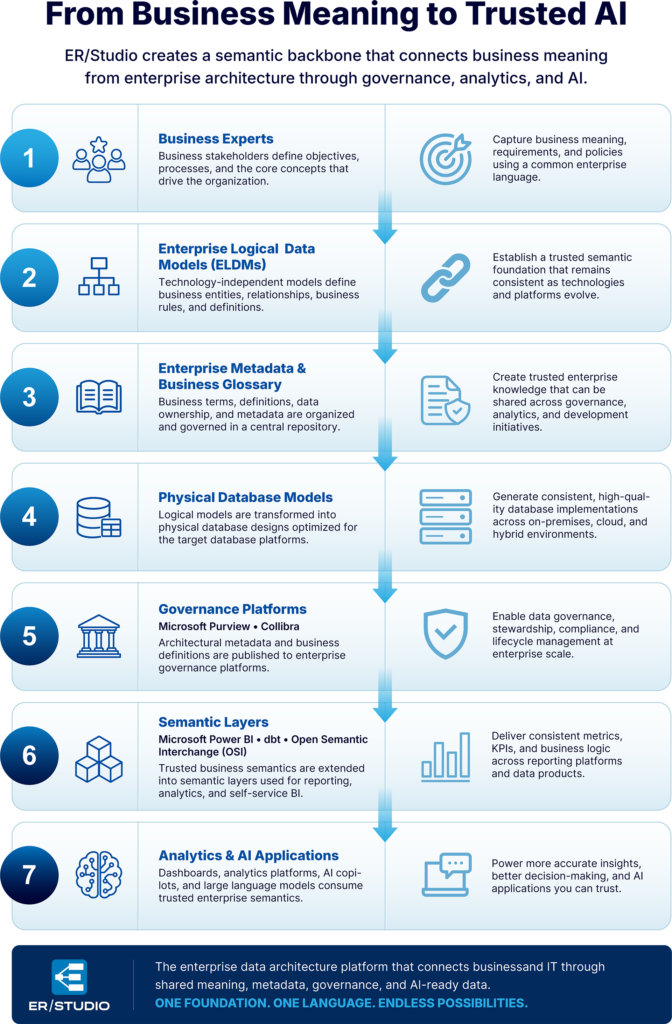
Artificial intelligence has accelerated the need for stronger enterprise data architecture, but not for the reasons many organizations expected.
Much of the conversation surrounding AI has focused on models, prompts, and retrieval techniques. While these technologies are important, they all depend on one prerequisite that receives far less attention: trusted business meaning.
Large language models do not understand your organization’s definition of a customer, policy, product, asset, or revenue. They understand only the context they are provided. If enterprise information is inconsistent, incomplete, or disconnected across systems, AI simply reflects those inconsistencies.
This is why organizations often experience conflicting responses from AI assistants. One application may calculate a KPI using a semantic layer inside an analytics platform. Another may retrieve information from a business glossary. A third may reference technical metadata captured from a database. If each source represents the same business concept differently, AI cannot determine which interpretation is authoritative.
The problem is not the AI.
The problem is that enterprise knowledge has become fragmented.
Building trustworthy AI therefore begins long before an organization deploys a large language model. It begins with creating an architectural foundation where business meaning is established once, governed consistently, and reused across every downstream technology.
That foundation is enterprise semantics.
Every organization possesses a shared understanding of how its business operates.
There are agreed-upon definitions for customers, products, suppliers, contracts, claims, invoices, policies, revenue, and hundreds of other concepts that describe the business. These definitions guide decision-making every day, yet they are often scattered across spreadsheets, documentation, governance tools, reporting platforms, and application-specific metadata.
The challenge is not creating business knowledge. The challenge is preserving it.
As organizations introduce new technologies, those enterprise concepts are repeatedly translated into physical database schemas, reporting models, governance catalogs, semantic layers, APIs, and AI applications. Each translation creates another opportunity for definitions to diverge.
Over time, the architecture becomes increasingly fragmented, even though every system is intended to represent the same business.
This is where enterprise semantics changes the conversation.
Instead of allowing business meaning to be recreated independently within every technology, organizations establish trusted enterprise concepts once and extend them throughout the broader data ecosystem.
ER/Studio supports this approach by enabling Enterprise Logical Data Models to become reusable semantic assets. Business definitions captured during architecture remain connected as organizations generate physical database implementations, populate governance platforms, build semantic layers, and support AI initiatives.
Rather than viewing architecture as the beginning of a project, organizations begin viewing architecture as the source of enterprise meaning that every downstream system inherits.
This semantic backbone reduces duplication, improves consistency, and creates greater confidence in both analytics and AI-generated insights.
The value of enterprise architecture does not end once a database has been implemented.
In fact, that is where many of its greatest benefits begin.
As organizations mature their data strategies, architecture increasingly becomes the starting point for a much broader ecosystem of enterprise capabilities.
Governance platforms consume trusted business definitions.
Business glossaries provide a common vocabulary across departments.
Enterprise data dictionaries document approved terminology and technical metadata.
Analytics platforms inherit standardized semantic definitions that reduce duplicated business logic.
Data engineers work from consistent architectural standards rather than project-specific assumptions.
AI applications receive governed business context instead of isolated technical metadata.
Each capability reinforces the others because they all originate from the same architectural foundation.
This is why ER/Studio should not be viewed simply as software for designing databases.
Its greatest value lies in connecting enterprise architecture to the broader information ecosystem, allowing business meaning to flow naturally between architecture, governance, analytics, metadata management, and AI rather than being recreated independently within each discipline.
Many organizations have accumulated an impressive collection of data management technologies.
One platform supports governance.
Another manages business glossaries.
Another provides data catalog capabilities.
Additional tools handle modeling, metadata collection, semantic layers, reporting, and AI initiatives.
Individually, each solution addresses an important requirement.
Collectively, however, they often introduce new challenges because business knowledge becomes distributed across multiple platforms with limited coordination between them.
An enterprise data architecture platform addresses this fragmentation by serving as the connective tissue that links these disciplines together.
ER/Studio combines enterprise data modeling, Enterprise Logical Data Models, metadata management, collaboration, business glossaries, enterprise data dictionaries, Team Server Core, governance integrations, semantic technologies, and semantic layer generation within a unified architectural environment.
The objective is not to replace every specialized technology an organization already uses.
Instead, it is to establish a trusted architectural foundation that allows those technologies to operate using the same business understanding.
When business meaning remains consistent, governance becomes more effective, analytics become more reliable, collaboration improves, and AI applications produce more trustworthy results.
Enterprise data modeling will always remain one of the most important responsibilities within enterprise architecture. Well-designed conceptual, logical, and physical models continue to provide the structure required for building reliable systems, integrating data across platforms, and supporting long-term modernization initiatives.
However, enterprise architecture has evolved beyond the boundaries of individual databases.
Organizations are now managing interconnected ecosystems that span operational systems, cloud platforms, governance solutions, semantic layers, analytics environments, and AI applications. Success depends not only on designing those systems correctly, but on ensuring they all share the same understanding of the business they support.
That requires a platform capable of connecting business concepts, metadata, governance, collaboration, and technical implementation into a single architectural foundation.
ER/Studio was built to address exactly this challenge.
By combining enterprise data modeling with metadata management, Enterprise Logical Data Models, governance integration, collaboration, semantic technologies, and AI-ready semantic foundations, ER/Studio enables organizations to preserve business meaning from initial design through implementation and beyond.
Rather than functioning solely as a data modeling application, ER/Studio serves as an enterprise data architecture platform that connects business and IT through shared enterprise knowledge.
As organizations continue investing in analytics, governance, and artificial intelligence, that shared understanding will become one of the most valuable assets they possess.
The technologies supporting enterprise data will continue to evolve. New analytics platforms will emerge. AI capabilities will advance. Cloud ecosystems will expand. Yet the need for trusted business meaning will remain constant.
Organizations that establish that foundation today will be better positioned to adapt to whatever comes next. Learn more today.
An enterprise data architecture platform helps organizations design, manage, govern, and share enterprise knowledge by connecting data modeling, metadata management, business glossaries, governance, collaboration, and semantic technologies into a unified environment.
Traditional data modeling software focuses primarily on database design. ER/Studio extends those capabilities by connecting Enterprise Logical Data Models, metadata management, governance integrations, business glossaries, semantic layer generation, collaboration, and AI-ready semantic foundations within a single platform.
Enterprise Logical Data Models provide technology-independent representations of business concepts that preserve shared meaning across databases, governance platforms, analytics tools, semantic layers, and AI applications. They help organizations reduce semantic drift while improving consistency across the enterprise.
ER/Studio connects business definitions with logical models, physical database implementations, metadata, governance platforms, semantic assets, and downstream analytics technologies. This creates a shared architectural foundation that allows business and technical teams to work from the same trusted enterprise knowledge.
AI systems depend on consistent business context. Enterprise semantics ensures that business definitions remain consistent across governance platforms, semantic layers, databases, analytics environments, and AI applications, reducing conflicting interpretations and improving the trustworthiness of AI-generated insights.